Saves instantly, no account needed. Already a member? Sign in.
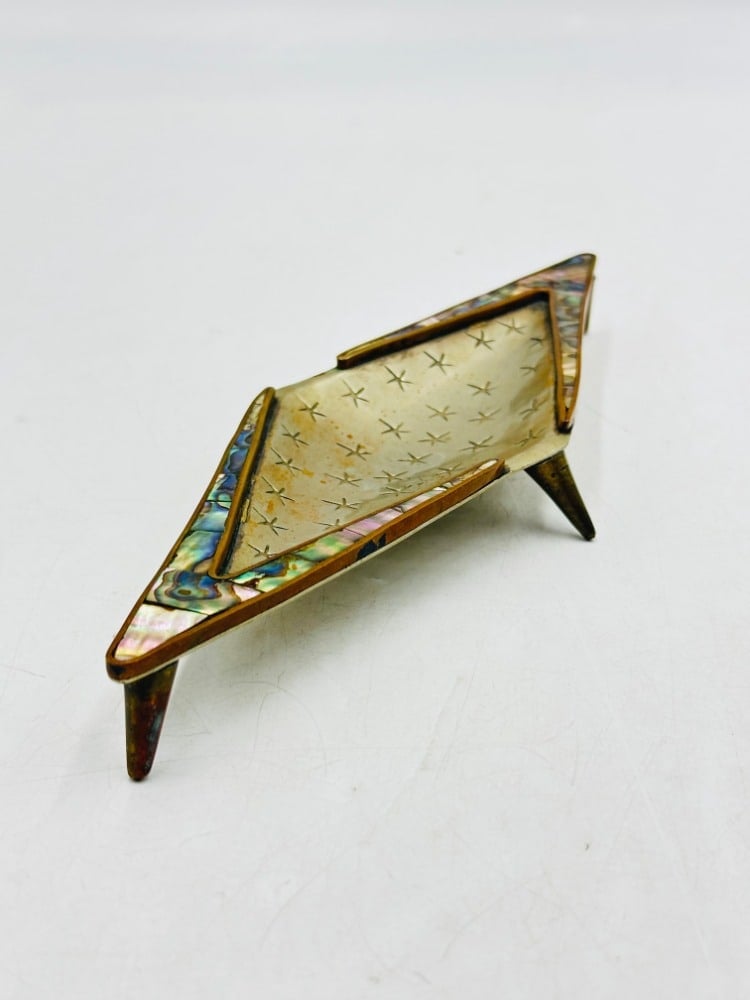
A shallow round object joins two materials that Los Castillo used often but rarely in this pairing: mother-of-pearl set against a silverplated ground. The nacre supplies the object its life, catching light as a soft spectral shimmer while the surrounding metal holds a cooler, steadier reflection. The workshop is best known for combining silver with stone, enamel, and other inlays, and the mother-of-pearl here works as a color and texture event rather than as a precious accent. On a serving object meant to be seen from above, that iridescence becomes the design's central incident.
The construction follows the logic of the taller's decorative wares. A plateado, or silverplated, base carries the design at a scale and price aimed at table use rather than solid silver hollowware. The mother-of-pearl is worked into a shell motif, a subject Los Castillo returned to across its production and one that suits nacre's natural association with the sea. The pairing is practical as well as visual: silverplate gave the workshop a durable, reflective field for inlay without the material cost of sterling, and the shell form organizes the object around a single legible image. The nacre and the metal read as complementary surfaces, one warm and shifting, the other bright and fixed.
Los Castillo was founded in 1939 by Antonio Castillo with his brothers Jorge and Justo and their cousin Salvador Terán, several of whom had trained at William Spratling's Taller de Las Delicias before establishing their own workshop. From the start the enterprise pursued material invention, developing named inlay and mosaic lines such as Mosaico Azteca, Pluma Azteca, and Onix Negro that the museum's hallmark reference documents through their line marks. A mother-of-pearl and silverplate pairing belongs to this broader appetite for combining metal with contrasting materials, though it sits in the decorative housewares register rather than among the workshop's exhibition pieces. The plateado marks recorded for Los Castillo, including later examples, confirm that silverplated production was a continuing part of the operation and not a departure from it.
As a document of workshop practice, the object shows how Los Castillo extended its interest in inlay across price points and functions, translating the same material intelligence found in its silver mosaics into serviceable tableware. It records the workshop's willingness to treat mother-of-pearl as a designer's material, valued for optical behavior rather than status, and to build a functional object around a single decorative subject. The piece clarifies a working side of one of Taxco's most inventive talleres, the making of accessible plated wares that still carried the workshop's characteristic feeling for contrasting surfaces.
Museum of Mexican Silver. “Geometric Footed Catchall with Abalone Inlay.” Catalog no. MoMS-001863. https://museumofmexicansilver.com/pieces/los-castillo-geometric-footed-catchall-abalone-inlay
See something wrong with this record? Suggest a correction and the piece details fill in automatically.
Los Castillo
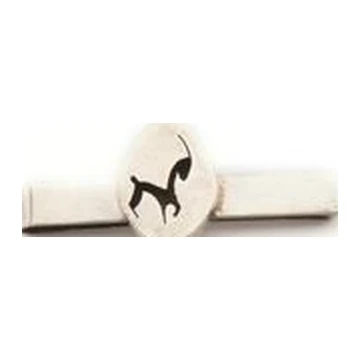
Goat-Motif Money Clip