Story
The Taxco Renaissance
Nearly a century ago, a remote silver-mining town in the mountains of southern Mexico became the unlikely birthplace of one of the twentieth century’s most important artistic movements.
Over the next several decades, a remarkable cast of characters would pass through Taxco. American architects. Mexican muralists. European collectors. Hollywood stars. Indigenous craftsmen. Visionary silversmiths. Entrepreneurs, archaeologists, designers, writers, and dreamers.
Together they built something extraordinary.
What emerged was far more than a silver industry. Taxco became a creative laboratory where ancient traditions met modern ideas, where hand craftsmanship met international demand, and where a small group of ambitious makers transformed a forgotten mining town into the world’s leading center for handwrought silver design. In the process, they created one of the most distinctive artistic expressions of modern Mexico and a movement whose influence continues to be felt nearly a century later.
Today, the finest works of the Taxco Renaissance reside in museums across North America and Europe. Collectors pursue them through auction houses, antique dealers, estate sales, and active online communities that number in the thousands. New scholarship continues to emerge. Major exhibitions continue to be organized. Auction records continue to climb as a new generation discovers the field.
Yet despite all of this attention, remarkably few places tell the complete story.
Most people encounter a bracelet, a necklace, a bowl, or a photograph. They may recognize the name William Spratling, Antonio Pineda, Héctor Aguilar, Los Castillo, or Margot de Taxco. What is often missing is the larger picture: how these artists were connected, why they emerged when they did, and how a small mountain town became the center of a movement that would reshape silver design around the world.
That story deserves to be better known.
Because what happened in Taxco was a rare and beautiful thing.
A Town Waiting for Its Moment
Artistic movements usually emerge in great cities.
Paris. Vienna. New York. Copenhagen. Berlin.
Taxco was none of those places.
Perched high in the mountains of Guerrero, it was a former mining town with a small population, difficult roads, and little connection to the traditional centers of power, finance, or culture. By every conventional measure, it was an unlikely place for a major artistic movement to emerge.
And yet that isolation proved to be one of its greatest strengths.
Taxco possessed something many larger cities did not. It had a deep tradition of craftsmanship, a strong sense of identity, and a community of makers whose skills had been shaped by generations of work. Long after the great mining fortunes had faded, the culture of making remained.
In retrospect, it is difficult to imagine a more improbable birthplace for what would become the most important non-European silver movement of the past two centuries.
Mexico Reimagines Itself
At precisely the same moment, Mexico was undergoing a profound cultural transformation.
The Revolution had ended only a few years earlier. Across the country, artists, writers, architects, archaeologists, and intellectuals were engaged in an ambitious project: defining what modern Mexico should look like. The country’s indigenous past, once overlooked or marginalized, was being rediscovered and reexamined. Ancient cities were excavated. Murals covered public buildings. Folk traditions gained new respect. A generation of artists began searching for forms of expression that felt unmistakably Mexican while still belonging to the modern world.
Taxco became one of the places where that search took physical form.
While Mexico’s muralists painted a new national identity on walls, Taxco’s designers forged it in silver.
William Spratling and Las Delicias
When William Spratling arrived in the late 1920s, he immediately recognized that the town possessed extraordinary potential.
Taxco’s greatest resource was not silver at all, but people.
The town was filled with craftsmen whose skills had been shaped by generations of work and whose talents, given the right opportunity, could compete with the finest artisans anywhere in the world. Spratling saw traditions worth preserving, but he also saw something more ambitious: the possibility of creating a workshop that could provide economic opportunity while encouraging artistic excellence.
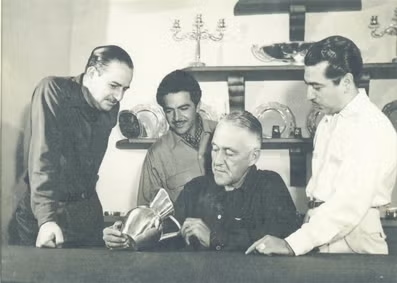
In 1931, he opened a small workshop called Las Delicias.
The silver that emerged from Las Delicias would eventually become famous.
But its greatest product was talent.
The young apprentices who passed through its doors would go on to become many of the defining figures of the Taxco Renaissance: Antonio Pineda, Antonio Castillo, Héctor Aguilar, Salvador Terán, Margot de Taxco, MATL (Matilde Poulat), Ana Núñez Brilanti, Sigi Pineda, Enrique Ledesma, and many others whose influence continues to shape the field today.
Within a remarkably short period of time, Taxco ceased to be identified with a single workshop and became something much larger. Independent ateliers appeared across town. Designers developed distinct artistic voices. Technical innovations spread rapidly. Friendly rivalries pushed standards higher. New materials, new forms, and new techniques emerged almost every year.
What followed was not simply the growth of an industry.
It was the birth of a true artistic movement.
The Taxco School
Like the Bauhaus in Germany or Danish Modernism in Scandinavia, Taxco became a place where creativity accumulated. Each generation built on the achievements of the previous one. Ideas circulated. Standards rose. Ambition expanded.
The silver itself evolved in fascinating ways.
Early designs often drew inspiration directly from pre-Columbian art, architecture, clay seals, codices, masks, and ceremonial objects. Over time those references became increasingly sophisticated. Rather than reproducing ancient forms, designers transformed them. A temple motif became a bracelet. A ceremonial serpent became a necklace. A mask became a brooch. Ancient visual language found new expression in modern materials.
As the movement matured, the work became increasingly ambitious. Antonio Pineda pushed silver toward abstraction and wearable sculpture. Antonio Castillo pioneered new techniques and materials. Héctor Aguilar explored bold architectural forms. Others experimented with mixed metals, stone inlay, enamels, mosaics, wood, gold, and innovative approaches to modern design.
Together they created a visual language that felt simultaneously ancient and modern, regional and international.
A Global Conversation
Taxco never developed in isolation.
The town became a crossroads where ideas, people, and cultures met. Artists arrived from Mexico City. Writers and architects came south from the United States. Archaeologists, diplomats, collectors, and filmmakers passed through its streets. Hollywood stars vacationed nearby. Tourists carried Taxco silver home with them. International department stores began placing orders. Museums took notice.
The exchange was remarkably productive. American collectors and tourists provided access to international markets while Mexican artists and craftsmen supplied the cultural foundations and creative vision. The movement belonged fully to neither country and was strengthened by both.
Few artistic movements of the twentieth century demonstrate international collaboration more successfully.
The Collector’s Perspective
By the 1940s and 1950s, Taxco had become the world’s leading center for handwrought silver design.
Yet the movement never lost the qualities that made it special. The finest pieces remained handmade. The strongest designs remained deeply personal. The workshops retained the atmosphere of ateliers rather than factories. Craftsmanship remained central.
Taxco occupied a unique position between studio art and industrial production. The workshops produced enough work to build a movement, but not enough to flood the market. Most pieces were handmade. Many were worn daily for decades. Others were melted for silver value, damaged, altered, or simply lost.
As a result, some of the most important designs of the period survive today in surprisingly small numbers.
Many of the movement’s most celebrated works were never produced in large quantities. Some remained in production for only a few years. Others were created for exhibitions, competitions, important patrons, or special commissions. For the rarest and most sought-after pieces, the surviving population may be measured in dozens rather than hundreds.
This combination of artistic significance, documented history, and genuine scarcity has increasingly attracted the attention of museums, scholars, and serious collectors.
Part of the enduring appeal of Taxco lies in the fact that these objects still carry the fingerprints of their makers. A great Taxco bracelet does not feel manufactured. It feels imagined.
The best pieces reveal the personalities of the artists who created them: the boldness of Pineda, the experimentation of Castillo, the architectural confidence of Aguilar, the elegance of Margot, the sculptural instincts of Spratling. Collectors often begin by acquiring a piece. Many eventually find themselves captivated by the people and stories behind it.
The deeper they explore, the more remarkable the story becomes.
A Renaissance Still Being Discovered
Nearly a century after the founding of Las Delicias, the story of Taxco is still unfolding.
New scholarship continues to emerge. Museums continue to acquire important works. Collectors continue to rediscover forgotten masterpieces. Pieces once overlooked are being reevaluated, connections between artists continue to surface, and a new generation is beginning to appreciate the significance of what happened in this mountain town.
What began as a small workshop in a former mining community grew into a movement that helped define modern Mexican design, launched the careers of some of the country’s most important artists, and produced objects that continue to inspire collectors, scholars, and museums around the world.
The remarkable thing is not simply that Taxco succeeded. It is that it succeeded so improbably. Far from the traditional centers of art, wealth, and influence, a community of craftsmen, designers, and visionaries created something that has endured for nearly a century and continues to grow in relevance with each passing decade.
We believe the world is only beginning to understand the significance of the Taxco Renaissance. Not because the story has changed, but because more people are finally discovering it.
And as they do, they often arrive at the same conclusion: that one of the most important artistic movements of the twentieth century has been hiding in plain sight.