Saves instantly, no account needed. Already a member? Sign in.
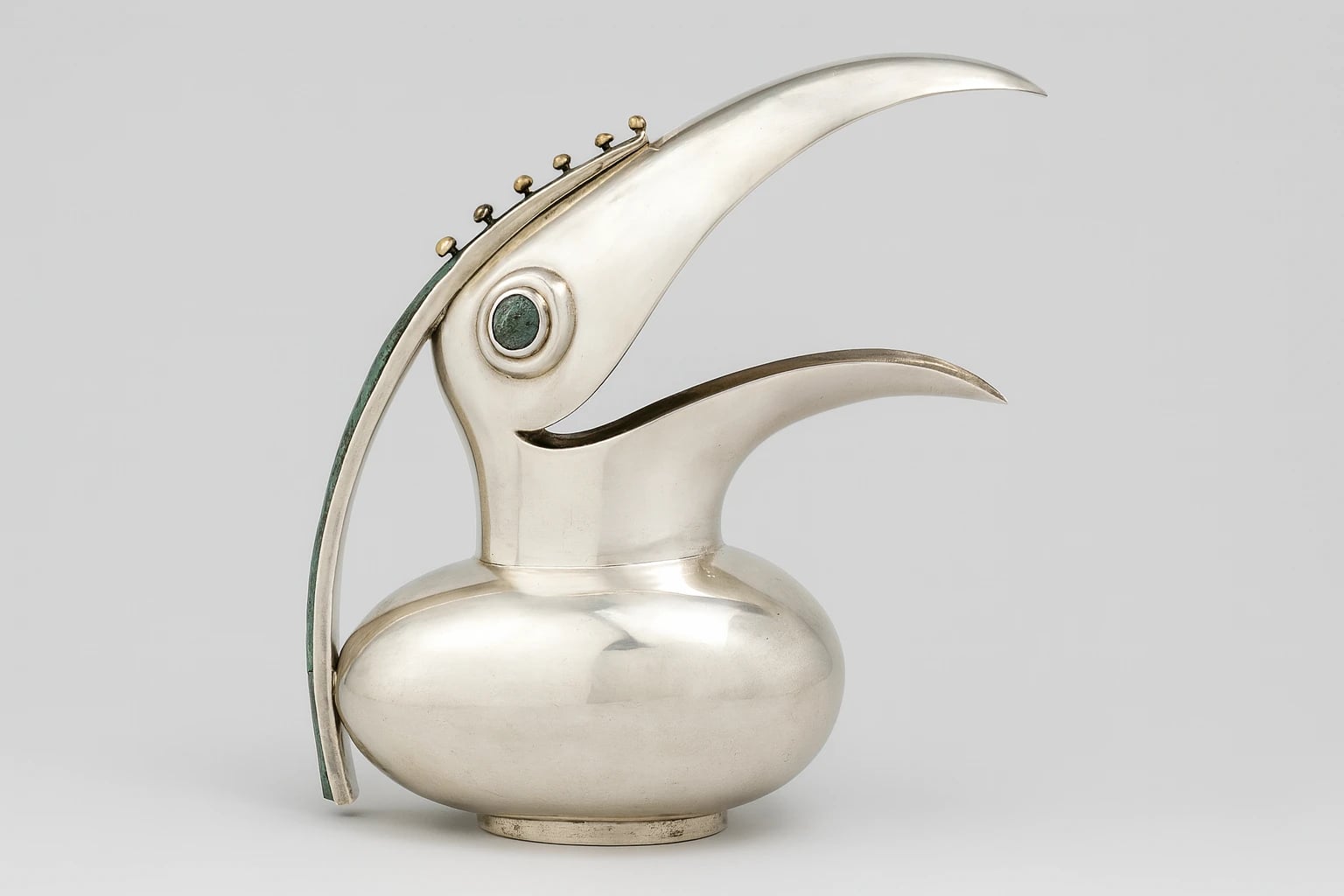
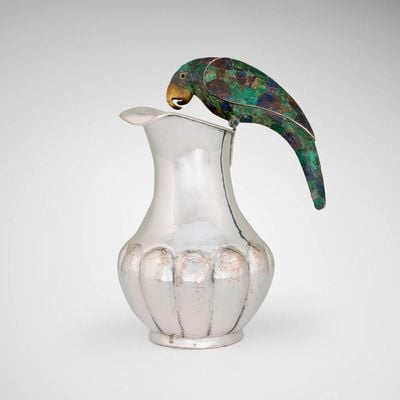
A parrot leans over the rim of this pitcher and becomes its handle, gripping the lip with its beak while its long tail sweeps down to rejoin the body below the shoulder. The conceit is simple and complete: the bird's natural posture, head down and tail raised, happens to describe exactly the arc a hand needs, so the figural ornament and the functional grip are one continuous form. Los Castillo built the bird not in silver but in stone, a mosaic of mottled tesserae fitted over the handle's core, with a polished metal beak that reads as the bird's one hard, bright feature. Against the plain reflective surface of the vessel, the stone registers as color, texture, and weight, a passage of opacity interrupting the shine.
The parrot was not a casual choice within this family of makers. Jorge "Chato" Castillo, who left Spratling's Taller de Las Delicias in 1939 to help his brothers found Los Castillo, used a parrot image in his own hallmark, and Hougart notes that many of his early designs served as prototypes for pieces later produced under the Los Castillo name. Whether or not this particular model descends from one of those prototypes, the bird belongs to the workshop's established visual vocabulary, and the pitcher shows how naturally that vocabulary translated to hollowware. The baluster body is unornamented, letting the spout's pulled lip and the bird's silhouette carry the whole profile.
Material invention was the engine of Los Castillo's reputation. Where other Taxco workshops refined a single silversmithing idiom, the Castillos kept adding techniques, and the hallmark record makes the point concretely: the firm maintained dedicated line marks for Esmalte a Fuego fired enamel, Mosaico Azteca, Pluma Azteca feather mosaic, and Onix Negro stone inlay, each documented in Hougart's compilation. Stone mosaic applied to a sculptural handle, as here, sits squarely within that program. The workshop treated inlay not as surface decoration on jewelry alone but as a way to give tableware a second material voice, and the parrot pitcher became one of its recognizable orfebrería forms.
This example carries the workshop's plateado mark, stamped on the base with "Los Castillo," "Taxco," "Hecho en Mexico," and the word Plateado identifying the body as silver plate over base metal. Hougart documents these plateado marks as a distinct branch of Los Castillo production, which allowed the firm to issue its established designs in a more accessible material while keeping the stone mosaic work, the part that could not be economized, fully intact. That decision is worth taking seriously rather than apologizing for. The design's effect depends on the contrast between reflective metal and matte stone, on the wit of the bird's posture, and on the balance of the tail against the pouring lip, none of which changes with the fineness of the metal. As a document of how Los Castillo carried its signature ideas across price levels and decades of production, the pitcher shows the workshop's design intelligence operating exactly where most histories of modern silver stop looking: in the serial, usable object made for an ordinary table.
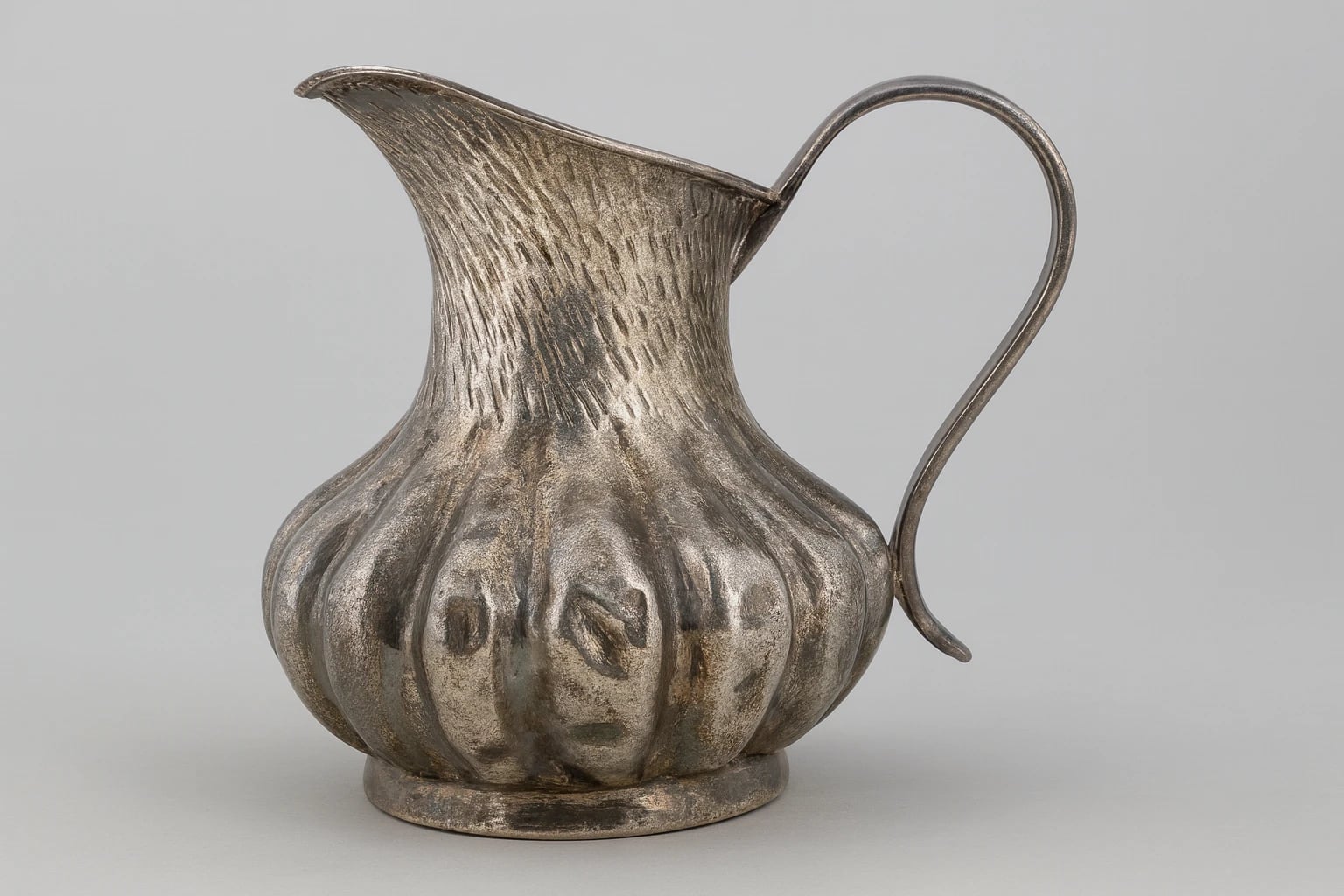
Los Castillo Taxco Silver-Plated Pitcher with Figural Parrot Handle
Lion and Unicorn · 2026-04-11
Los Castillo, Pitcher with parrot handle
Toomey & Co. Auctioneers · 2026-03-26
Emilia Castillo for Los Castillo, Pitcher with parrot handle
Wright · 2026-01-27
Los Castillo, Tall pitcher with parrot handle
Wright · 2026-01-27
Emilia Castillo, Parrot pitcher
Museum of Mexican Silver. “Parrot-Handled Pitcher with Stone Mosaic.” Catalog no. MoMS-001125. https://museumofmexicansilver.com/pieces/los-castillo-pitcher-parrot-stone-inlay-silverplate
See something wrong with this record? Suggest a correction and the piece details fill in automatically.
Wright · 2025-11-05
Los Castillo
Mother-of-Pearl Pitcher
Mother-of-pearl