Free account. We'll finish the save once you're in. Already a member? Sign in.
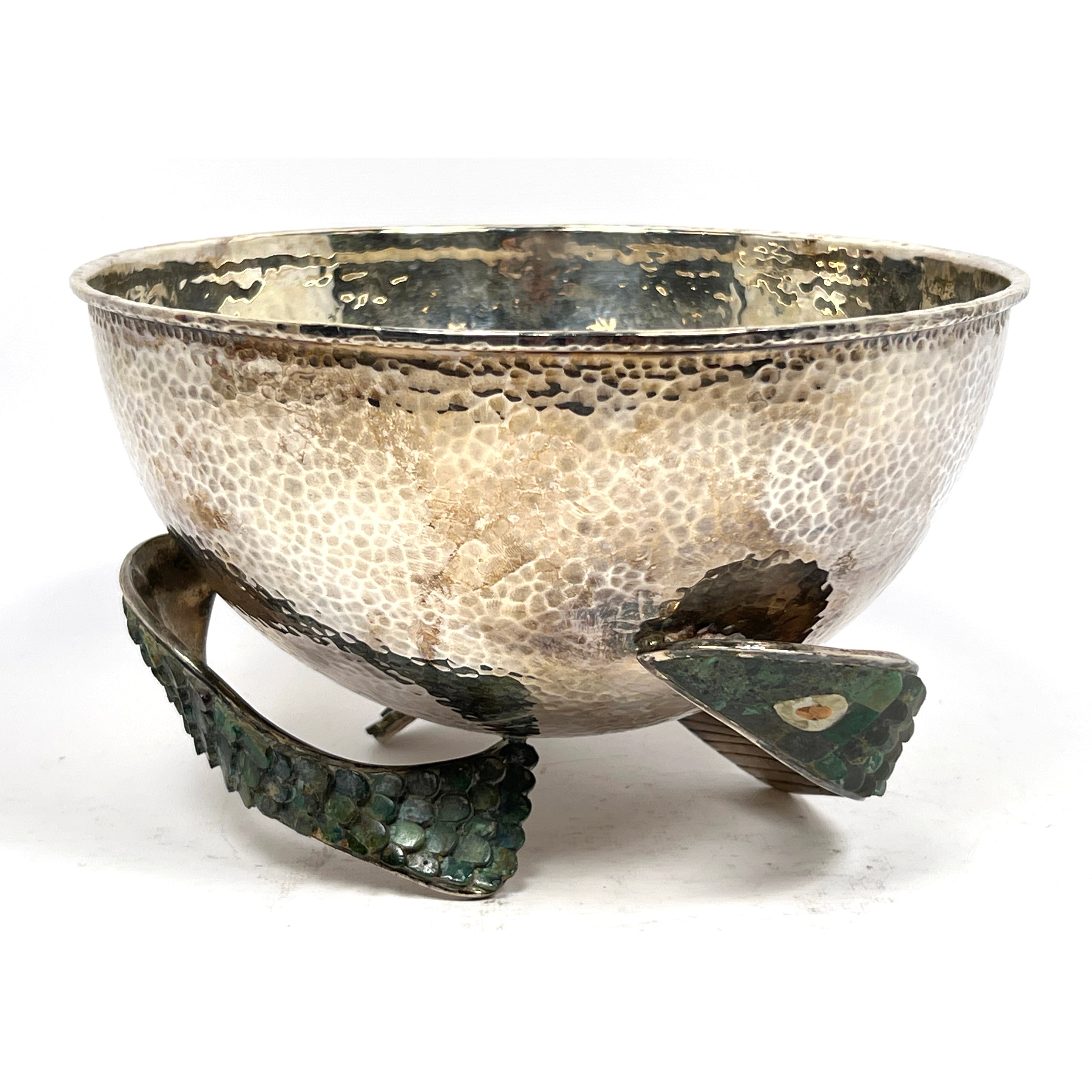
A fish motif rendered in hammered silver with stone inlay, this plate belongs to the larger decorative output Los Castillo sustained alongside their jewelry work — a category Morrill and Berk describe as orfebrería, the workshop production of trays, serving pieces, and objects beyond the wearable. Swirling fish are documented in Los Castillo jewelry suites of the mid-century period (Morrill & Berk 1996, p. 173); here the same vocabulary migrates to the table, the fish forms worked into the ground through the repoussé technique Taxco craftsmen called embutir — hammer and embutador pressed against the sheet from the reverse to coax the metal into relief (Morrill, Mexican Silver, 1994, p. 15).
Stone inlay is among the most labor-intensive elaborations the Castillo workshop pursued. Morrill and Berk record pieces set with crushed stone, tortoise, and onyx worked into silver, a process requiring the channel to be cut precisely enough that the inset material sits flush to the finished surface (Morrill & Berk 1996, p. 174). On a plate subject to repeated handling, that technical commitment extends well beyond the decorative.
The silver-plate construction rather than solid sterling situates this object within the workshop's broad production range, which over more than five decades encompassed everything from jewelry to major ecclesiastical commissions.
See something wrong with this record? Suggest a correction and the piece details fill in automatically.