Free account. We'll finish the save once you're in. Already a member? Sign in.
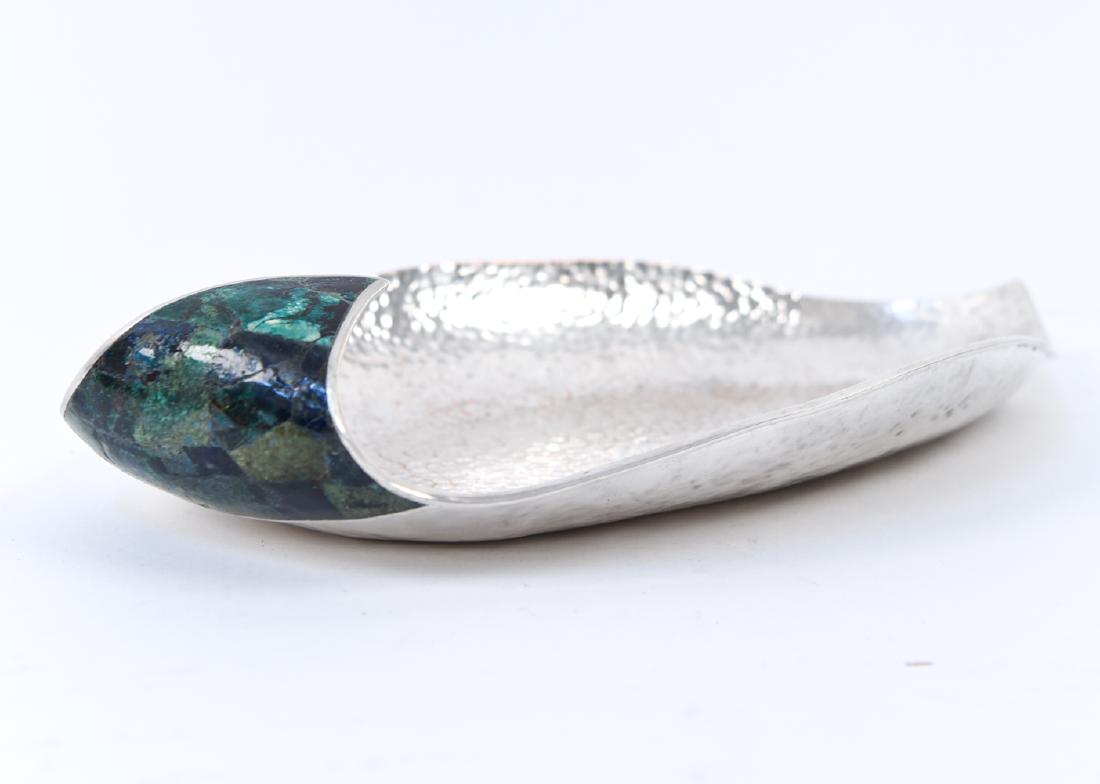
Three-material inlay in silver, brass, and malachite on a hammered ground shows the mixed-metals program at Los Castillo applied to the orfebrería register — the larger decorative objects the taller produced alongside its jewelry. Morrill records that Rafael Ruiz Saucedo, a master silversmith who served as administrator of the workshop, was tasked in the 1950s with developing the taller's first models and prototypes in mixed metals, establishing the foundation of a practice that would define much of the workshop's decorative identity in the decades that followed.
The leaf motif follows the simplified naturalism characteristic of the Taxco idiom — botanical form reduced to essential silhouette, then given texture through hammering. On a plate, the three materials are readable at the scale the design warrants: silver providing the planished ground, brass introducing a warmer tone, and malachite bringing a deep mineral green that anchors the composition. The restraint of the arrangement reflects the craft discipline the workshop was built on.
Morrill quotes the Castillo family's stated principle as never repeating a design and always improving the quality of craft — a standard maintained through a long-tenured team trained over fifty years (Mexican Silver, 1994). Examples that combine stone inlay with both silver and brass offer a fuller view of the technical range the workshop developed in this tradition.
See something wrong with this record? Suggest a correction and the piece details fill in automatically.