Saves instantly, no account needed. Already a member? Sign in.
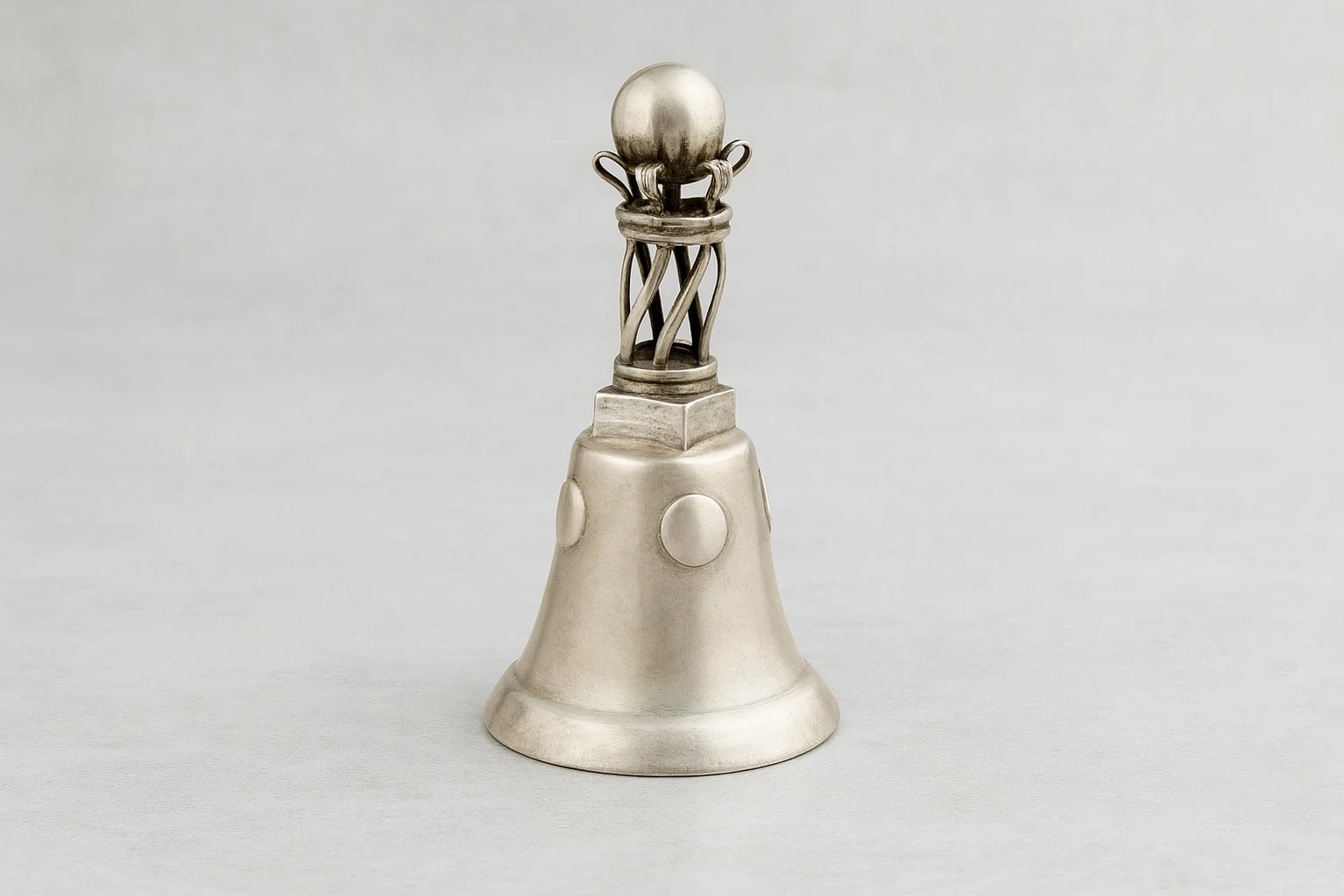
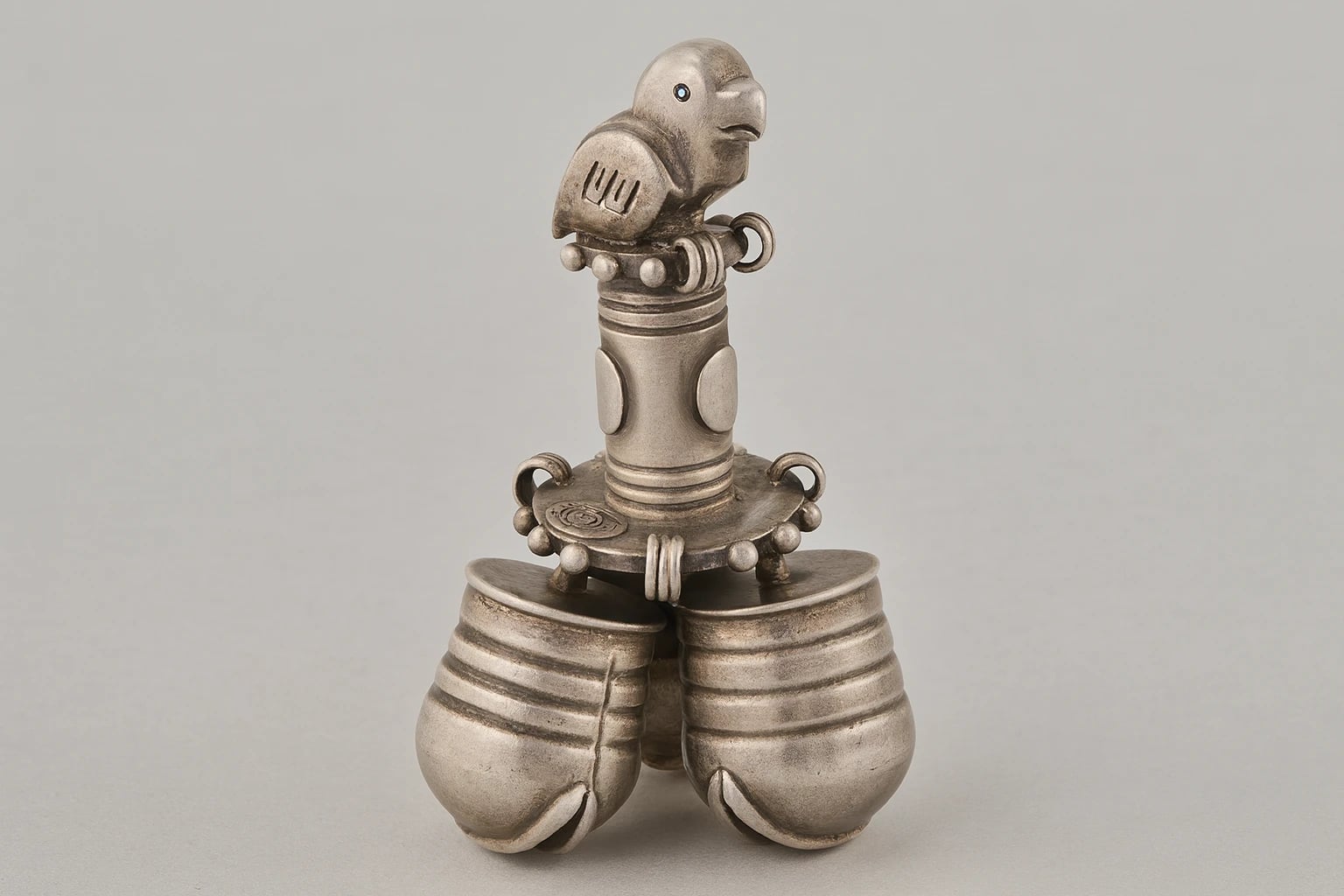
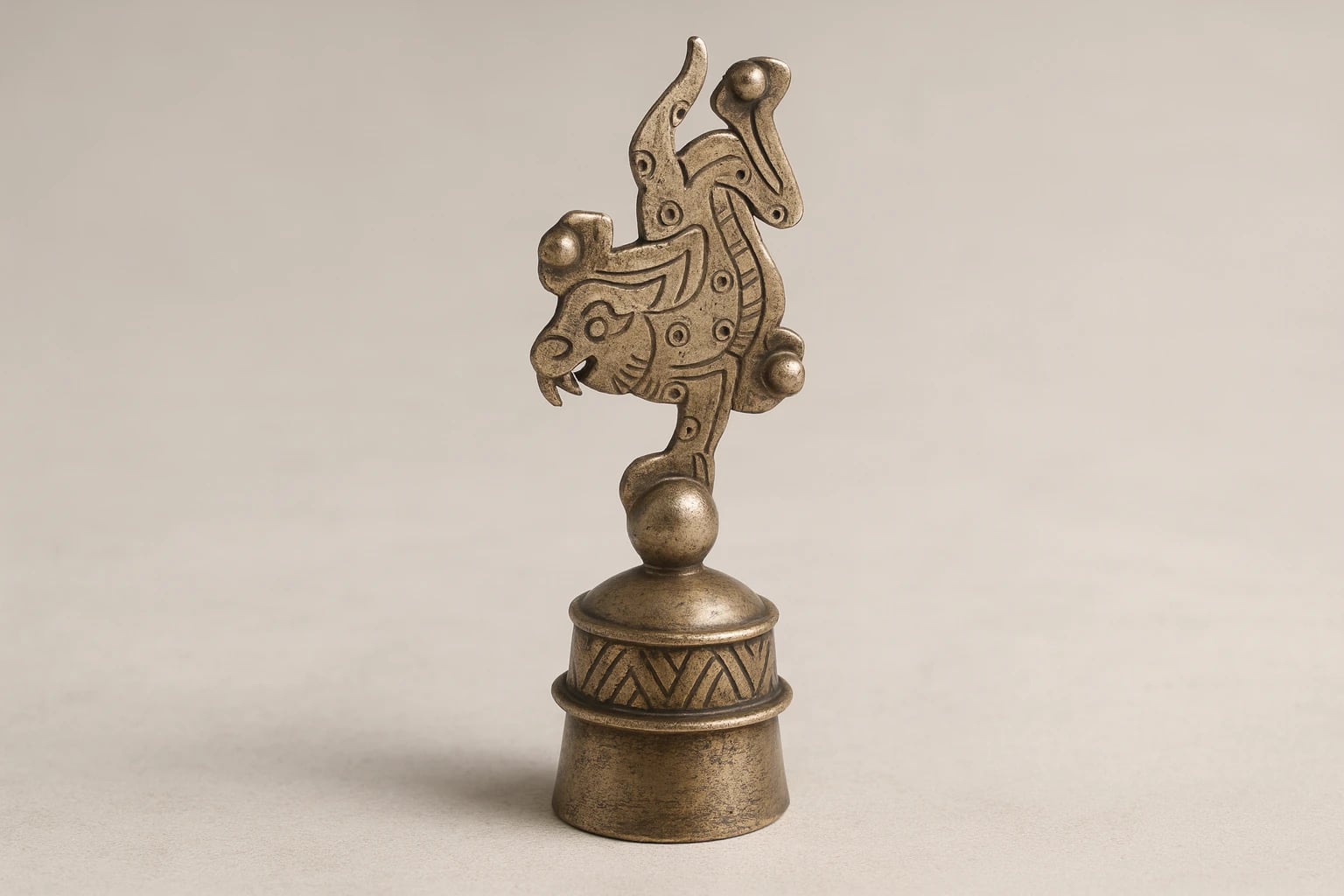
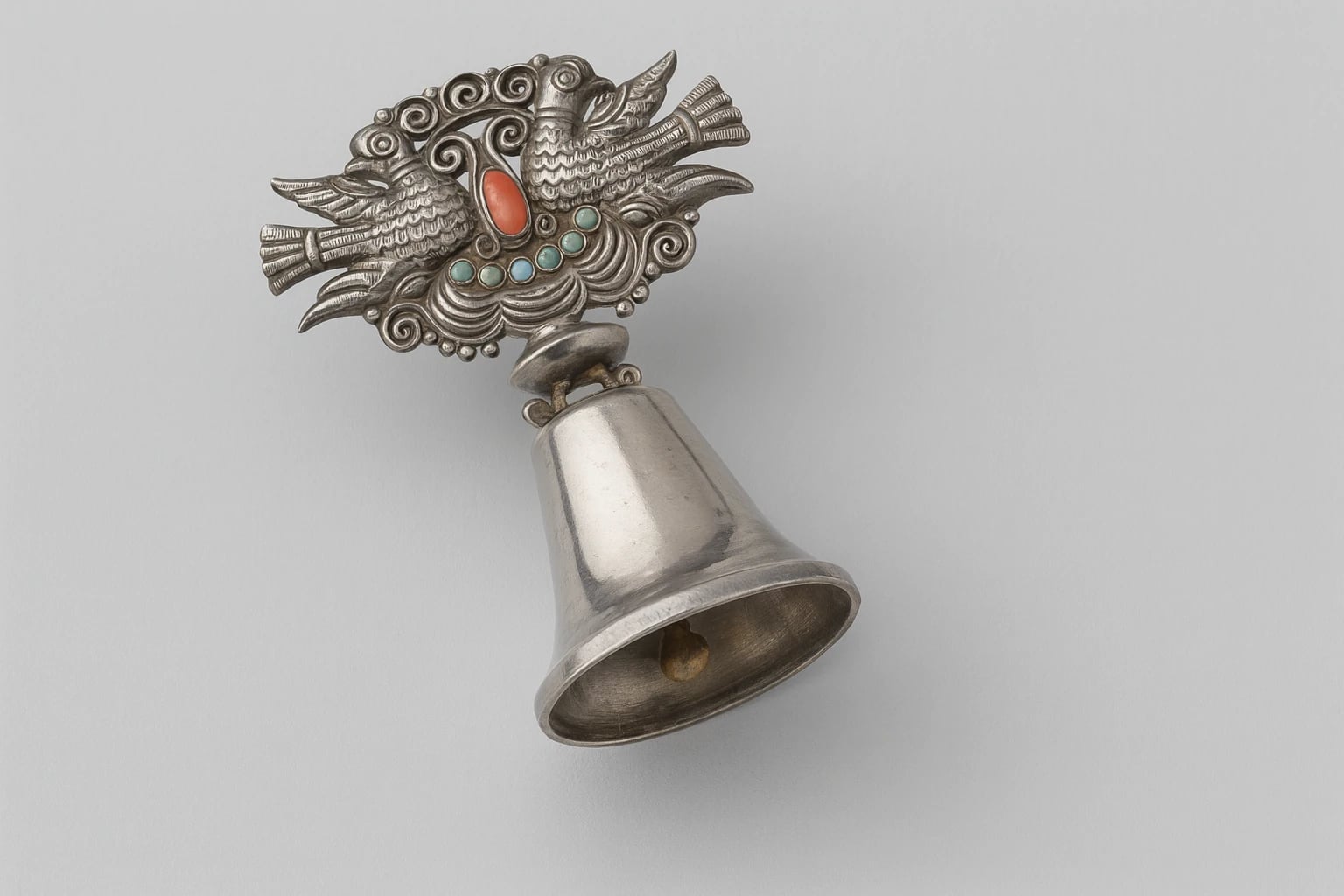
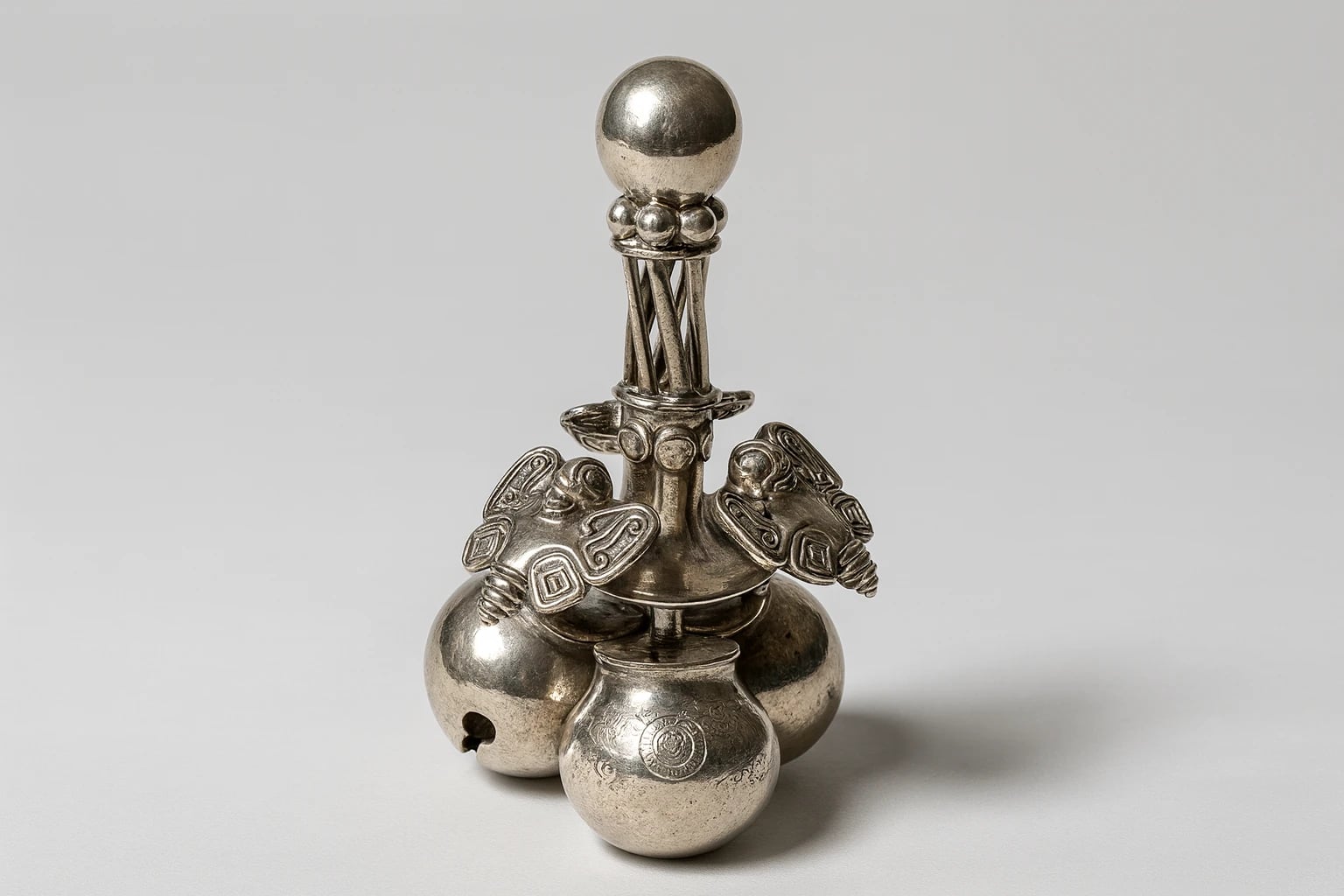
Three small bells hang from a silver frame crowned with three butterflies rendered in the flattened, geometric idiom Spratling drew from ancient Mexican sources. The butterfly here is not a naturalistic insect but a stylized sign, its wings reduced to paired planes and its body to a central axis, closer to the glyphic butterfly imagery of central Mexican art than to anything observed from life. That translation of an indigenous motif into a functional domestic object, a bell meant to be rung and heard, is characteristic of the way Spratling's workshop moved ancient form into the ordinary furniture of modern life.
The design organizes itself around repetition and suspension. Three bells and three butterflies establish a triangular rhythm, and the bells depend on the frame both structurally and acoustically, hanging free so they can sound. Silver serves this object in two registers at once. It gives the butterflies their reflective, planar surfaces, and it gives the bells their voice, since the metal must be worked to a wall that rings rather than deadens. The maker of such a piece is working as much with weight and resonance as with silhouette, a reminder that Spratling hollowware was designed to be used and not only looked at. The butterfly forms would have been developed through the workshop's standard practices of piercing and shaping sheet silver, the calar and cincelar techniques that Penny Morrill recorded from the Taxco smiths themselves.
The bell belongs to Spratling's third design period, the years from 1951 to 1967, when he had reorganized production at his ranch outside Taxco and, as Alberto Ulrich later recounted to Morrill, had increasingly turned his own attention toward collecting ancient Mexican art while turning production control over to Juan Gómez. The butterfly bell reflects that late sensibility, in which motifs drawn from Mexico's indigenous past were applied to small, saleable objects for a market Spratling had spent two decades building. It carried a wholesale price of forty-eight dollars in the 1961 catalogue and fifty-two dollars in the 1967 catalogue, and it was included in "The World of William Spratling," the exhibition that toured the United States in 1965. That exhibition history places the design among the works Spratling and his circle chose to present as representative when the renaissance he helped catalyze was shown to a national audience.
The design appears in the principal Spratling references, including the field guide by Phyllis Goddard and Morrill's *Maestros de Plata*, and an example is held by the Birmingham Museum of Art. The design has since been reissued, so a given bell must be read carefully for period and mark rather than assumed to be an original workshop piece. As a small functional object built from an ancient Mexican sign, the butterfly bell shows how Spratling extended his design vocabulary beyond jewelry into the household, treating a bell as another surface on which indigenous form could be made modern and useful.
Only 3 known to exist. One held in a private collection in Austin, acquired from Federico Jimenez after being displayed at the Museo Belber in Oaxaca
Museum of Mexican Silver. “Aztec Butterfly Bell.” Catalog no. MoMS-000833. https://museumofmexicansilver.com/pieces/spratling-27
See something wrong with this record? Suggest a correction and the piece details fill in automatically.
William Spratling
Flat Animal Bell
First Design Period: 1931 - 1946
Silver