Saves instantly, no account needed. Already a member? Sign in.
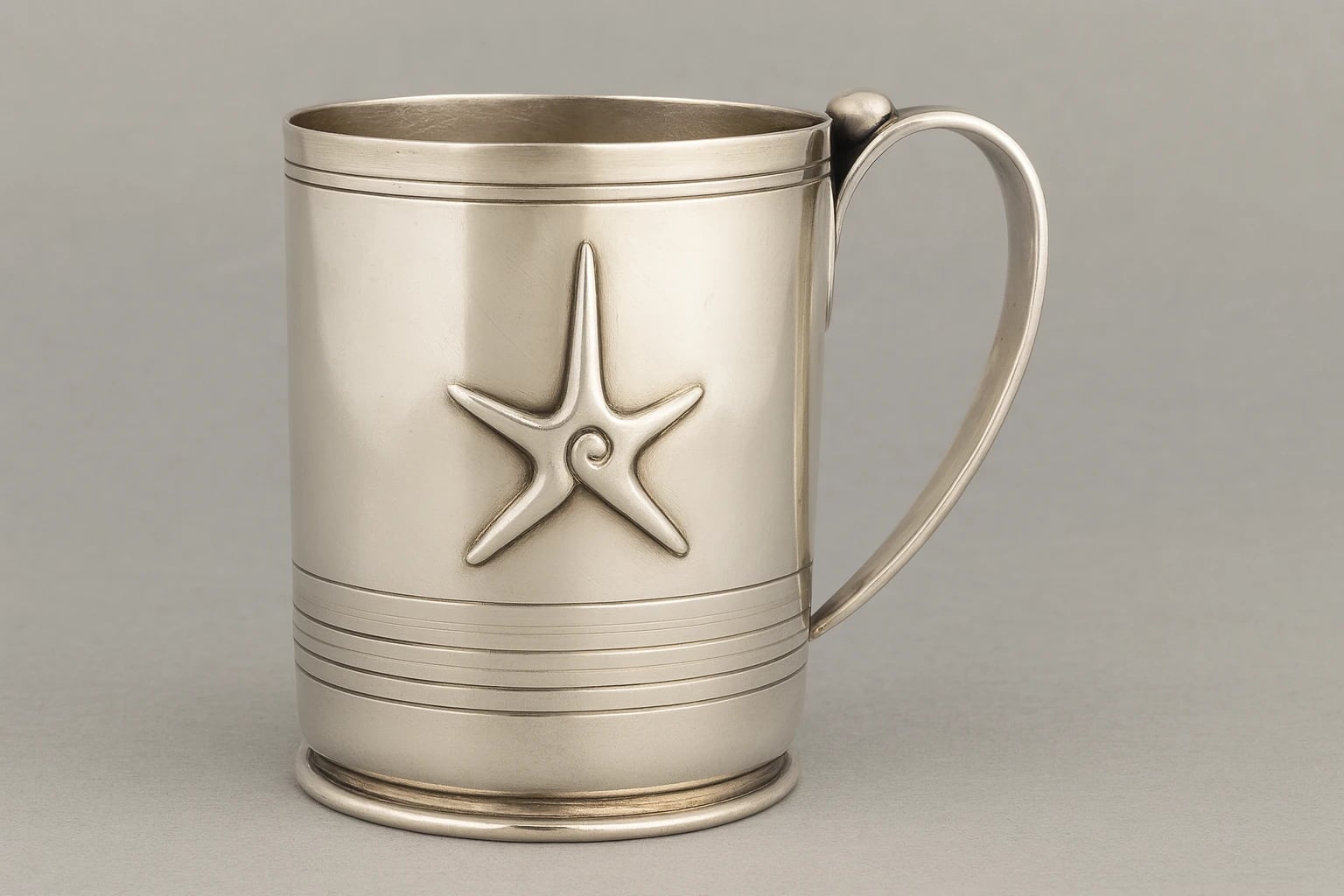
A cross section of a conch shell, cut to reveal its interior spiral, sits alone on the wall of this mug, and that single choice of ornament carries a long history. The sectioned conch was an emblem of Quetzalcoatl in ancient central Mexico, and Cholula was the great pilgrimage center of his cult, which makes the mug's title, Cholulteca, a precise rather than decorative name. Spratling wrote that Pre-Columbian values lay "latent, waiting for the eye that can bring them to life," a phrase Grace Kuipers has placed at the center of her recent account of his work, and this mug shows the method in its plainest form: an ancient sign lifted from ritual context and set onto an object made for daily drinking.
The design is economical. The cylindrical body is left largely as an open field, framed by a pair of incised lines below the rim and a denser register of lines above the stepped foot, banding that recalls both the horizontal registers of pre-Hispanic pottery and the reeded discipline of interwar modern tableware. Against that restraint the applied conch section reads clearly, its five tapering points radiating from a small coiled center, modeled in enough relief to catch light along its ridges. The strap handle carries a rolled edge for stiffness and comfort, and its upper junction is finished with a rounded bead where the thumb naturally rests. Nothing here is elaborated beyond function; the ornament is concentrated in one motif and the rest of the vessel supports it.
The object's documentary interest runs deeper than its design. The base bears Spratling's primary hallmark, the conjoined WS stamp that indicates sterling quality, yet the Museum's record notes that the mug may in fact be silver plate, made as a model for the tableware designs Spratling created for the Hotel Pierre Marques in Acapulco. The silver content has not been tested. Read as a model, the mug opens a window onto workshop procedure: a large hotel commission required prototypes, and a plated example allowed form, proportion, and ornament to be resolved before committing to sterling production. The design is recorded in Phyllis Goddard's field guide to Spratling silver, which places it securely within his documented body of work. Whether this example left the taller as finished merchandise or as a working pattern, it preserves the moment when a design moved from the bench toward production at scale.
That passage from ancient emblem to hotel table is worth pausing over, because institutional histories long had no place for it. When the Museum of Modern Art staged Twenty Centuries of Mexican Art in 1940, silver appeared only as colonial church plate and as folk ex-votos and charro trappings; the modern section contained no metalwork at all, and Spratling surfaced just once in two hundred pages, as the author of a preface to a Siqueiros portfolio. Roberto Montenegro's catalog essay even worried that commerce was turning "a pure and exquisite art into tourist curios of no great importance." A mug like this one answers that worry from inside the commercial world Montenegro distrusted. It demonstrates that a hotel commission could carry a serious design discipline, a specific iconographic program, and a continuous line back to the imagery of Cholula. For the Museum, it documents both a design and a process: the everyday object as the place where the Mexican silver renaissance actually did its work.
Museum of Mexican Silver. “Cholulteca Handled Mug.” Catalog no. MoMS-000574. https://museumofmexicansilver.com/pieces/spratling-275
See something wrong with this record? Suggest a correction and the piece details fill in automatically.
William Spratling
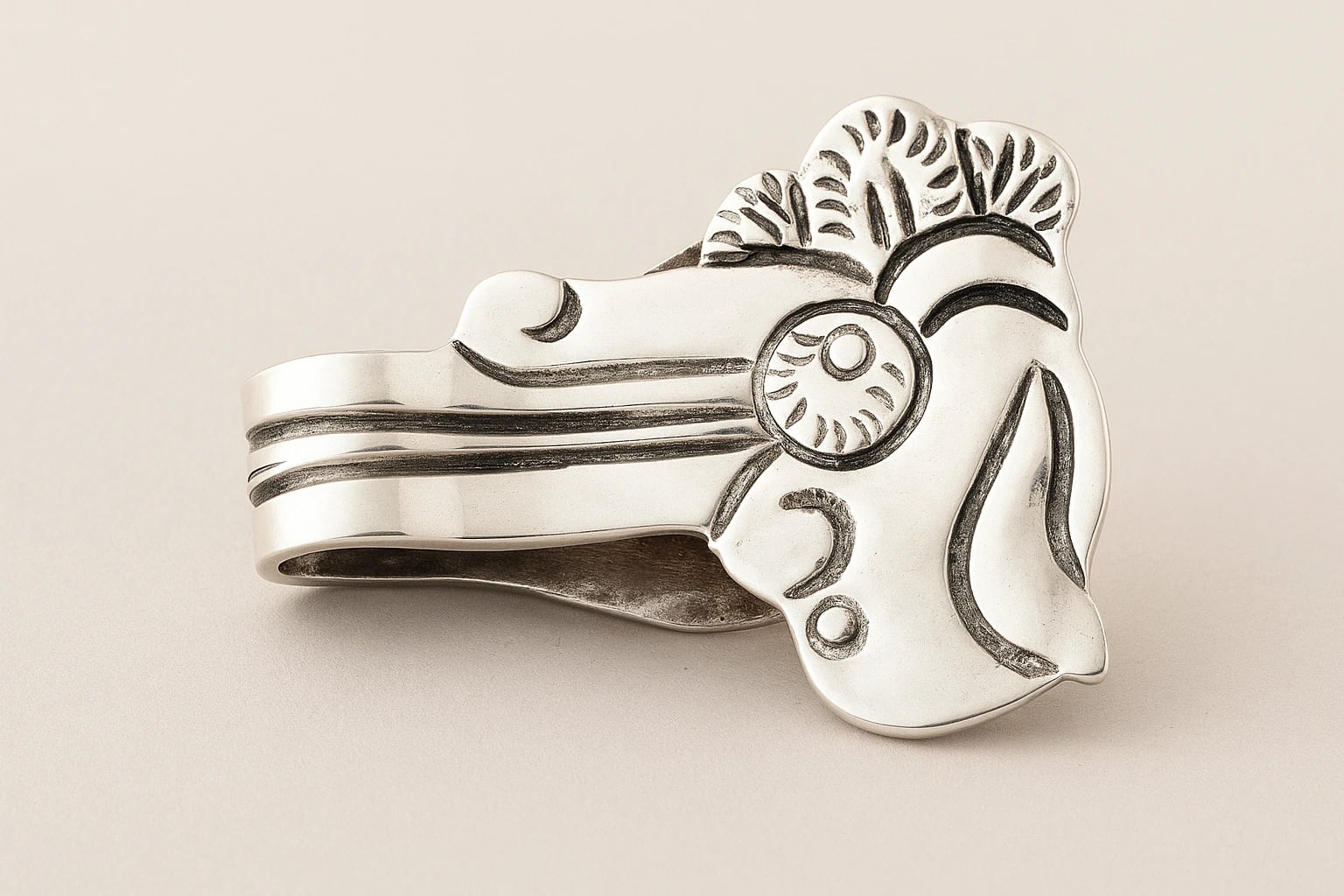
Silver Money Clip
First Design Period: 1931 - 1946
Silver