Saves instantly, no account needed. Already a member? Sign in.
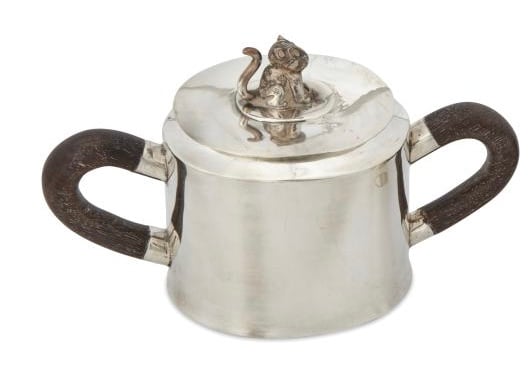
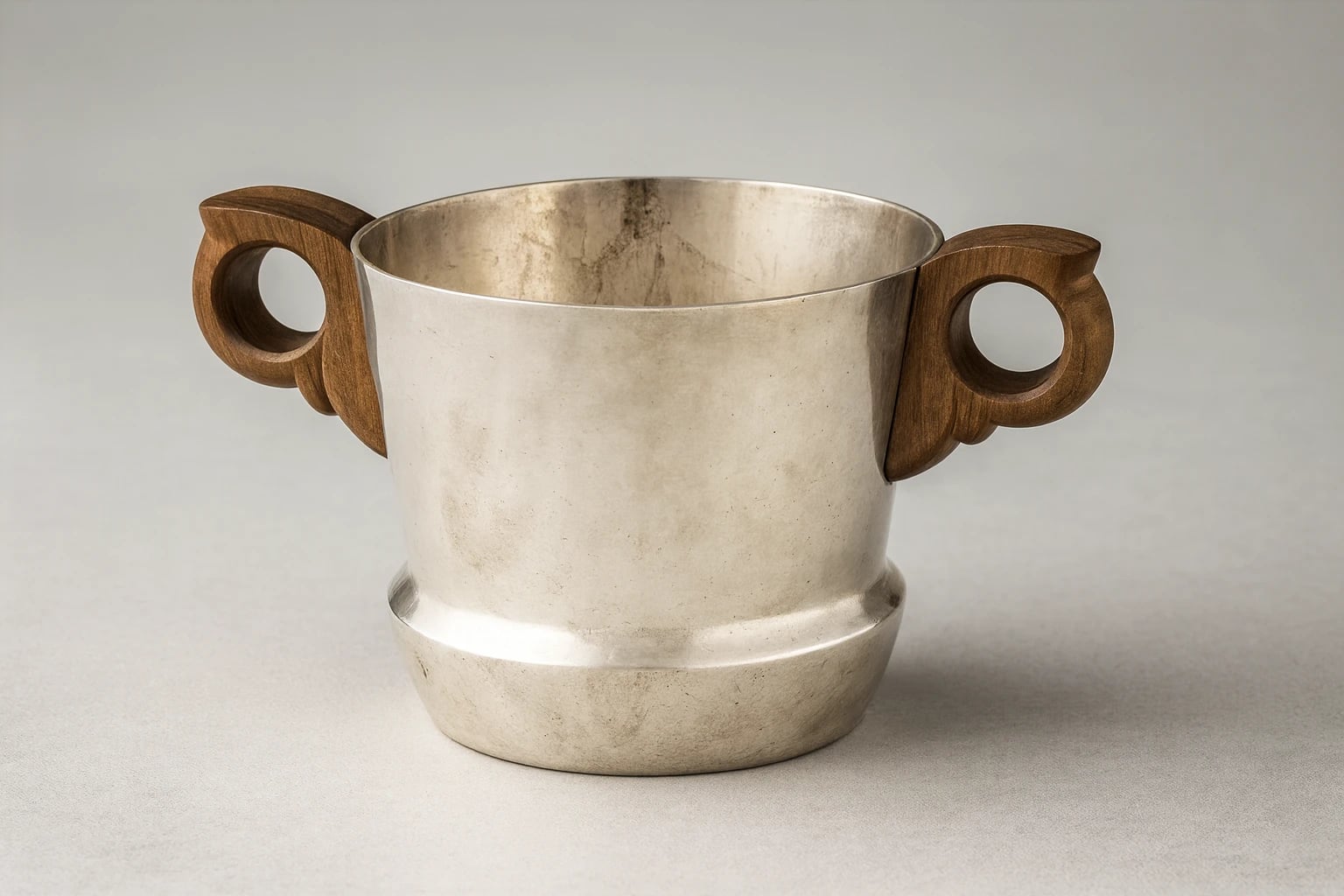
A sugar bowl that asks its handles to do the expressive work is unusual, and this one commits to that idea completely. Two spheres of rosewood sit at the ends of a plain silver vessel, dark and warm against the metal's cool reflection. The design withholds ornament from the bowl itself, letting the silver stay quiet so that the wood can register as pure form. That decision, restraint in the body and emphasis at the grip, is what distinguishes the object from most hollowware of its period, which tended to lavish attention on chased or repoussé surfaces.
The bowl reads as a study in contrast held under tight control. Silver returns light; rosewood absorbs it. The metal is planar and open at the rim; the handles are dense, round, and closed. Where many sugar bowls fold their handles into scrolls or cast them as part of the wall, here the two round grips read as independent volumes, attached rather than grown from the vessel. The roundness matters to the hand as much as to the eye, offering a warm and solid hold that silver alone would not provide. This pairing of silver with a tropical hardwood belongs to a strain of Spratling's work in which local materials carry the design rather than serve as accents, and rosewood's deep color and close grain give the piece its gravity.
The object dates to Spratling's first design period, the years following his founding of the Taller de Las Delicias in 1931, when the workshop was consolidating a vocabulary that treated indigenous Mexican materials and forms as the foundation of a modern idiom rather than as decorative quotation. Spratling did not introduce silverworking to Taxco, where metal and jewelry traditions long predated him, but at Las Delicias he built a taller system in which designers, master smiths, and specialists could refine such ideas into producible objects. The vocabulary of pairing silver with wood ran through the wider silver renaissance and through the generation of designers who passed through or near his workshop, from Héctor Aguilar to Antonio Pineda, each of whom pursued material contrast in a distinct formal language. Within that milieu, this bowl represents the plainer, more architectural end of Spratling's thinking, where the composition depends on the meeting of two materials rather than on surface incident.
For a collection tracing the Mexican silver renaissance, the bowl documents how tableware could carry the same modernist discipline that the movement is better known for in jewelry. It shows Spratling subordinating a functional vessel to a single formal proposition, the confrontation of reflective metal and absorbing wood, and trusting that proposition to hold the entire design. That confidence, applied to something as domestic as a sugar bowl, is precisely where the renaissance made its case that decorative arts could think as rigorously as any other medium of Mexican modernism.
Museum of Mexican Silver. “Small Rosewood Sugar Bowl.” Catalog no. MoMS-000473. https://museumofmexicansilver.com/pieces/spratling-838
See something wrong with this record? Suggest a correction and the piece details fill in automatically.
William Spratling
Domed Base Sugar Bowl
First Design Period: 1931 - 1946
Silver