Saves instantly, no account needed. Already a member? Sign in.
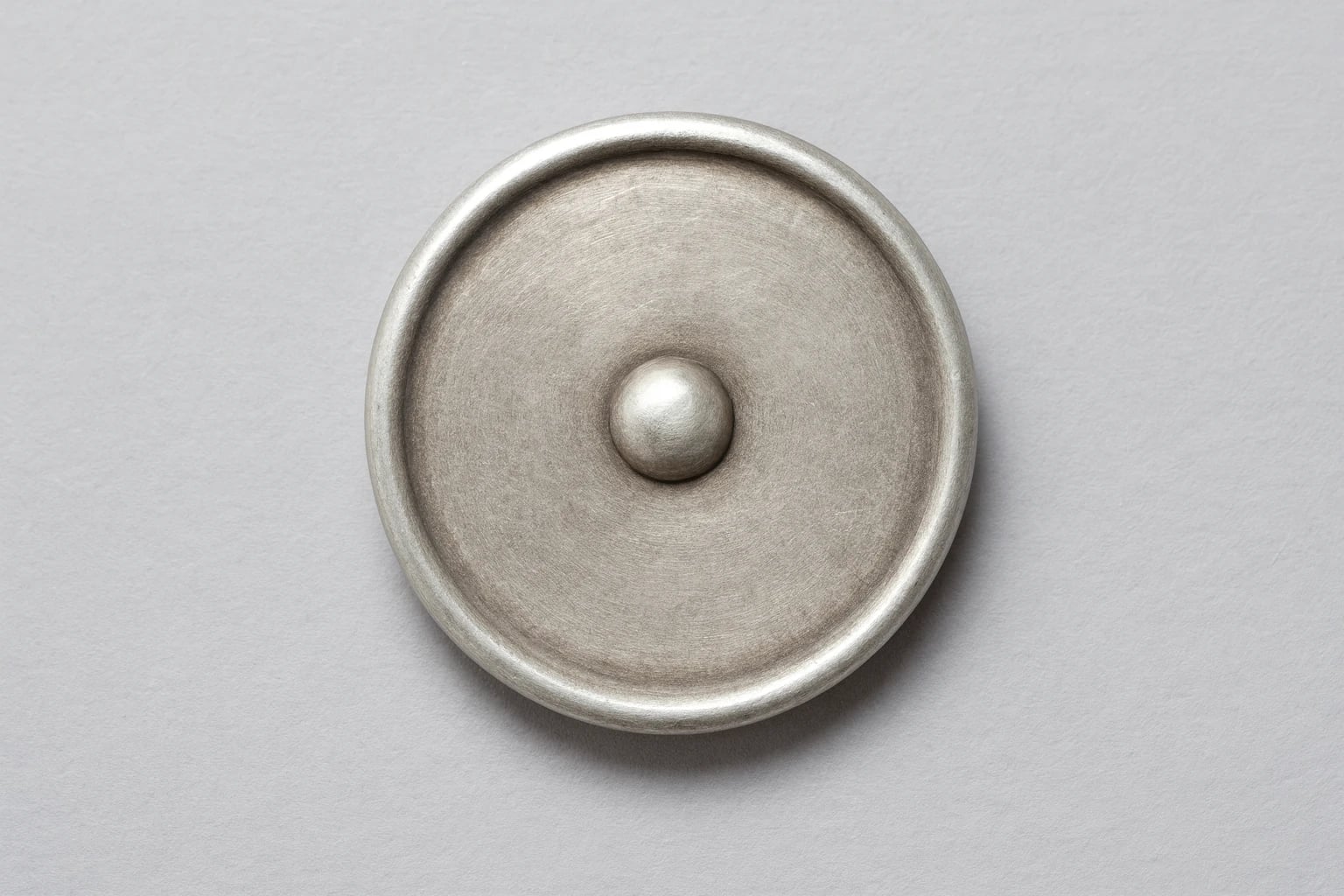
A silver button is one of the smallest problems a designer can be handed, and this one solves it by keeping only the essentials: a raised rim, a plain field, and a single ball fixed at the center. The composition is almost diagrammatic, a circle within a circle resolving on a sphere. Where a decorative button might crowd the surface with ornament, this design lets the geometry and the reflective behavior of the metal do the work. The rim gathers a bright line of light around the edge, the recessed field reads as a quieter disc, and the central ball throws a small concentrated highlight that shifts as the wearer moves. That economy is the point, and it is why an object this modest still carries William Spratling's design intelligence.
The effect depends on how silver handles light across three levels of relief. A button is seen in motion, on a jacket, a cuff, or a garment closure, and it is never viewed in a single fixed position the way a brooch on a lapel might be. The concentric structure answers that condition. The raised rim reads clearly from any angle because its curved edge always catches illumination somewhere along its circumference. The field between rim and center supplies a calm interval that keeps the two bright elements from competing. The ball at the center behaves like a tiny convex mirror, compressing its surroundings into a single glinting point. Whether this example was raised, cast, or die formed cannot be determined from surface appearance alone, but the design reads as a deliberate exercise in controlling reflection with the fewest possible parts.
Buttons occupied a real place in Spratling's shop and in Taxco production more broadly. Morrill records a range of Spratling button marks spanning roughly 1935 to 1955, in both 925 and 980 silver, which tells us these were a standing part of the workshop's output rather than an occasional novelty. The subject also points to how thoroughly silver had entered daily dress in and around the Taller de Las Delicias and the workshops that grew from it. Rafael Dominguez, trained in Spratling's shop from the time he could lift a hammer, was singled out in a 1950 Taxco guidebook specifically for his silver buttons, a detail that shows how these small fastenings circulated as desirable objects among the visitors who came through the town. A button was an accessible entry into hand-wrought Mexican silver, small enough to buy in a set and to wear every day.
Set beside Spratling's ambitious jewelry and hollowware, a rimmed button with a central ball is a study in restraint rather than a showpiece, and that is its value to a collection. It demonstrates that the same designer who could orchestrate large articulated necklaces also disciplined himself to the scale of a fastening, applying the concentric logic and reflective control that run through the workshop's vocabulary. Objects like this fill in the ordinary, wearable end of the Mexican silver renaissance, the part that reached shoulders and cuffs rather than exhibition vitrines, and they help explain how a mountain town's silver became something people wore rather than merely admired.
Museum of Mexican Silver. “Rimmed Button with Ball in Center.” Catalog no. MoMS-000704. https://museumofmexicansilver.com/pieces/spratling-868
See something wrong with this record? Suggest a correction and the piece details fill in automatically.
Clasped Hands Button
Silver