Free account. We'll finish the save once you're in. Already a member? Sign in.
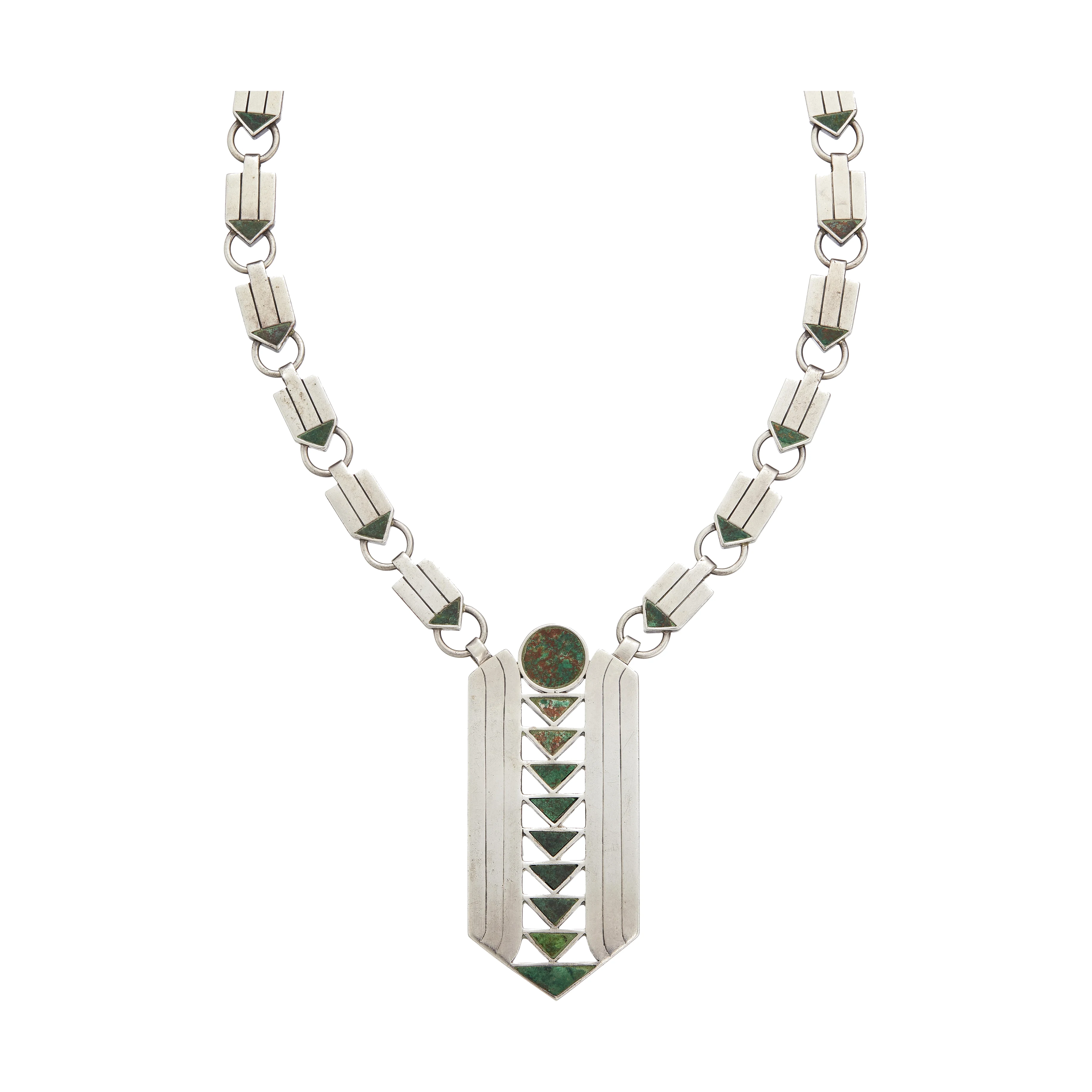
A column of green malachite triangles runs down the long silver pendant, each one set point-down so the row reads as a stack of arrowheads narrowing toward a chevron tip. Framed by a pair of incised vertical lines and crowned by a round malachite cabochon, the plaque builds its whole ornament from a single repeated wedge, the kind of pre-Columbian source William Spratling drew on from the beginning of the Taxco silver revival.
The arrow-point logic carries up the chain, where each rectangular link is inlaid with a small malachite chevron, stepping the motif toward the throat link by link. The geometry is strict and architectural, bright flat silver against dark green stone, with the descending arrow ordering pendant and chain into one continuous idea.
The necklace carries the SPRATLING DE MEXICO STERLING mark and the eagle assay stamp, placing it in the sterling-and-eagle years of roughly 1949 to 1952, after the early oval Spratling-Silver period. The malachite is inlaid flush into the metal rather than raised in bezels, the precise hardstone-and-metal technique that became a Spratling signature and bound his modern forms to ancient Mexican material.
Built entirely around that one descending wedge, the piece belongs to an arrow-point suite made with a matching bracelet, the motif scaled from the broad pendant down to the smallest link. It is Spratling at his most disciplined, a pre-Hispanic device reduced to pure geometry and run cleanly through every part of the object.
See something wrong with this record? Suggest a correction and the piece details fill in automatically.