Free account. We'll finish the save once you're in. Already a member? Sign in.
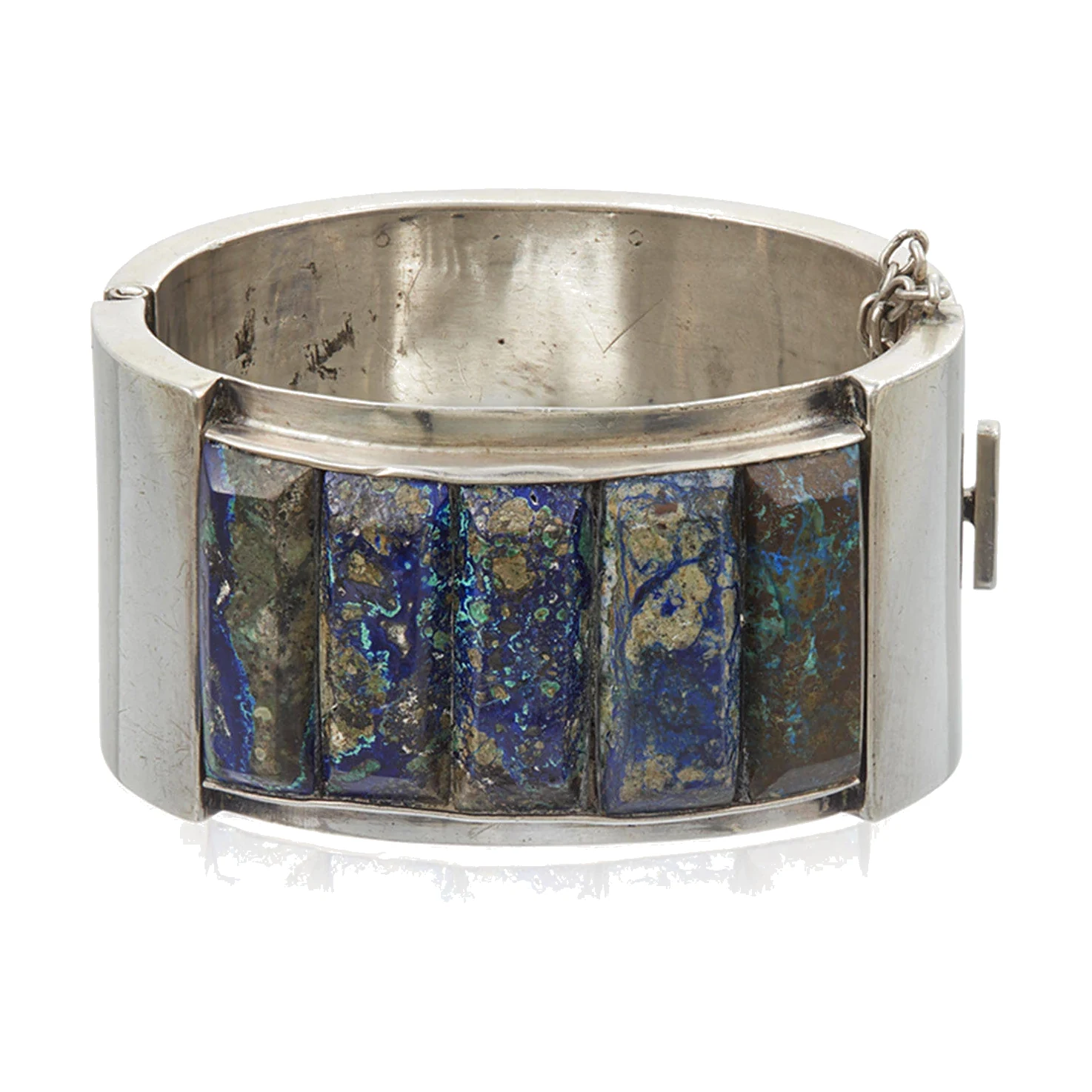
Five rectangular plaques of azurmalachite run in a single banded row across the broad face of this hinged silver cuff, each stone a swirl of azurite blue and malachite green flecked with ochre, framed by plain polished borders that let the mineral do the talking. Setting a strip of living stone into a wide, severe band of bright metal is the kind of sculptural restraint Antonio Pineda pursued further than most of his Taxco contemporaries, the whole design turning on one contrast: hard polished silver against soft, painterly mineral.
The cuff is a heavy hinged band closed by a safety chain, its inner surface left plain so the weight and shine of the metal carry the form. The five plaques sit flush in their channel and read as one continuous strip of blue-green, the irregular grain of each stone keeping the row from ever looking machined.
It is struck in 970 silver, the higher standard Pineda favored, and carries his Antonio-Taxco crown mark alongside a maestro's CMC mark — the second hallmark of the master silversmith who worked the design in the shop. The ZZ152 code places it in the bracelet sequence of the inventory system Pineda used through his Taxco years, recorded by Stromberg; the large talleres on the zócalo kept such maestros on hand to execute the designs he conceived.
Azurite and malachite, the blue and green copper minerals that often occur intergrown as azurmalachite, give the piece its color without a single faceted stone — a bracelet treated as a frame for one band of raw Mexican mineral, carried entirely by that meeting of stone and bright metal.
See something wrong with this record? Suggest a correction and the piece details fill in automatically.