Free account. We'll finish the save once you're in. Already a member? Sign in.
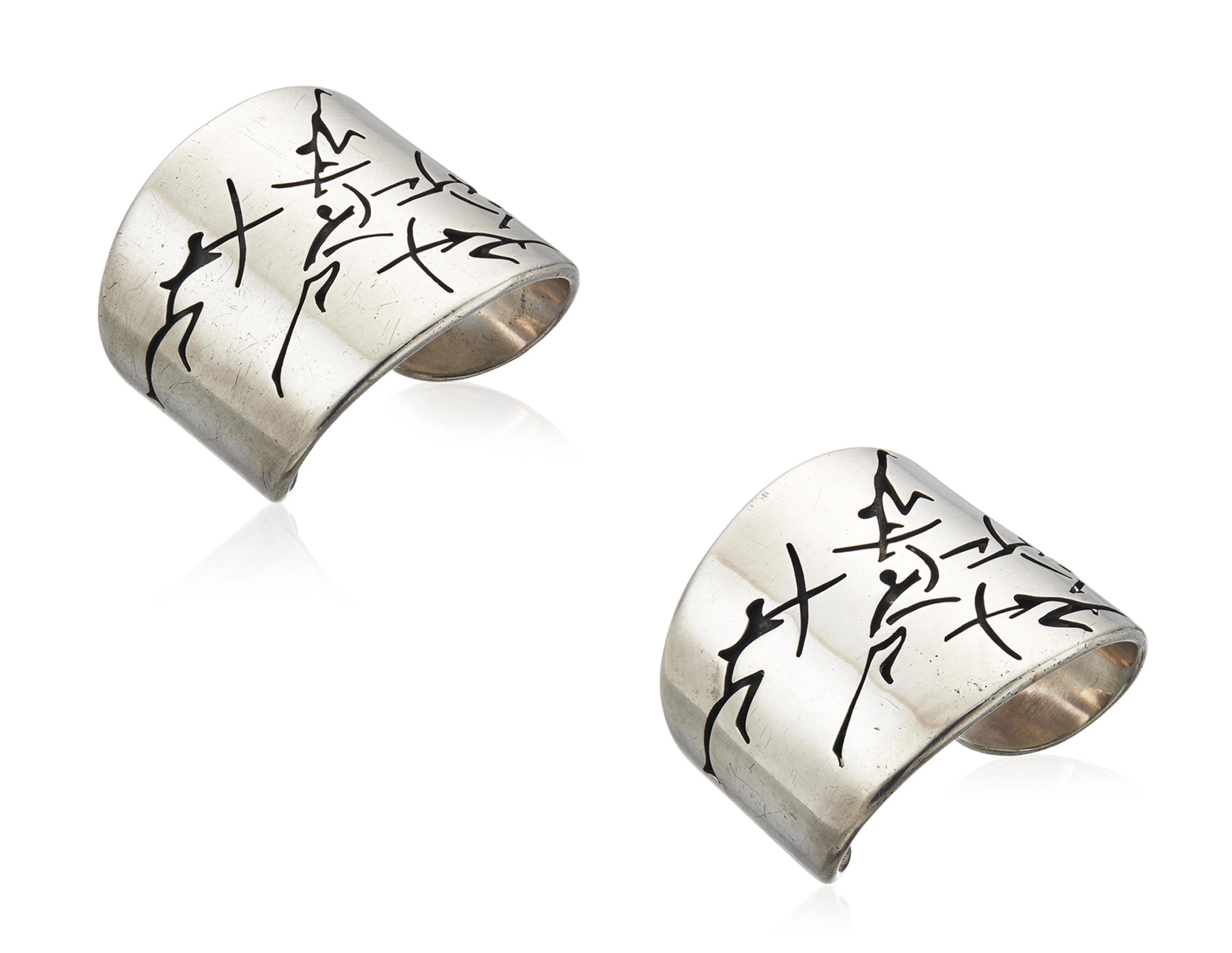
Figural narrative is rare in Antonio Pineda's work, which is why this pair of cuffs is worth pausing over. His reputation rests on cool geometry, on concave ovals and cartouches and the disciplined play of polished surface against gemstone. Here instead are striding warrior figures, drawn in oxidized line across a broad tapered ground like a fragment of a codex unrolled onto the wrist. The figures are reduced to the barest gesture, all motion and spear, set into a shadow-box outline. The result is a wearable piece of the pre-Hispanic past translated through mid-century modernism, the same synthesis the Taxco school built its identity on, but realized pictorially rather than abstractly, and in matched pairs that read as a single sculptural statement spanning both arms.
The drawing technique carries the whole design. The dark figures are achieved by oxidizing the silver into recessed line so the warriors stand against the bright planished field, the contrast of light and dark surface that runs throughout Pineda's mature output. Both cuffs are struck with the full hallmark of his taller: HECHO EN MEXICO, the eagle-17 assay mark, his ANTONIO-TAXCO crown maker's mark, and the inventory code ZZ717. The ZZ prefix is itself telling. Gobi Stromberg records that Pineda's shop assigned ZZ specifically to bracelets within its numbering system (Stromberg, "Antonio Pineda," 2008, p. 81), so the mark confirms not only the maker but the object's place in his production. The 970 fineness is the standard Pineda favored above ordinary sterling, a near-pure silver that gives his work its particular weight and color; Penny C. Morrill's catalogue of his bracelets records the same crown, eagle, and 970 marks across the concave-oval and cartouche cuffs of the 1950s and 1960s (Morrill, "Silver Masters of Mexico," 1996, pp. 173, 181). The two cuffs here are substantial and broad, tapering to roughly six centimeters at the widest, the kind of architectural scale Pineda intended to be worn as sculpture for the arm.
Pineda apprenticed as a teenager in William Spratling's Las Delicias workshop under the Iguala master smiths Alfonso Mondragón and Artemio Navarrete, whom he counted as his teachers (Stromberg, 2008, p. 29), before opening his own taller and building it into one of the grand Taxco houses whose designs he conceived while master smiths executed the work. His standing was confirmed by the Fowler Museum's 2008 retrospective "Silver Seduction: The Art of Mexican Modernist Antonio Pineda," which gathered nearly two hundred pieces spanning the 1930s through the 1970s. Against that body of work, a matched pair of figural narrative cuffs is an uncommon survival, and one that shows the side of Pineda most directly engaged with the ancient imagery the wider school only ever abstracted.
See something wrong with this record? Suggest a correction and the piece details fill in automatically.