Saves instantly, no account needed. Already a member? Sign in.
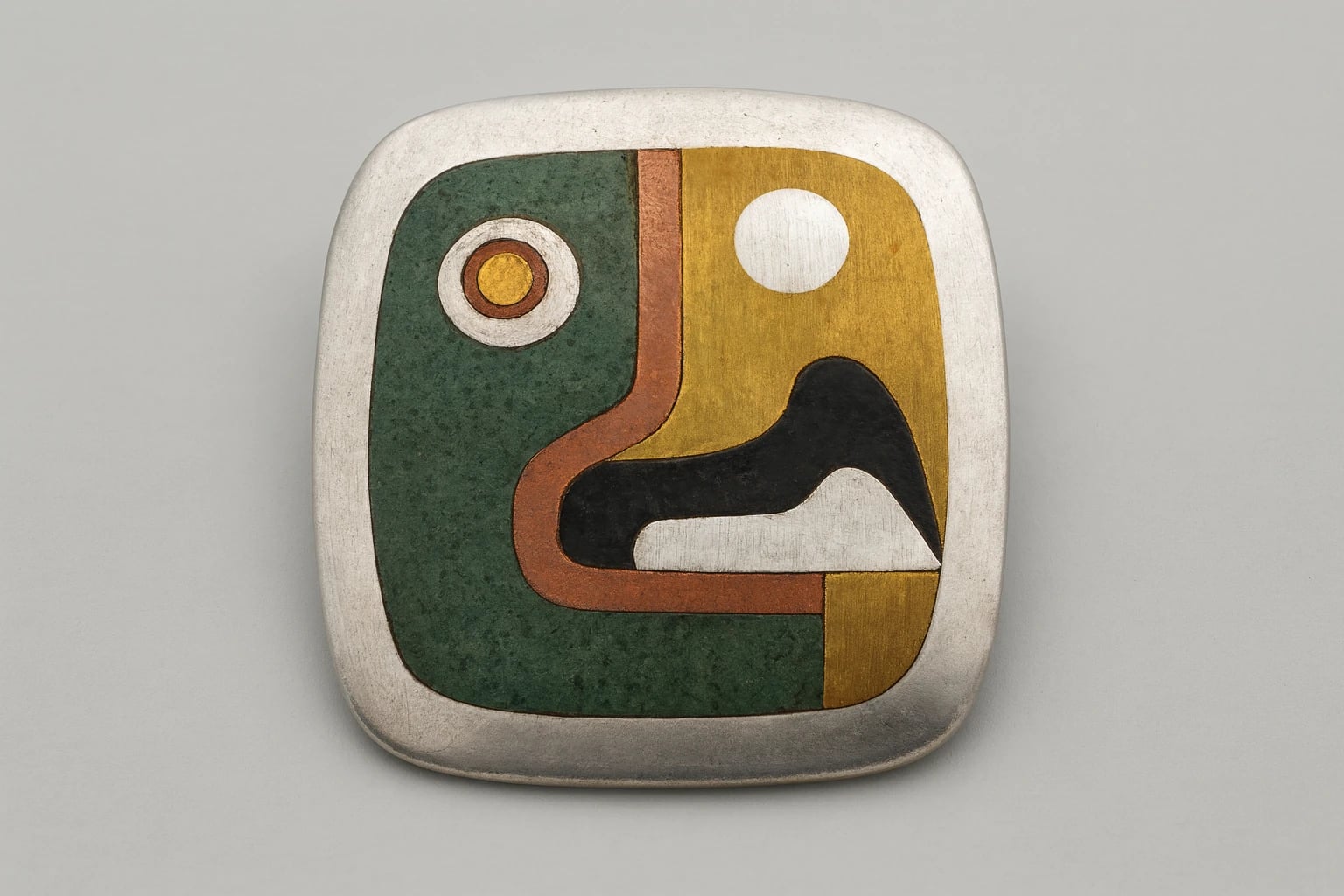
Few objects of the Taxco renaissance carry a documented triumph as specific as this one. At the 1955 Silver Fair, a competition in which some 2,500 silversmiths took part, this parrot design by Jorge "Chato" Castillo won first prize, awarded by a jury that included Miguel Covarrubias, Jorge Enciso, Daniel Rubín de la Borbolla, and Rufino Tamayo, who cited its design, color, composition, and ingenuity. Tamayo did more than vote for it. He afterward painted a parrot whose head is this very composition, inscribed "Primer Premio en Platería por su color, composición e ingeniosidad," so that a piece of jewelry passed directly into the pictorial imagination of one of Mexico's major painters. The pendant, only an inch and a half across, is therefore both a wearable object and a small, prize-winning modernist picture, and it remains among the most celebrated designs to come out of the Los Castillo workshop.
The image is a parrot's head in profile, compressed into a rounded silver square and built entirely from fitted planes of color. A deep green malachite field anchors the left side and carries the bird's eye, a bullseye of silver, copper, and brass. A warm copper band curves down and doubles back to draw the beak, brass gold fills the crown and cheek, and a wave of black onyx with a pale silver crest completes the lower face. The reduction is severe but never illegible. Four or five decisive relationships, the ringed eye, the hooked copper line, the gold ground, the black interruption, hold the bird together at wearing distance, while the precise seams between materials reward inspection at close range. The workshop's own account of the design names its full palette: silver, copper, brass, and monel, with incrustations of malachite and black onyx.
That palette is the point. The technique is metales casados, married metals, in which separate metals are cut, fitted, and soldered so exactly that the joins become drawing rather than construction. Morrill and Berk credit Chato Castillo with developing the technique and with naming it, and this design shows why it mattered. The parrot's color is not applied to a silver surface; it is the surface, each area a different substance with its own temperature, reflectivity, and density. Green comes from stone, warmth from copper, brilliance from brass, depth from onyx, and the silver frame and eye supply the cool light against which the rest reads. The inclusion of monel, a modern nickel alloy, alongside malachite, a stone with ancient Mexican associations, is characteristic of the workshop's willingness to treat any material as a legitimate source of color.
Museum of Mexican Silver. “Abstract Parrot Head Pendant in Married Metals.” Catalog no. MoMS-002300. https://museumofmexicansilver.com/pieces/los-castillo-brooch-pendant
See something wrong with this record? Suggest a correction and the piece details fill in automatically.
The design belonged to a family of forms. The workshop produced it as a pin, bracelet, rings, earrings, and cuff links, and Los Castillo, founded in Taxco in 1939 by Antonio Castillo with his brothers and their cousin Salvador Terán, became internationally identified with exactly this kind of polychrome metalwork. Chato, who had trained at Spratling's Taller de Las Delicias before helping to establish the family firm, was its most inventive metallurgical mind. What this pendant contributes to that history is a demonstration, ratified by the leading artists and scholars of its generation, that Taxco silver could be judged on the same terms as painting: color, composition, and ingenuity. When Tamayo gave the design a body and set it on a branch, he confirmed what the jury had already decided, that this small square of married metals was a complete work of Mexican modernism.
Los Castillo
Bull-Motif Money Clip