Saves instantly, no account needed. Already a member? Sign in.
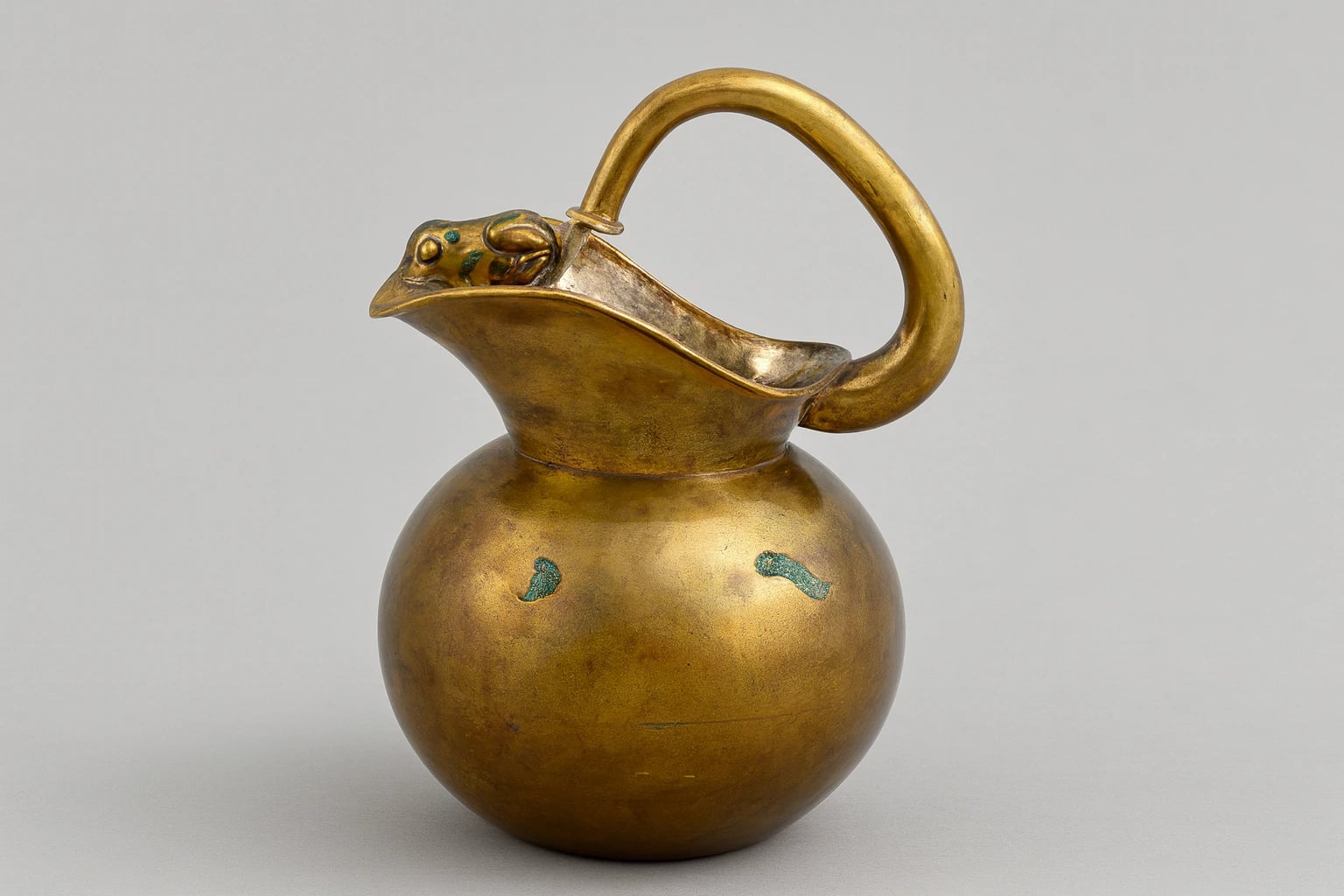
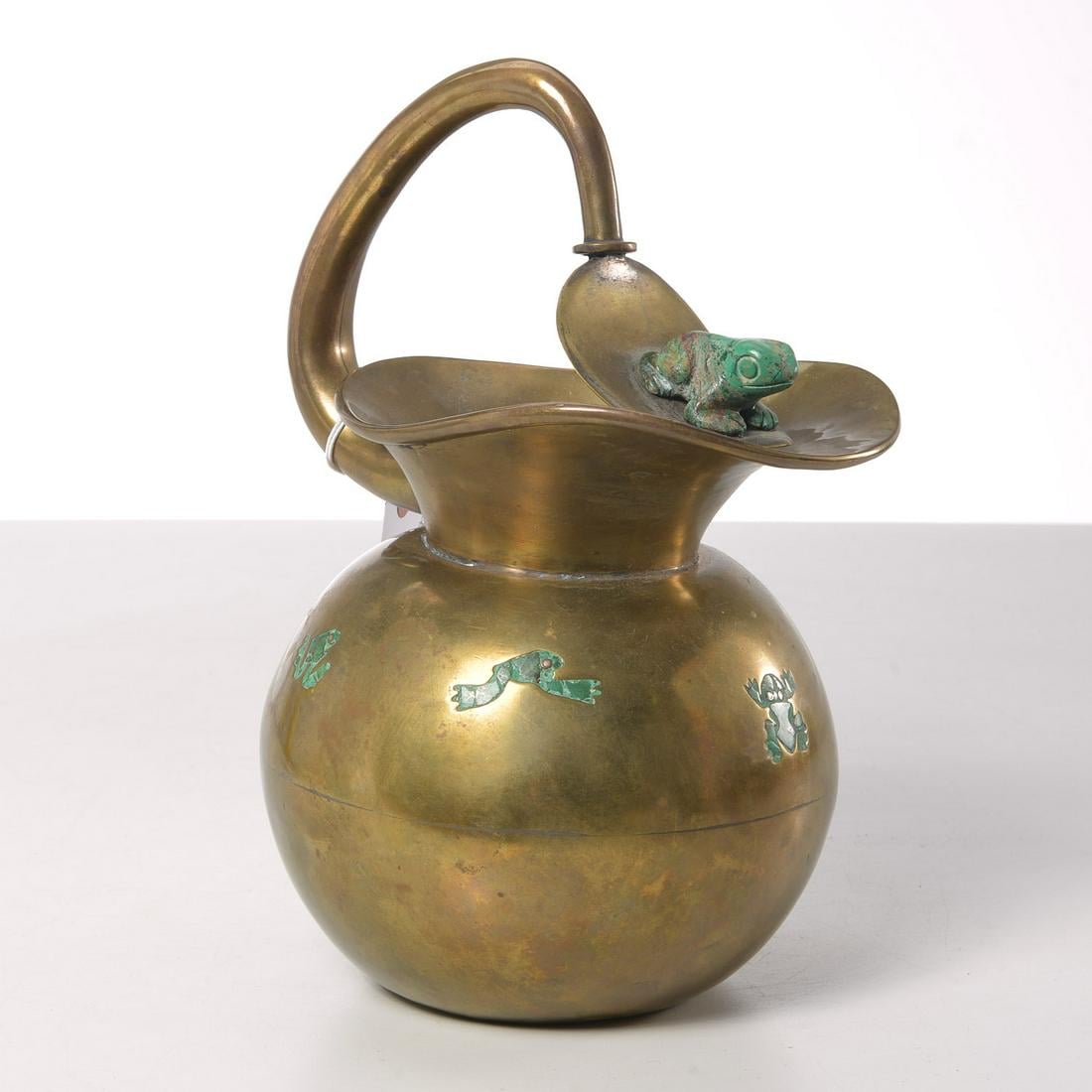
A pitcher in married metals, inset with malachite and worked with a frog motif, places this vessel at the center of what distinguished Los Castillo as an orfebrería workshop. The union of hollowware form, naturalist motif, and polychrome metal inlay calls on the full range of the workshop's technical vocabulary; it is in pieces of this kind that the married-metals method moved into three-dimensional form rather than remaining a surface treatment on flat panels.
Married metals, as documented by Morrill and Berk (Mexican Silver, 1994, p. 168), was invented at Los Castillo by Jorge "Chato" Castillo: different metals are cut to precise shapes and fitted into recesses in a background metal with little or no solder, so that all color comes from the inherent character of each material rather than any applied surface treatment. Silver supplies a cool, reflective light; brass brings warmth; malachite contributes a concentrated natural green that no metal can provide. The technique was sufficiently demanding that only a small number of silversmiths within the workshop could produce pieces of this type, and Morrill and Berk note that pitchers were among the canonical forms in which the method was expressed — objects "unique to Los Castillo" precisely because of that technical difficulty.
The frog motif gives this pitcher a naturalist specificity beyond the geometric and codex-derived compositions more commonly associated with Los Castillo mixed-metals work.
Museum of Mexican Silver. “Frog Mixed Metal Malachite Pitcher.” Catalog no. MoMS-001877. https://museumofmexicansilver.com/pieces/los-castillo-pitcher-frog-malachite-mixed-metal
See something wrong with this record? Suggest a correction and the piece details fill in automatically.
Los Castillo
Hummingbird Stone Inlay Pitcher
Unidentified stone