Saves instantly, no account needed. Already a member? Sign in.
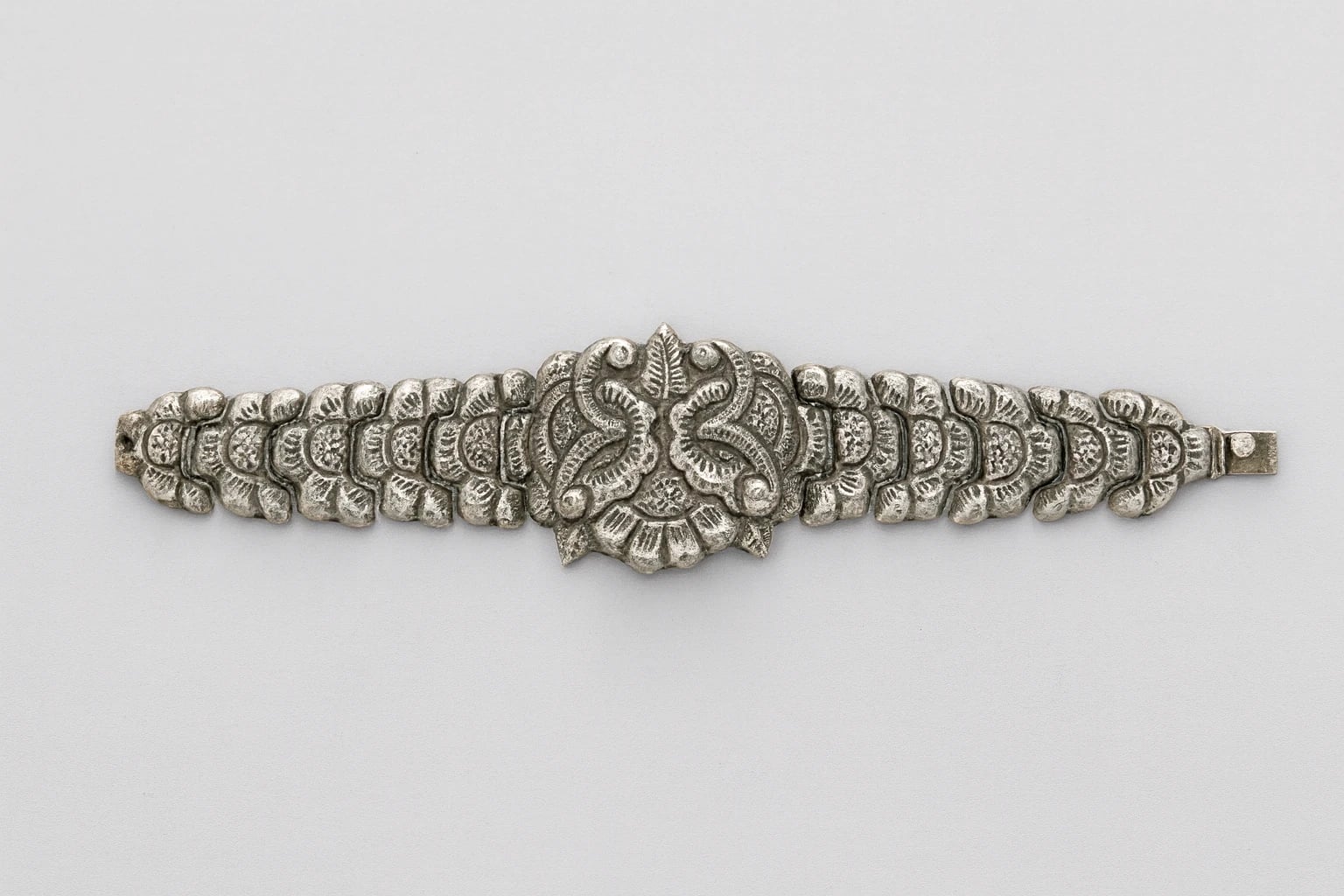
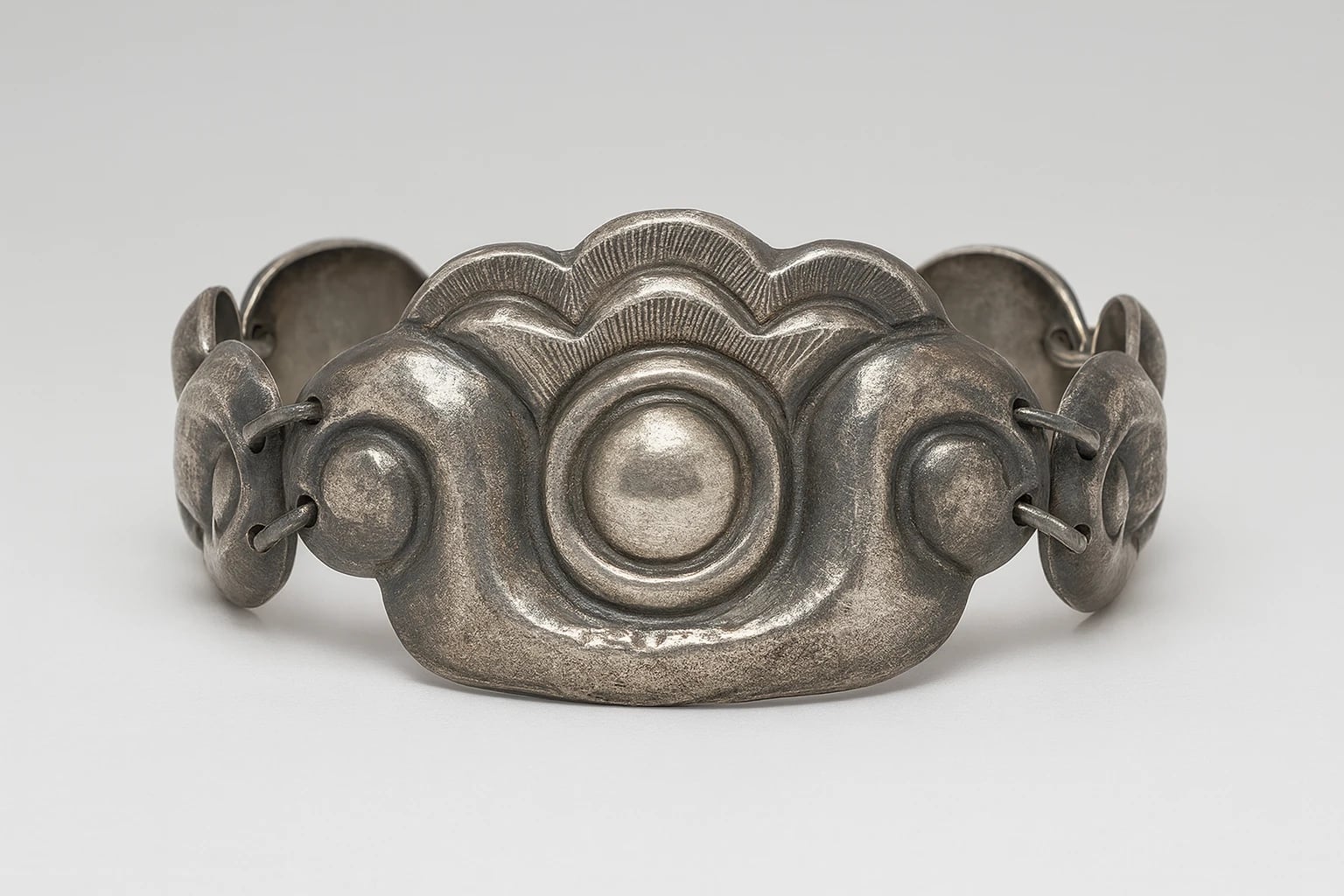
The bracelet concentrates Matl’s early language into a compact band of raised silver: a central round boss, nested within concentric rings, is held by broad repoussé lobes and a scalloped crest of finely tooled ridges. At seven inches long and one and one quarter inches wide, it has the scale of a substantial wrist ornament rather than a narrow bangle. Its old flat hook closure and articulated side joins keep the form close to the hand, while allowing the frontal plaque to read almost as a small relief. The mark, the old heavy script Matl with 950, places the object within Matilde Poulat’s pre-eagle production, consistent with the 1934 to 1948 950 mark recorded by Hougart and with the museum record’s dating to the mid-1930s to early 1940s.
The design depends on the pressure and release of repoussé. Smooth convex forms swell forward, then are tightened by crisp borders and short, repeated tool marks. Those ridged passages are not filler. They give the bracelet a second rhythm, finer and more graphic than the rounded masses they surround. The result is characteristic of early Matl work: surface is built as pattern, but the pattern never becomes flat. The bracelet keeps the memory of the silversmith’s hand in the shallow irregularities around the raised forms, in the way the edges catch light unevenly, and in the directness of the closure. Nothing about the construction disguises the object as machine perfection. Its refinement lies in the controlled vitality of the relief.
Matilde Eugenia Poulat came to silver as a trained artist. Morrill and Berk record that she studied painting at the San Carlos Academy of Fine Arts in Mexico City and taught painting before turning fully to silver, while Hougart notes that she opened her shop in 1934. That sequence matters here. The bracelet is not a translation of academic painting into jewelry, but it shows a painter and designer’s command of figure and ground. The raised central disk, the surrounding rings, and the scalloped upper edge are arranged with the clarity of an emblem. Morrill and Berk connect Poulat’s designs to the postrevolutionary search for a Mexican aesthetic and to her interest in the Mixtec gold jewelry excavated at Monte Albán in 1932. This bracelet does not need a literal archaeological quotation to belong to that current. Its relief, symmetry, and worked surface show how Matl transformed historical and popular sources into a personal modern Mexican ornament.
Within the Mexican silver renaissance, early Matl occupies a distinct position. Taxco’s better known modernist line often moved toward planar geometry, architectural hinges, and polished abstraction. Poulat’s Mexico City work followed another path, one in which repoussé, applied detail, religious imagery, birds, flowers, bells, and ancient sources could enter the modern field without becoming nostalgic revival. This bracelet is comparatively restrained within that vocabulary. It has no stones, no figural creatures, no dangling cascabeles. Its interest lies instead in silver itself: 950 fineness, raised volume, tooled texture, and a closure that belongs to an older jewelry practice. In the museum collection, it documents the early Matl workshop at a moment before later registration marks and before Ricardo Salas’s long continuation of the house. It shows Poulat’s achievement in a concentrated form, where the bracelet’s ornament is inseparable from the way the silver has been shaped.
Museum of Mexican Silver. “Repoussé Blossom Link Bracelet.” Catalog no. MoMS-002347. https://museumofmexicansilver.com/pieces/matl-bracelet-3
See something wrong with this record? Suggest a correction and the piece details fill in automatically.
MATL (Matilde Poulat)
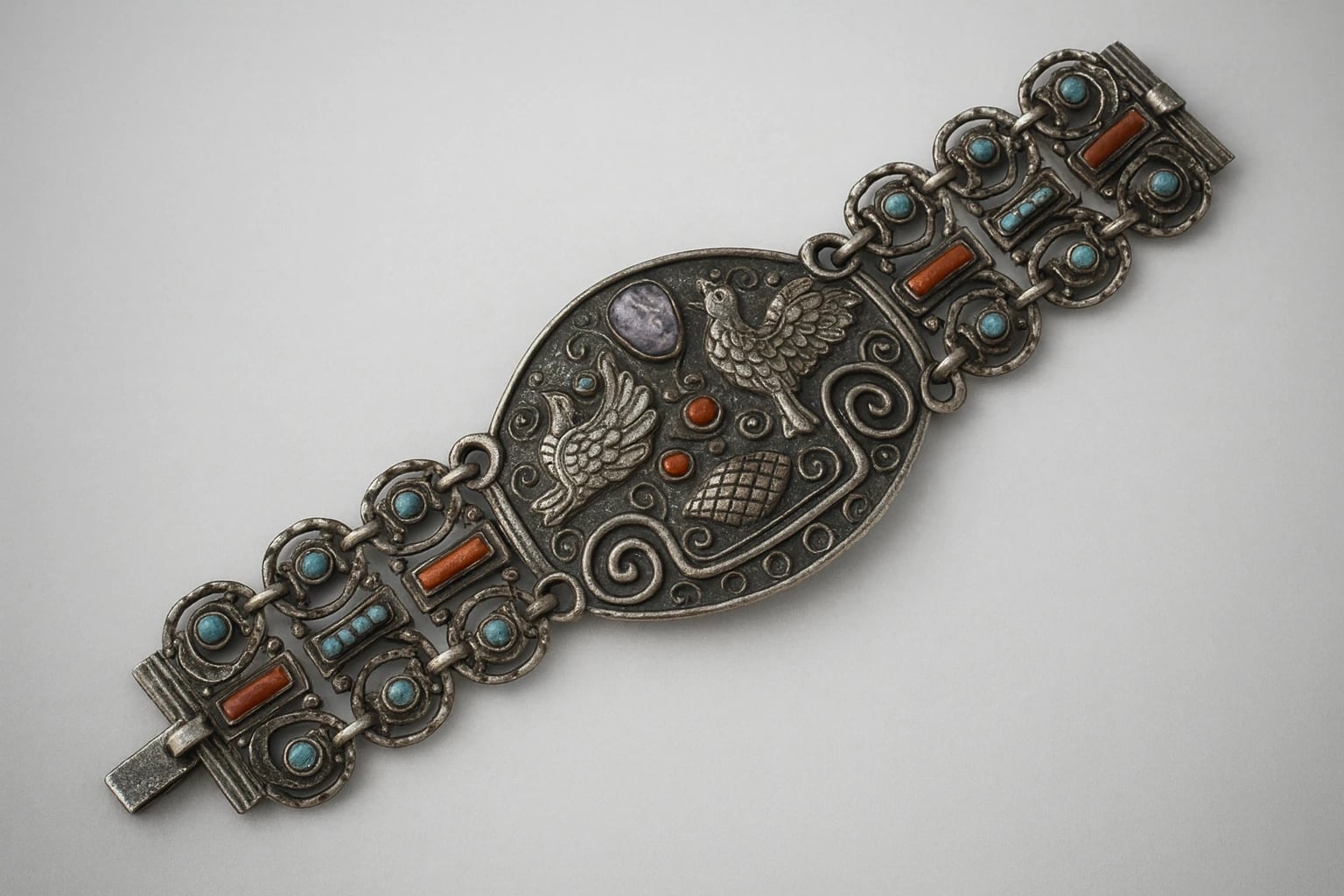
Dove Link Bracelet with Turquoise and Coral
1934 or later
Turquoise