Saves instantly, no account needed. Already a member? Sign in.
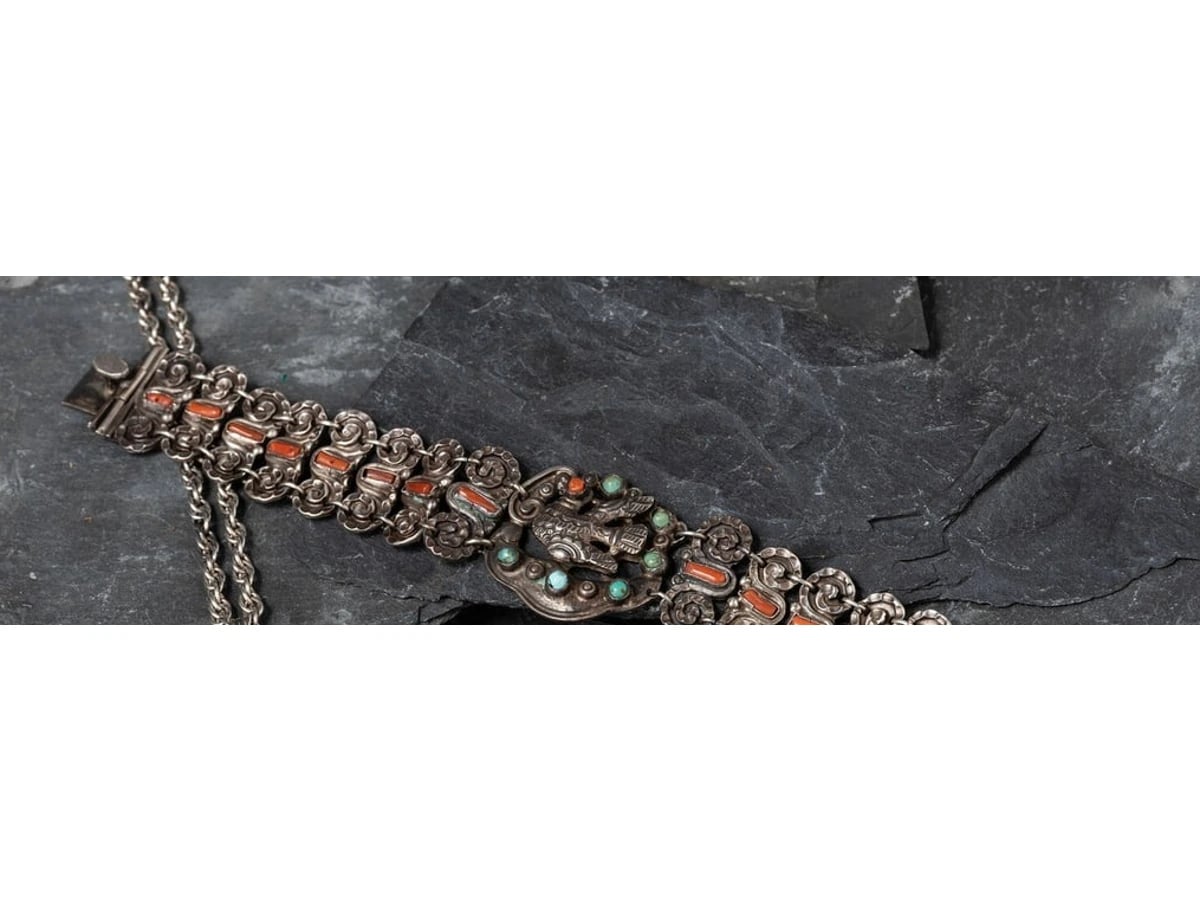
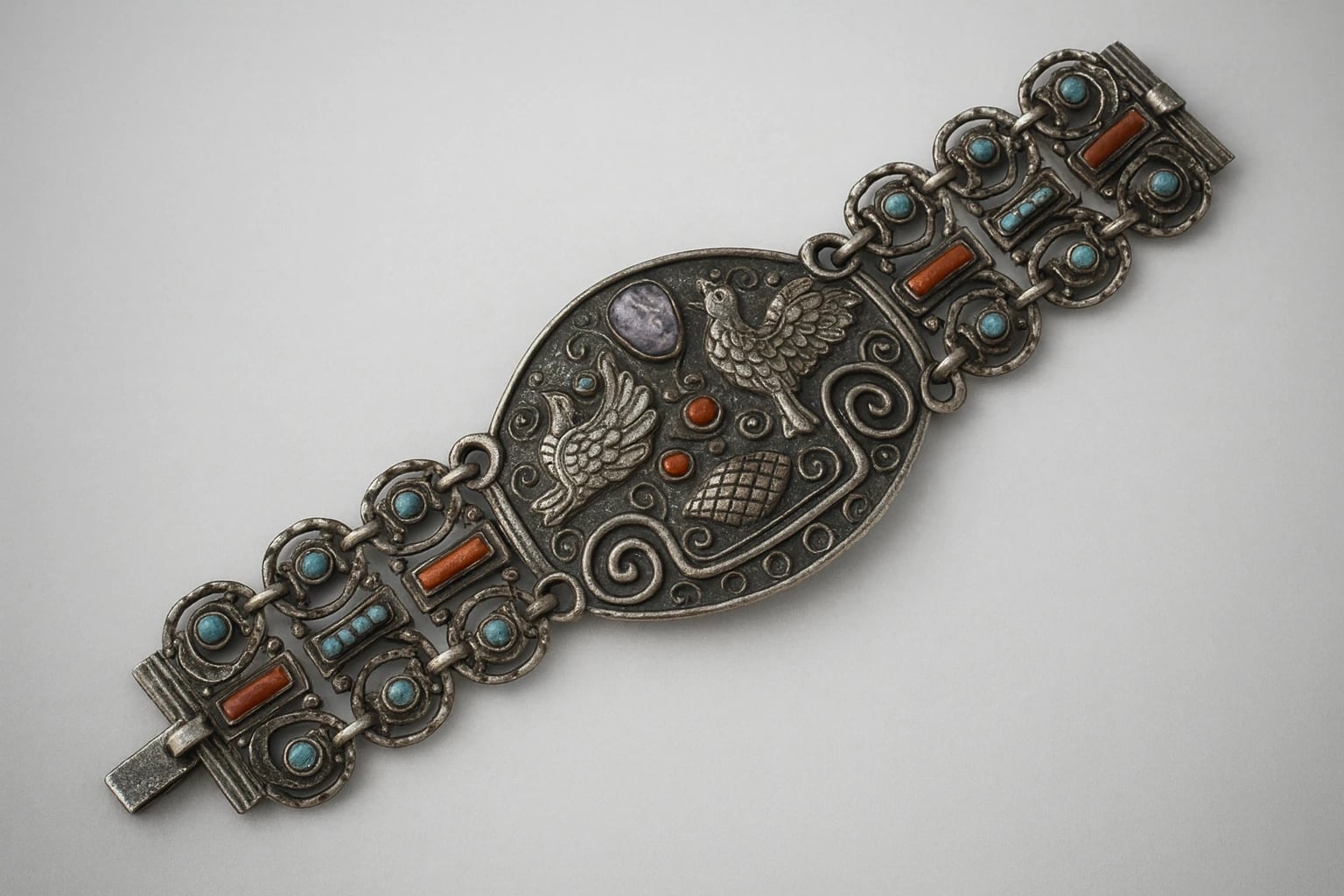
A bracelet of linked plaques carries the motif Matilde Poulat made her signature: a dove set within dense silver scrollwork, framed by turquoise and punctuated with coral. The design compresses a whole vocabulary into each link. Rounded silver volutes crowd around the central bird, small turquoise cabochons sit like beads of color within the metalwork, and coral supplies the warmer accent that keeps the palette from settling into a single register. Repeated along the wrist, the motif becomes a rhythm rather than a single image, each plaque echoing the last while the articulated joints let the whole band follow the curve of the arm.
The color logic is the heart of the object. Turquoise and coral were the stones Poulat returned to again and again, and here they operate as opposites held in balance: the cool blue-green of turquoise against the opaque red-orange of coral, both read clearly against oxidized silver that has been darkened in the recesses to throw the scrollwork forward. The silver is not a neutral setting but an active field, worked into curls and beads that fill nearly every surface. This density is characteristic of Poulat's approach, which drew on the visual habits of Mexican popular and devotional art rather than on the pared geometry favored in much Taxco design of the same years. The dove, a form with long currency in Mexican religious imagery, is treated here as ornament, repeated and stylized until it functions as pattern.
Matilde Poulat trained as a painter and designer at the San Carlos Academy before opening her own shop in 1934, and her jewelry reads as the work of someone who thought first in terms of image and surface. She registered "Matl," a name derived from an Aztec word for water, as a trademark, number 142093, and the mark in its several forms identifies work from her shop. After her death in 1960, her nephew Ricardo Salas continued the Matl designs, at times supervising several dozen silversmiths who fabricated and assembled the pieces, and later Salas-era work carries additional marks such as MS-12 alongside the Matl stamp. The dove-and-scroll vocabulary therefore spans decades and more than one hand, which means that identifying where a given bracelet falls within that long production depends on the specific mark it carries rather than on the design alone.
Within the broader silver renaissance, Poulat's work marks a distinct current, one that kept faith with the ornamental richness of Mexican folk and religious art at a moment when many workshops were moving toward abstraction and clean line. A dove link bracelet in turquoise and coral shows that vocabulary at full strength: the recurring bird, the crowded silver, and the deliberate opposition of blue and red stone. For a collection, it documents an alternative to the severe modernism often taken as the whole story of Taxco, and it preserves the particular way one designer translated a painter's sense of color and image into wearable metal.
Museum of Mexican Silver. “Dove Link Bracelet with Turquoise and Coral.” Catalog no. MoMS-002224. https://museumofmexicansilver.com/pieces/matl-dove-link-bracelet-with-turquoise-and-coral
See something wrong with this record? Suggest a correction and the piece details fill in automatically.
MATL (Matilde Poulat)
Parrot Bracelet
1934 or later
Silver