Saves instantly, no account needed. Already a member? Sign in.
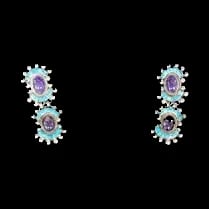
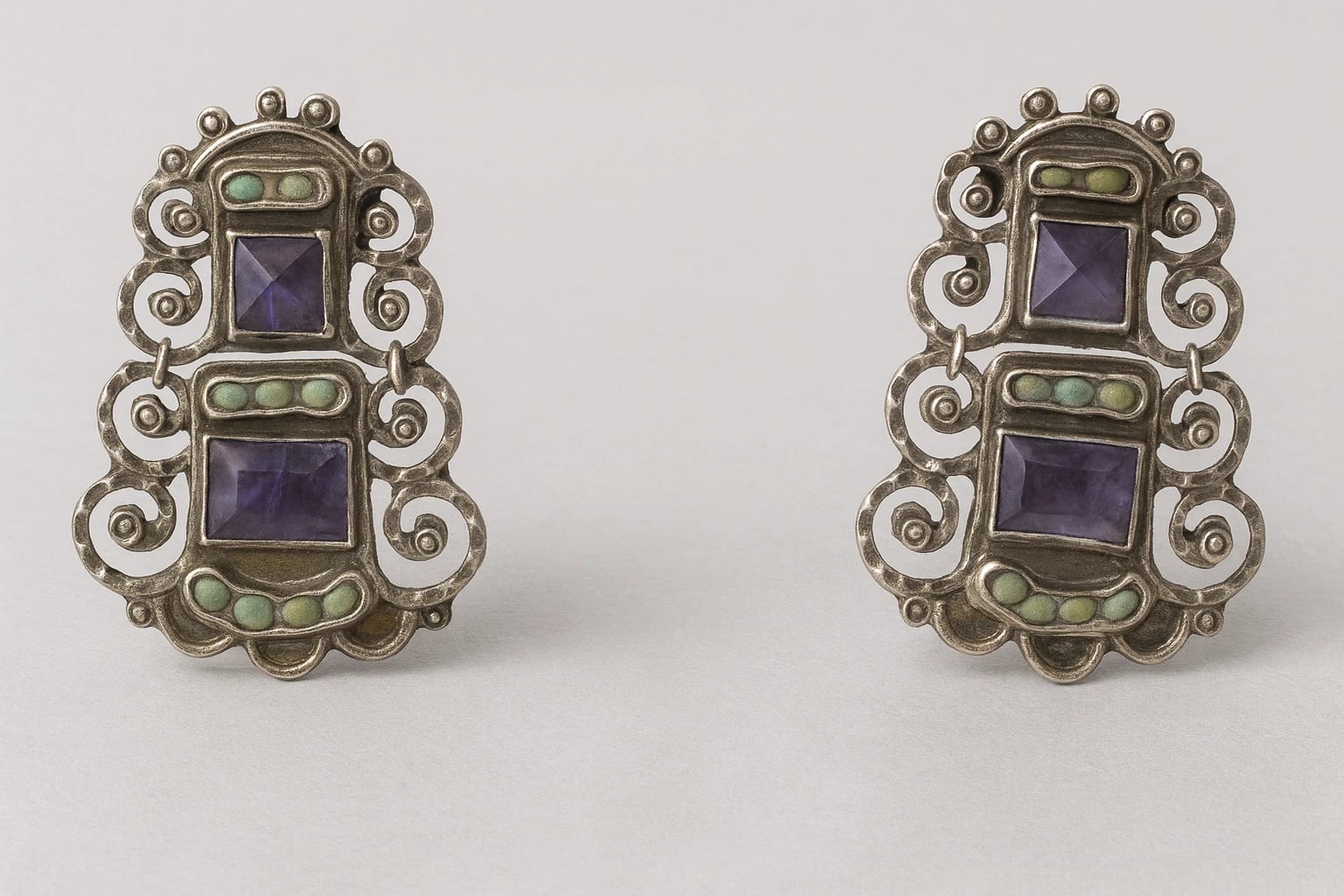
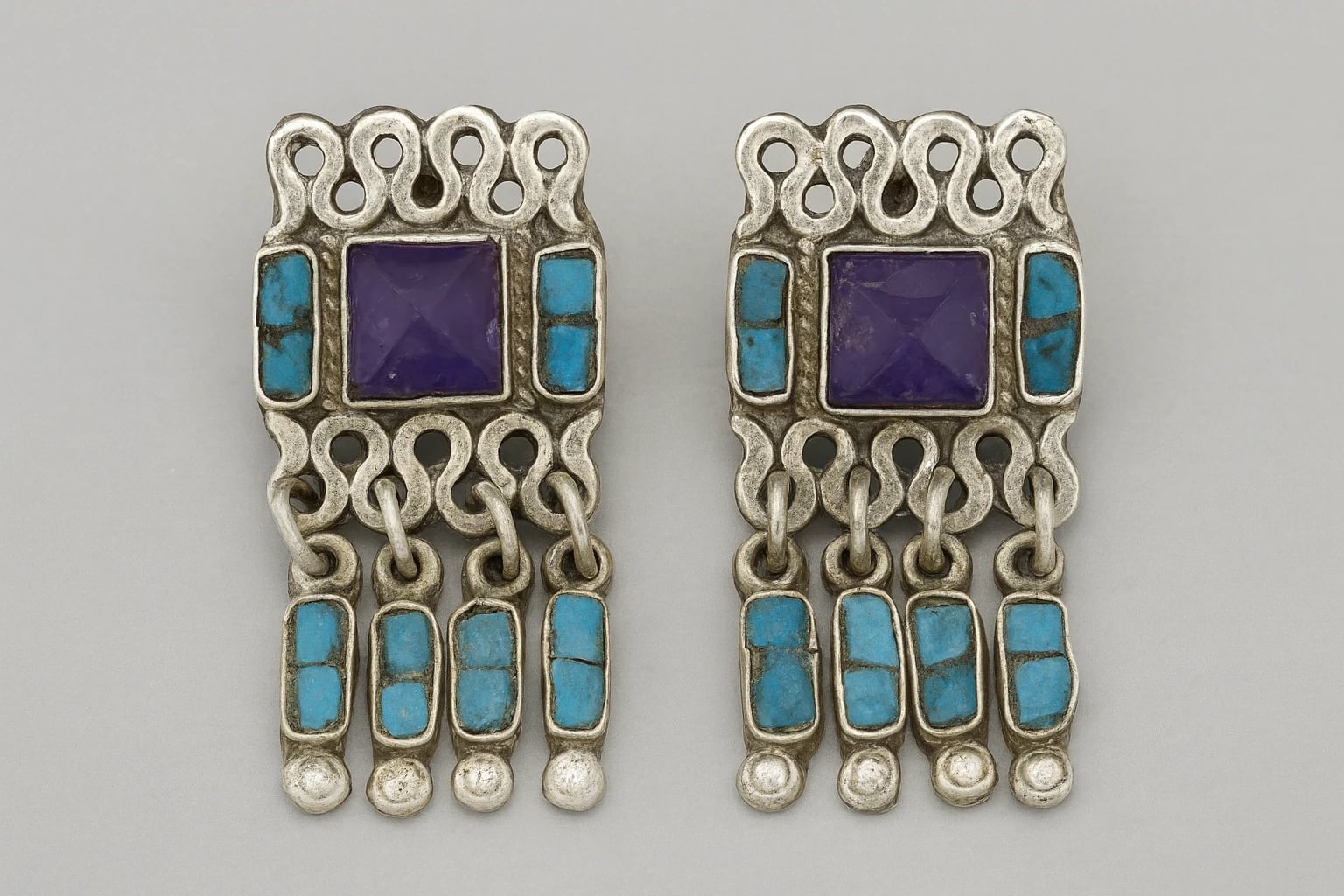
A pair of MATL earrings distills Matilde Poulat's ornamental language into a compact rectangular field, where turquoise and amethyst are set against silver in the dense, symmetrical manner that made her workshop recognizable across the Mexican silver renaissance. The rectangle is an unusual discipline for a designer whose vocabulary tended toward curved and radiating forms. Contained within a straight-edged border, the stones and silverwork read as a small panel of color and pattern rather than as a pendant or a spray, and the format lets the eye register the relationship between the cool blue-green of turquoise and the violet of amethyst as a deliberate pairing.
The color logic is the heart of the design. Turquoise, opaque and matte even when polished, sits against amethyst, which is transparent and takes light through its body. Poulat's work characteristically combined these two stones, and the contrast is not decorative accident but the organizing principle: one stone holds the surface, the other opens it. Silver frames and separates the stones, its reflective ground throwing the turquoise forward while catching light around the amethyst. In a rectangular format the silverwork must do the compositional work that a curved armature would otherwise perform, dividing the field, bordering the stones, and knitting the two colors into a single ornament small enough to hang at the ear.
Matilde Poulat trained as a painter and designer at the Academy of San Carlos before opening her shop in 1934, and her jewelry belongs to the postrevolutionary current that looked to Mexican popular and devotional art rather than to imported modernism. She registered "Matl," a variation of an Aztec word for water, as a trademark, number 142093, and built a folk-inflected style of dense stonework, birds, flowers, and hearts that stood apart from the austere geometry associated with Taxco. Her earliest fineness marks read MATL over 0.900, with later stamps in script carrying 0.925 or 0.950 and the phrase Hecho en Mexico. After her death in 1960 the designs continued under her nephew Ricardo Salas, who added his own marks, so that the MATL name spans several decades of production and requires attention to the specific stamp before a date is assigned to any one object.
The earrings belong to that long MATL tradition rather than to a single documented moment, and their value lies in how efficiently they carry Poulat's ideas at small scale. Where her larger brooches and pendants can spread color across an elaborate silver structure, the rectangular earring compresses the same turquoise-and-amethyst dialogue into a form the body wears in motion. For a collection tracing the Mexican silver renaissance beyond the geometric Taxco School, they document the alternative path Poulat opened: a jewelry rooted in Mexican popular ornament, organized around the meeting of an opaque stone and a transparent one, and sustained by a workshop whose designs outlived their author.
Museum of Mexican Silver. “Rectangular Turquoise and Amethyst Earrings.” Catalog no. MoMS-002220. https://museumofmexicansilver.com/pieces/matl-rectangular-turquoise-and-amethyst-earrings
See something wrong with this record? Suggest a correction and the piece details fill in automatically.
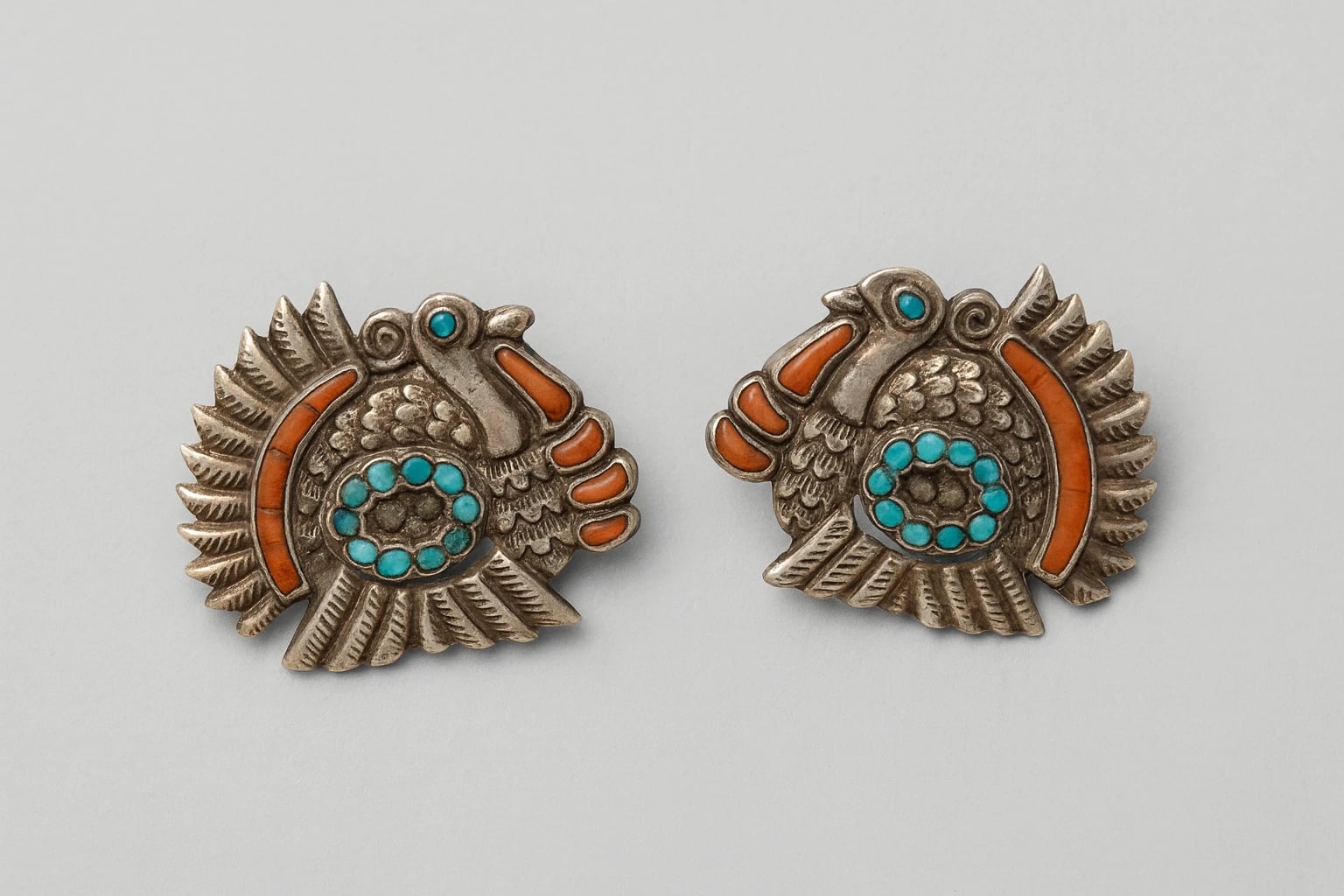
MATL (Matilde Poulat)
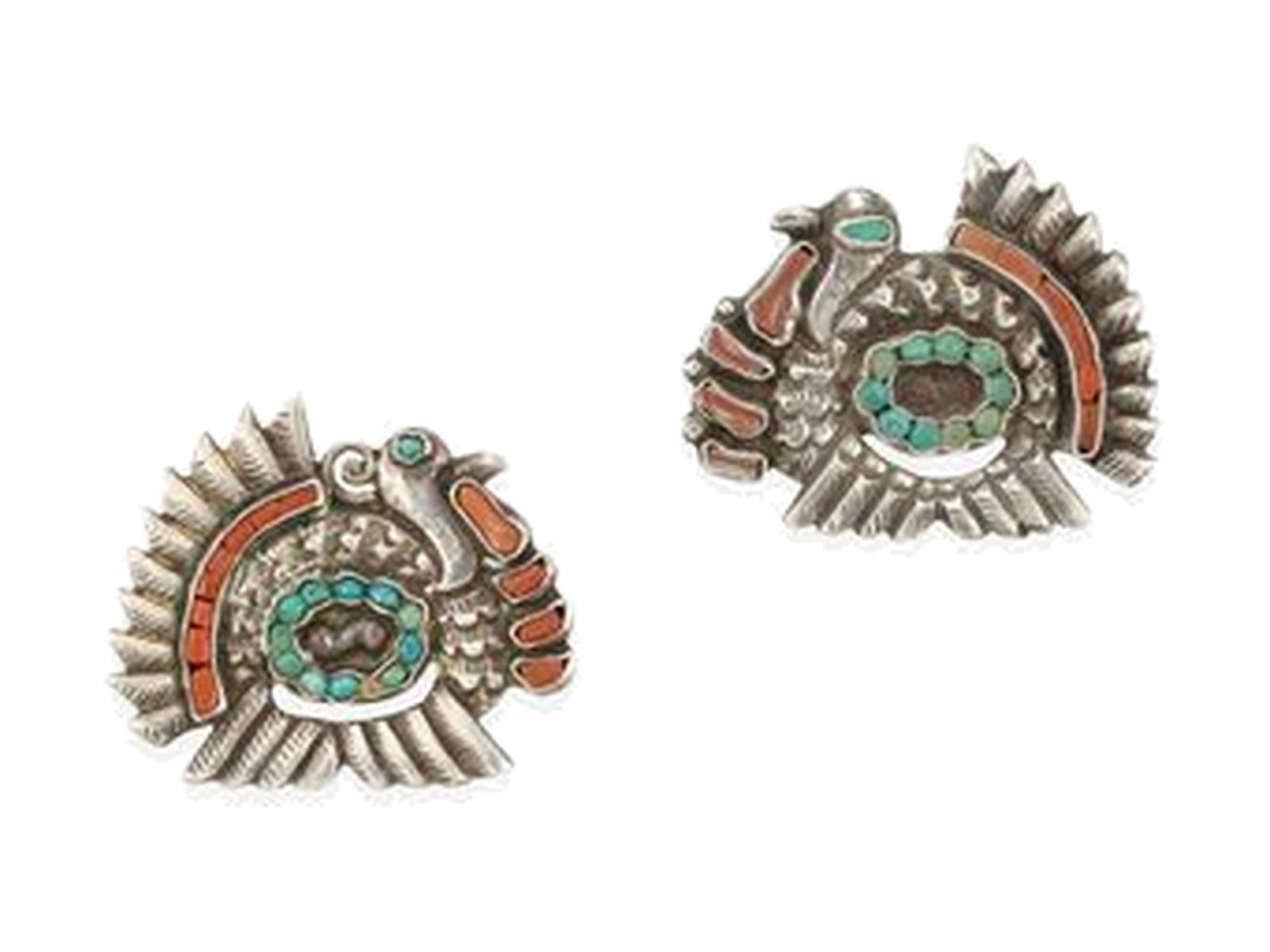
Bird Earrings with Turquoise and Coral
1934 or later
Turquoise