Saves instantly, no account needed. Already a member? Sign in.
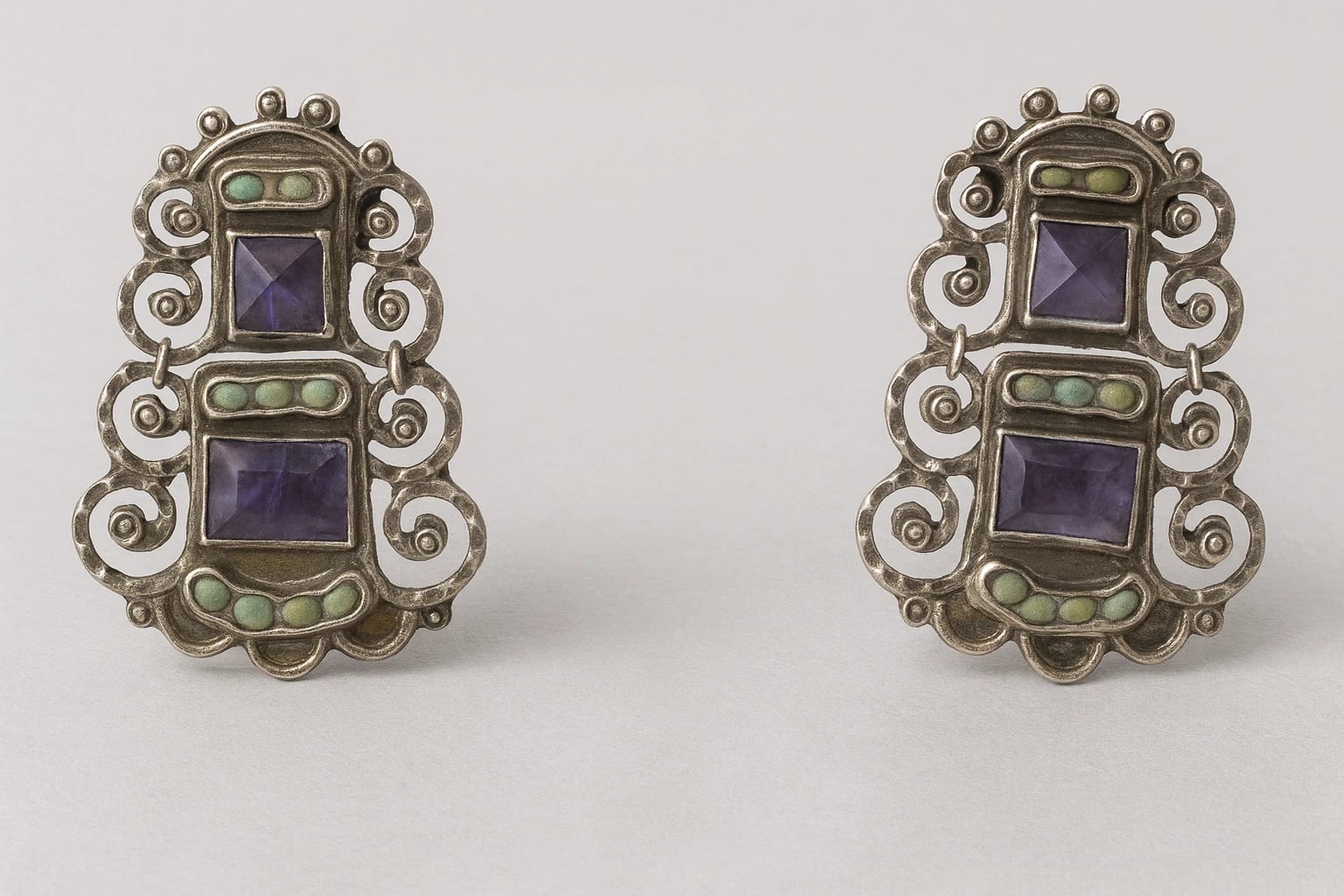
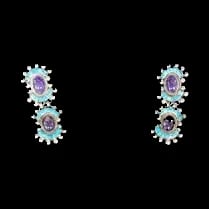
These drop earrings organize MATL color into a compact vertical rhythm. Each earring is built from two clustered elements, a smaller upper form and a larger suspended drop, so that the purple amethyst and blue green turquoise are read not as isolated stones but as a sequence of small, bright centers held within silver borders. At 2 1/2 inches long, the pair has enough length for movement, but the composition remains close and concentrated. The effect is characteristic of the MATL vocabulary: color is not applied as accent alone, but woven into the surface structure of the jewel.
The silver surrounds give the stones a beaded, petaled edge, with small points and rounded passages catching light around the opaque turquoise and translucent violet amethyst. The upper and lower sections repeat the same ornamental grammar at different scales, a device that gives the earrings clarity when worn. They belong with the turquoise and coral drop necklace in this collection, and the suite relationship matters. MATL and MATL Salas jewelry often gains force through accumulated color and repeated motifs, and these earrings condense that larger necklace language into pendant form: a colored center, a silver perimeter, a fringe of small intervals, and a final downward pull.
The stamped marks place the earrings in the post 1960 continuation of the MATL workshop under Ricardo Salas. The sequence read from the objects, “MATL, M.Regis, 14-2093, Mexico, 925, MS-12,” preserves the registered trademark number associated with MATL and the later MS-12 registration used for Salas production. Hougart records this exact combination as the S-3 mark for Ricardo Salas, used from 1980 to 2006, while Morrill explains that after Matilde Eugenia Poulat’s death in 1960 Salas continued producing jewelry in the MATL style and that MS-12, the MATL mark, and Salas’s signature became identifying features of MATL Salas work.
The earrings also carry forward a workshop history that began well before this particular mark. Morrill records that Matilde Poulat introduced MATL in 1934, that her jewelry received international recognition through the 1941 Pan American Union exhibition of Latin American silver in Washington, D.C., and that wartime demand expanded the taller to thirty three silversmiths. In 1950 Poulat and Salas opened a showroom in the same house that held the workshop, and Salas later recalled an astonishing range of designs, including thousands of jewelry types and many religious pieces.
Sold in one lot with the turquoise coral drop necklace in this collection (matl-turquoise-amethyst-necklace-and-earrings), Winter Associates 2023; both stamped 'MATL, M.Regis, 14-2093, Mexico, 925, MS-12'.
Museum of Mexican Silver. “Cluster Drop Earrings with Turquoise and Amethyst.” Catalog no. MoMS-002200. https://museumofmexicansilver.com/pieces/matl-turquoise-amethyst-drop-earrings
See something wrong with this record? Suggest a correction and the piece details fill in automatically.
Within that history, these earrings are not early Matilde Poulat pieces, and their importance should be understood differently. They document the survival and adaptation of a distinctive Mexico City MATL language under Ricardo Salas, especially its preference for dense silver borders, saturated stone color, and a scale that joins devotional, popular, and modern decorative sensibilities. Morrill notes the workshop’s use of coral, turquoise, and amethyst quartz as part of its colorful surface language, and these earrings show how that language remained legible in later sterling production. They add to the collection a precise example of continuity: a late MATL Salas jewel that keeps the workshop’s ornamental intelligence active in the years after the central decades of the Mexican silver renaissance.
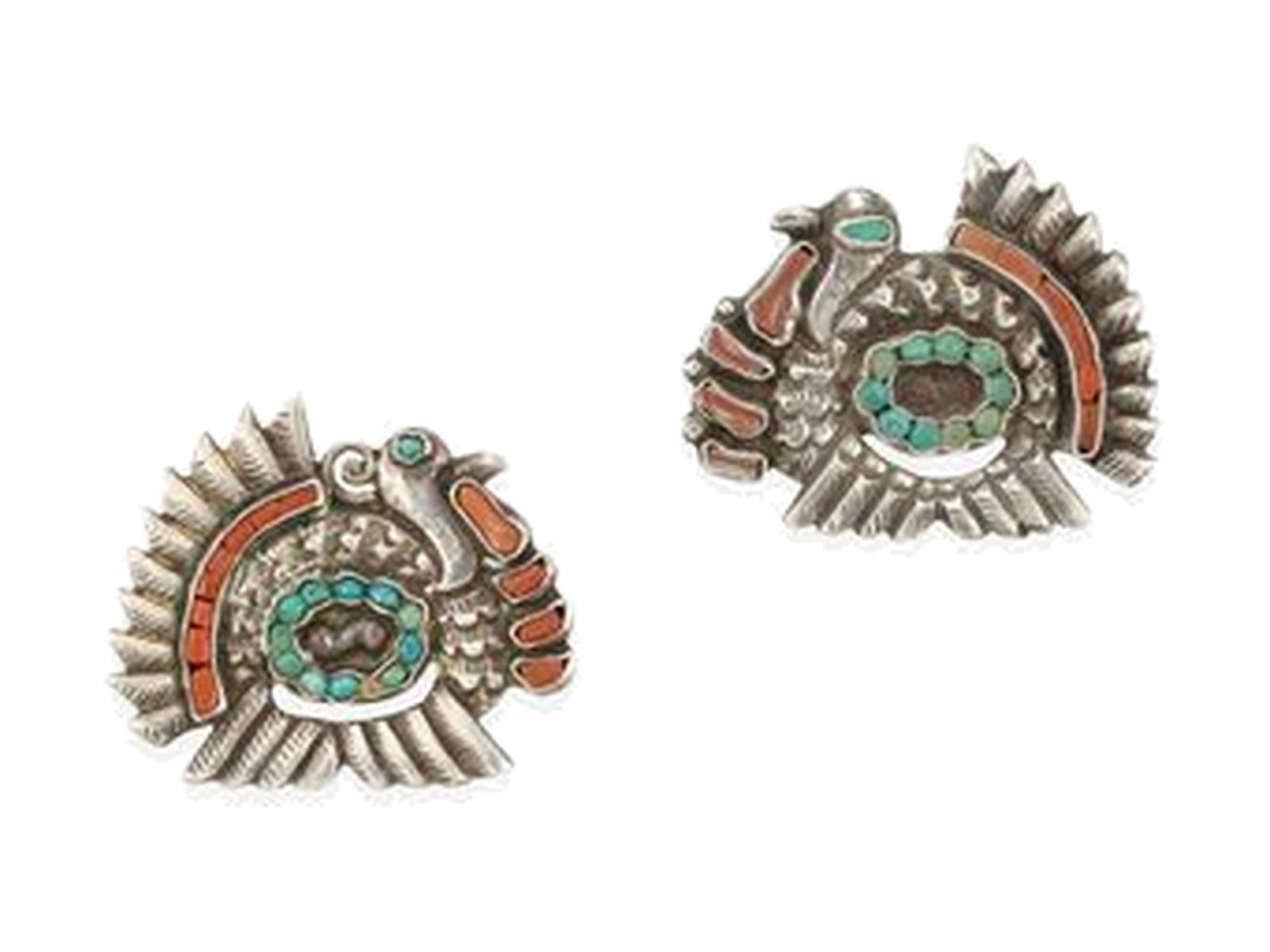
MATL (Matilde Poulat)
Turkey Earrings with Turquoise and Coral
1934 or later
Turquoise