Saves instantly, no account needed. Already a member? Sign in.
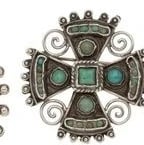
A small silver cross packed with color, this brooch condenses the devotional imagery of Mexican colonial ornament into a dense, symmetrical composition of scrolls and set stones. The cross is built from tightly coiled silver scrollwork that fills the arms and center, so the metal reads less as a plain crucifix than as a garden of curling tendrils. Turquoise anchors the color, its opaque blue set against warmer accents, and the whole surface is organized around a bilateral symmetry that gives the small object the presence of a much larger devotional piece. This is the visual language for which Matilde Poulat, working under the mark MATL, became known: religious and folk motifs rendered in curling silver wire and clustered stones.
The design depends on the interplay between the busy metalwork and the punctuation of the stones. Scrollwork of this kind, sometimes called filigree in a loose sense though here it functions as applied wirework, creates a restless, light-catching ground across the entire cross. Against that field, the turquoise cabochons hold still as fixed points of saturated color, and the secondary stones introduce a contrasting warmth that keeps the palette from settling into a single note. The symmetry is strict, arm answering arm and the vertical axis mirrored left to right, which is what allows so much ornamental incident to remain legible rather than chaotic. Color and metal are not separable decorative choices here. The stones give the silver its rhythm, and the silver gives the stones their frame.
Poulat trained as a painter and designer at the San Carlos Academy, the same institution that shaped Diego Rivera, and she opened her Mexico City shop in 1934. The MATL name, registered as trademark number 142093, drew on an Aztec word for water, and the workshop's output looked deliberately to Mexican sources rather than to imported European modernism. Where much of the Taxco renaissance pursued streamlined geometry, Poulat pursued a self-consciously folkloric and colonial vocabulary: crosses, birds, flowers, and hearts elaborated in scrollwork and native turquoise and coral. Her nephew Ricardo Salas worked alongside her throughout her career and continued the MATL designs after her death in 1960, so this cross belongs to a design tradition that outlived its originator and remained in production under the same famous mark. The precise date of this example depends on its hallmark, since the early script MATL stamps span 1934 to 1948 while later registration and Salas-period marks carry the work forward for decades.
Museum of Mexican Silver. “Scrollwork Cross Brooch with Turquoise and Coral.” Catalog no. MoMS-002252. https://museumofmexicansilver.com/pieces/matl-scrollwork-cross-brooch-with-turquoise-and-coral
See something wrong with this record? Suggest a correction and the piece details fill in automatically.
Within a museum collection, the brooch documents a distinct current of the Mexican silver renaissance, one rooted in devotional and popular imagery rather than in imported abstraction. MATL jewelry demonstrates that the movement's modernism included a deliberate return to colonial and folk forms, reworked with a designer's control of symmetry, color, and density. As a compact cross carrying turquoise and secondary stones across a fully worked silver ground, it shows how Poulat translated a painter's eye for composition into a small, wearable object built for saturation rather than restraint.
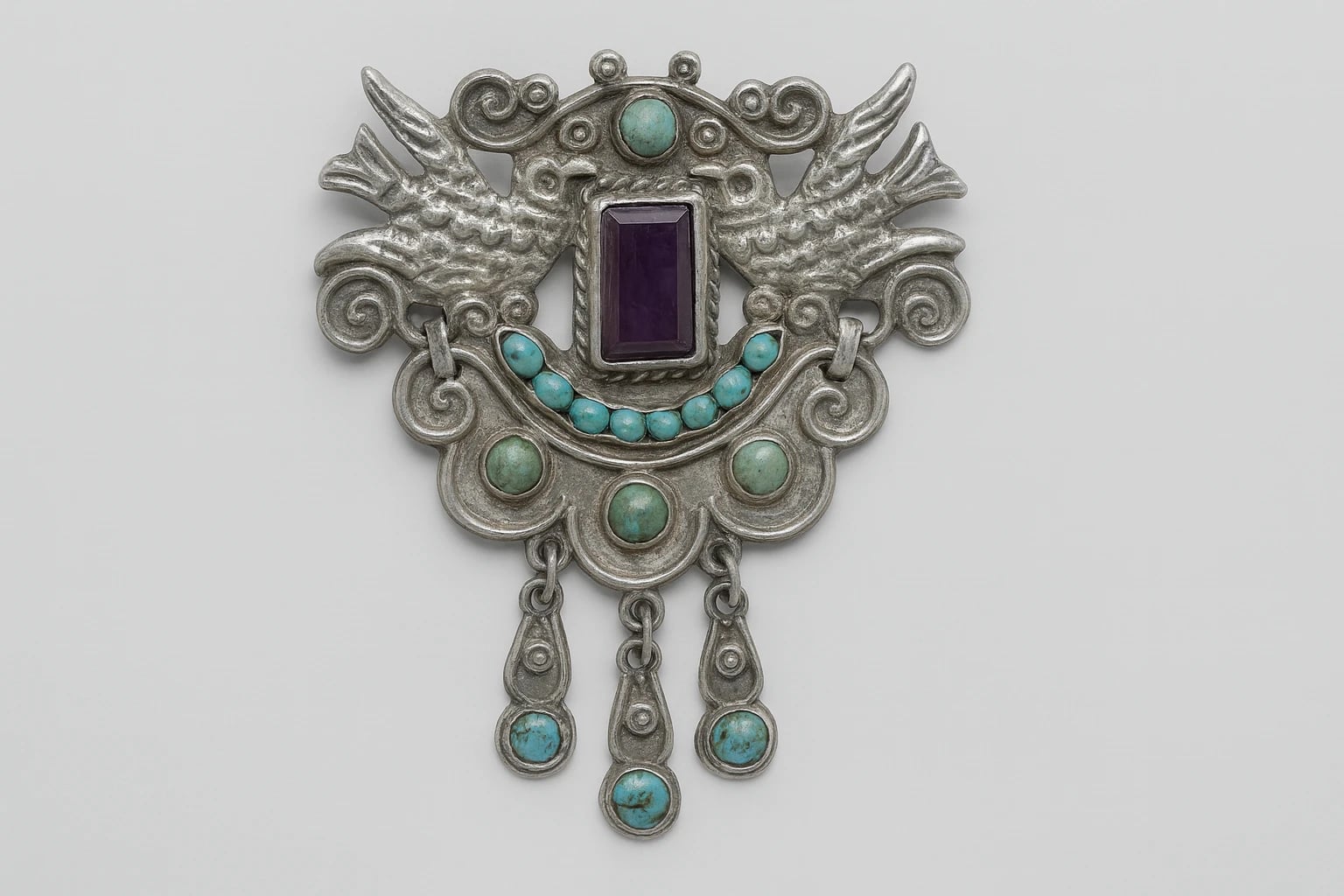
MATL (Matilde Poulat)
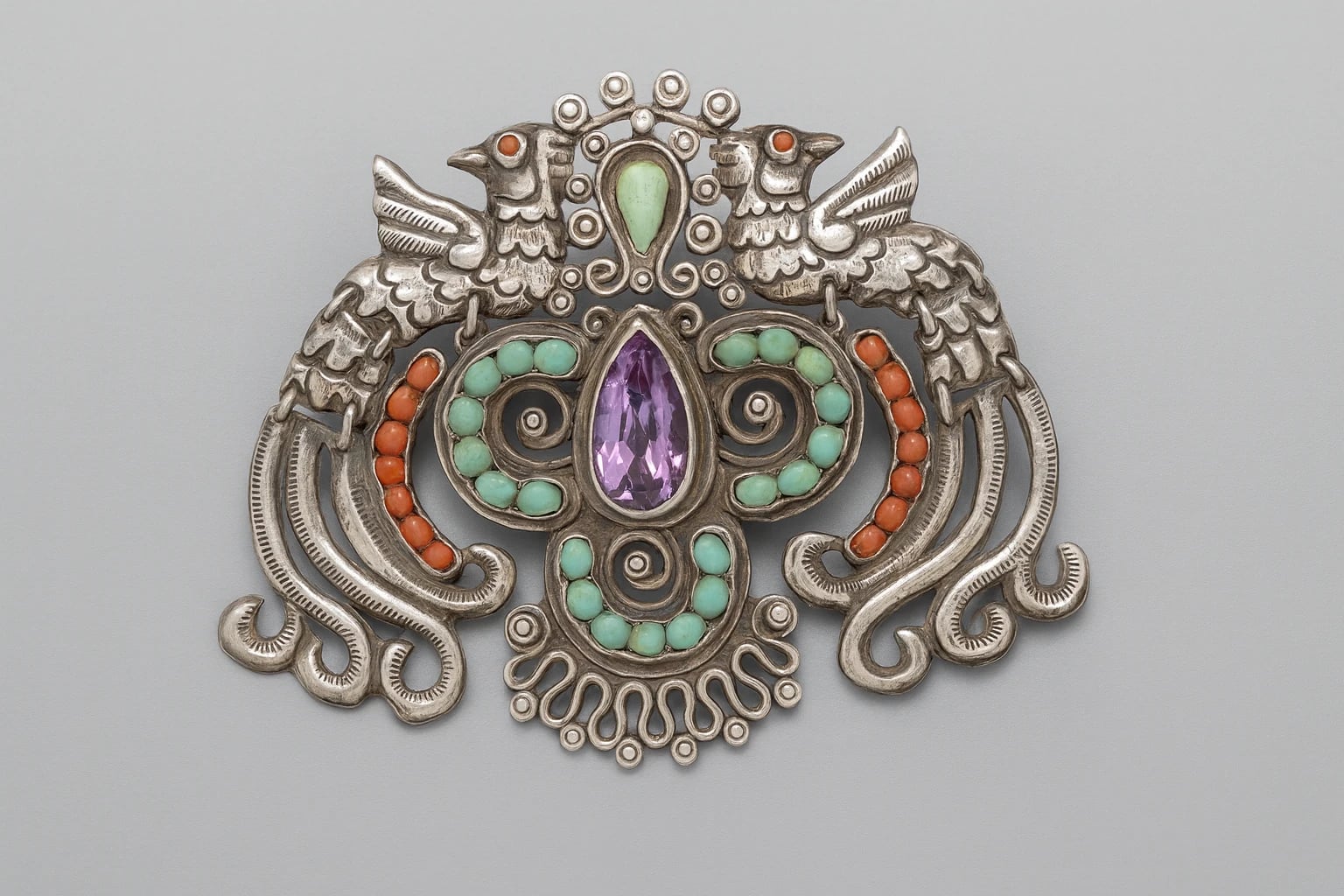
Winged-Dove Medallion Brooch with Turquoise and Amethyst
1934 or later
Turquoise