Saves instantly, no account needed. Already a member? Sign in.
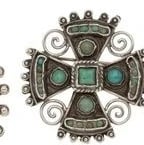
A silver cross barely larger than a thumb, dense with turquoise and set with a small amethyst, this brooch compresses the entire visual argument of Matilde Poulat's workshop into a devotional format. The cross holds firmly to Mexican colonial and popular religious tradition, yet its surface belongs to the twentieth century: cabochon turquoise crowds the arms of the cross, small silver forms curl and bead between the stones, and a single amethyst introduces a note of violet against the blue. The MATL style rarely announces itself through scale. It works instead through concentration, and this piece is a study in how much incident a small object can carry.
The construction follows the workshop's characteristic method of building a dense field from many small elements. Turquoise cabochons are set close together so that stone almost touches stone, and the silver between them is worked into the tight scrolls, tendrils, and beaded droplets that give MATL jewelry its distinctive read. The amethyst functions as a focal accent rather than a centerpiece, its cool purple pulling against the greener and grayer blues of the turquoise. Turquoise carried particular resonance in this idiom, a stone with deep roots in Mexican material culture that Poulat used less for luxury than for color and density. The cross form organizes the composition, but the ornament nearly overtakes the structure, so that the religious silhouette reads at a distance while the eye discovers the small silverwork only up close.
Matilde Eugenia Poulat trained as a painter and designer at the San Carlos Academy before opening her shop in 1934, and the sensibility of a painter survives in this brooch's handling of color and pattern. The name MATL, registered as trademark number 142093, derives from a word associated with water, and the workshop built a folk art vocabulary that stood apart from the Taxco taller system to its south. Poulat worked in Mexico City, and her jewelry drew on colonial religious silver and Mexican popular art rather than on the geometric modernism of Spratling's Las Delicias. Her marks record this early period through the block and script MATL stamps with fineness and the curved "Hecho en Mexico DF." After her death in 1960, her nephew Ricardo Salas continued the designs, and the later Salas production carries the MS-12 registration alongside the famous mark, so the presence or absence of that later stamp separates workshop periods within a continuous style.
Within a museum collection, a small cross brooch documents how the MATL workshop adapted its saturated stone-and-silver manner to an explicitly devotional subject, joining Mexican Catholic imagery to a modern jeweler's love of pattern and color. It shows that the silver renaissance was not confined to Taxco geometry or to secular ornament, and that a Mexico City workshop led by a woman trained as a painter could build a national style out of turquoise, scrollwork, and the cross. The object's value lies in that clarity: it is a compact, characteristic statement of an idiom that collectors have long recognized by its density and its color, made legible here at the scale of a single religious emblem.
Museum of Mexican Silver. “Small Cross Brooch with Turquoise.” Catalog no. MoMS-002251. https://museumofmexicansilver.com/pieces/matl-small-cross-brooch-with-turquoise
See something wrong with this record? Suggest a correction and the piece details fill in automatically.
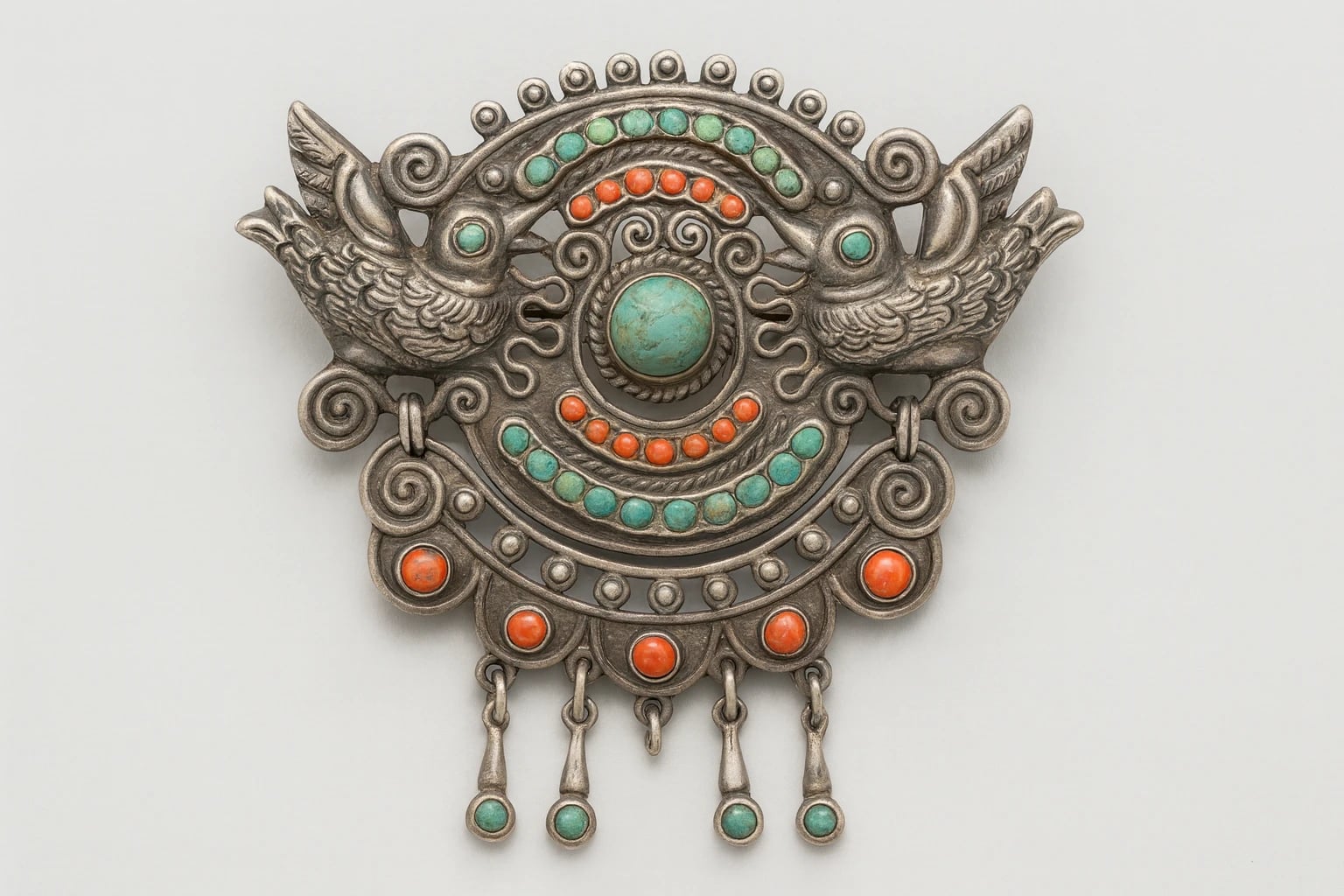
MATL (Matilde Poulat)
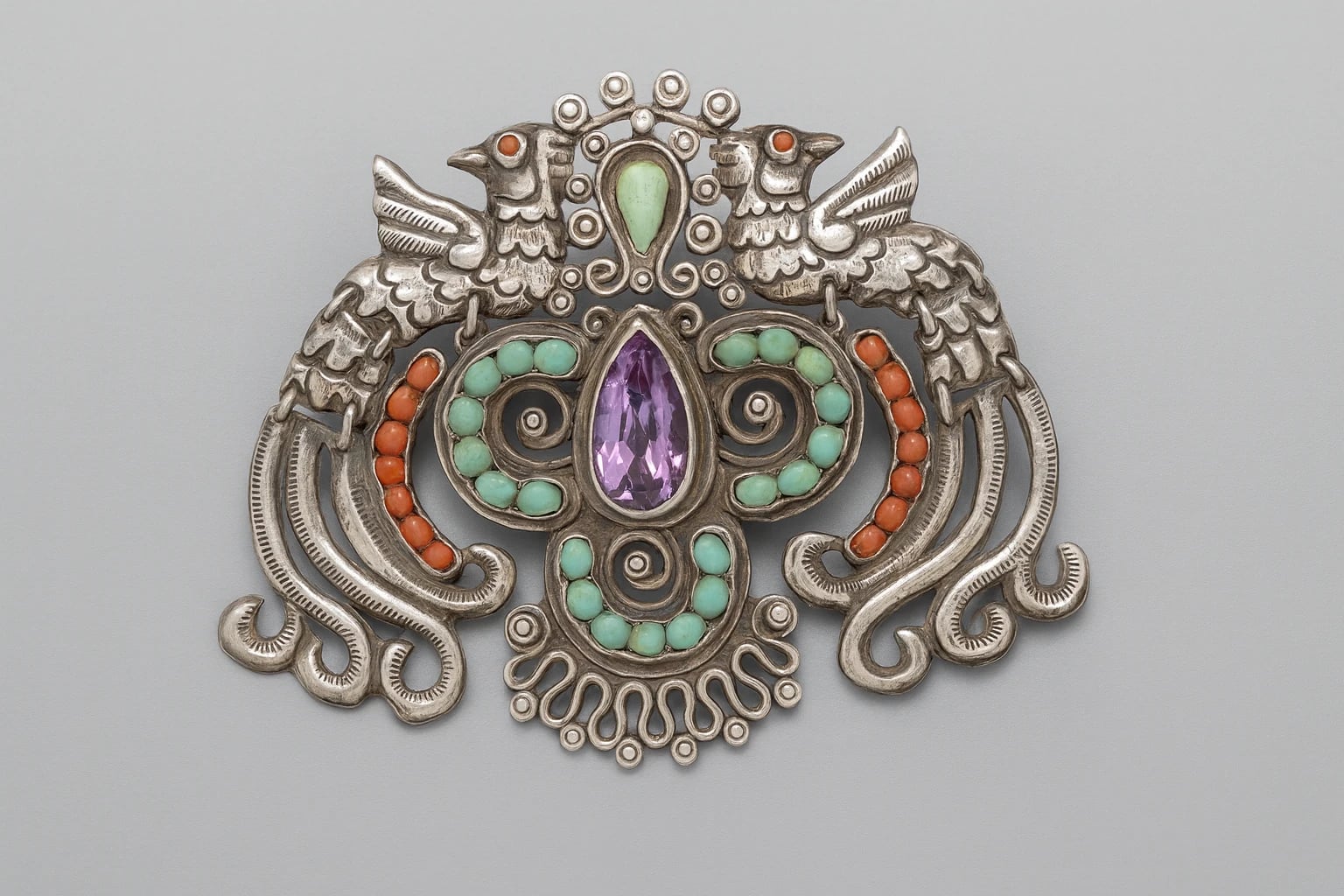
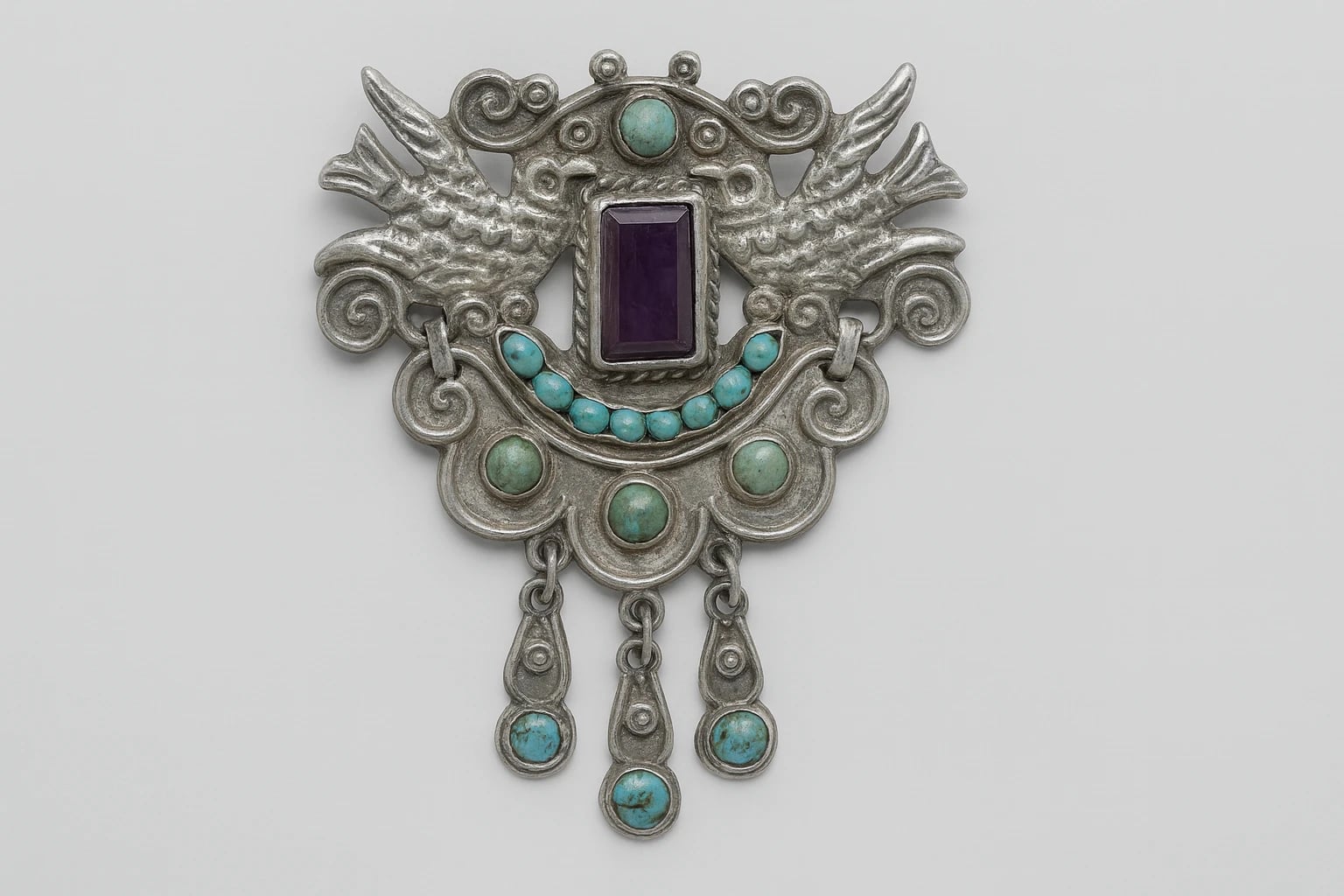
Paired-Dove Medallion Brooch with Turquoise and Coral
1934 or later
Turquoise