Saves instantly, no account needed. Already a member? Sign in.
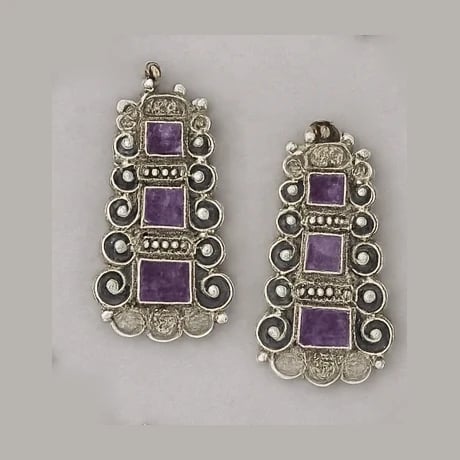
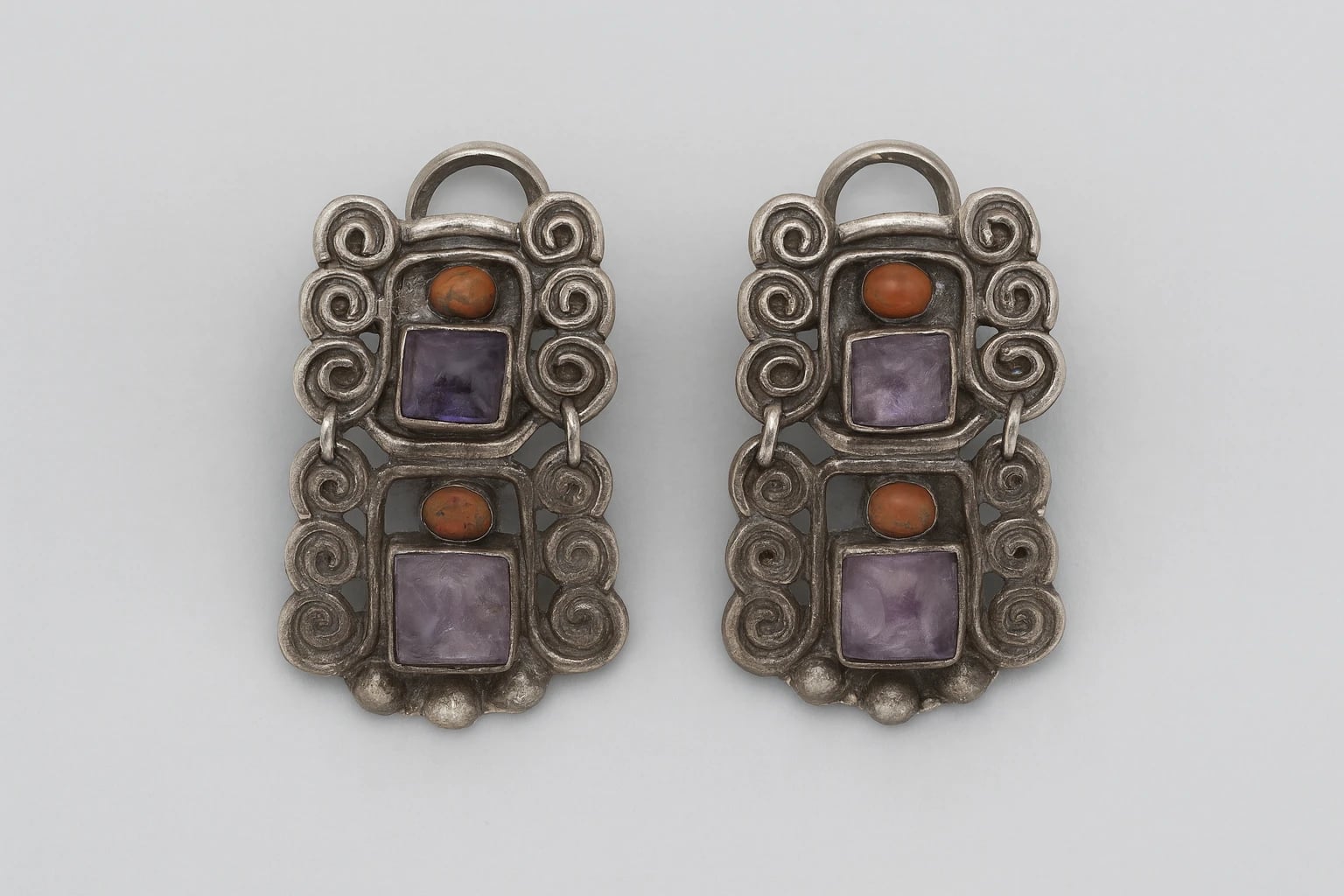
These MATL clip earrings compress the language of the accompanying cuff into two small architectural panels. Each earring is organized as a vertical rectangle with openwork passages, two square-cut amethysts, and small coral cabochons held within a scrolled repoussé frame. The form is compact, but not simplified. Silver curls around the stones in repeated volutes, then opens into small pockets of shadow, so that the surface alternates between metal, color, and void. As a pair, the earrings show how the MATL workshop could translate an ornate vocabulary across scale: the cuff gives the design a broader horizontal field, while the earrings concentrate the same visual density close to the face.
The stones are important to that concentration. The amethysts sit as squared points of violet color within a silver setting that otherwise favors curves, beads, and scrolling movement. Their cut gives the earrings a measured geometry, a quiet counterweight to the soft relief of the metal. The coral cabochons work differently. They are small, rounded notes of red set into the frame rather than dominant centers, and their opacity strengthens the contrast with the cooler translucency of the amethyst. Morrill and Berk observed that MATL silver often introduced color through coral, turquoise, and amethyst quartz, with surfaces enriched by applied wire, embossing, and repoussé. These earrings belong to that same material intelligence. Color is not applied as an afterthought. It is distributed through the construction and used to keep the silver surface active.
MATL was the mark of Matilde Eugenia Poulat, who introduced it in 1934, and the workshop’s history is inseparable from the collaboration and continuation of her nephew Ricardo Salas. Hougart records the MATL mark under Matilde Eugenia Poulat and also connects it to Ricardo Salas, noting eagle numbers 1, 123, and 129, and the later registration MS-12. Morrill and Berk describe Poulat’s jewelry and religious silver as part of a postrevolutionary search for Mexican aesthetic sources, especially the Mixtec gold jewelry discovered at Monte Albán in 1932, while also noting the appeal of flowers, doves, and small bells associated with Mexican popular art. The earrings do not reproduce a single archaeological motif in a literal way. Their importance lies in the way a Mixtec-inflected love of dense surface, color, and rhythmic ornament is reorganized into a wearable modern object.
The clip mechanism places the earrings within the social world of mid-twentieth-century adornment, when Mexican silver moved between local workshop practice, Mexico City retail culture, international visitors, and collectors who recognized the difference between souvenir silver and serious design. MATL occupied a distinctive position within that world. Its work was not the stripped geometry often associated with Taxco modernism, nor was it simply revivalist ornament. These earrings show another current within the Mexican silver renaissance: a modernism of elaboration, close detail, and saturated surface. In the Museum’s collection, their connection to the larger cuff is especially useful. Together, the pieces demonstrate how the MATL workshop treated a suite not as repetition alone, but as a change of tempo from wrist to ear, from broad band to concentrated panel.
Sold in one lot with the amethyst coral bracelet in this collection (matl-amethyst-coral-bracelet), Ripley Auctions 2016; the as-sold photo showed the full set.
Museum of Mexican Silver. “Rectangular Clip Earrings with Amethyst and Coral.” Catalog no. MoMS-002197. https://museumofmexicansilver.com/pieces/matl-amethyst-coral-clip-earrings
See something wrong with this record? Suggest a correction and the piece details fill in automatically.
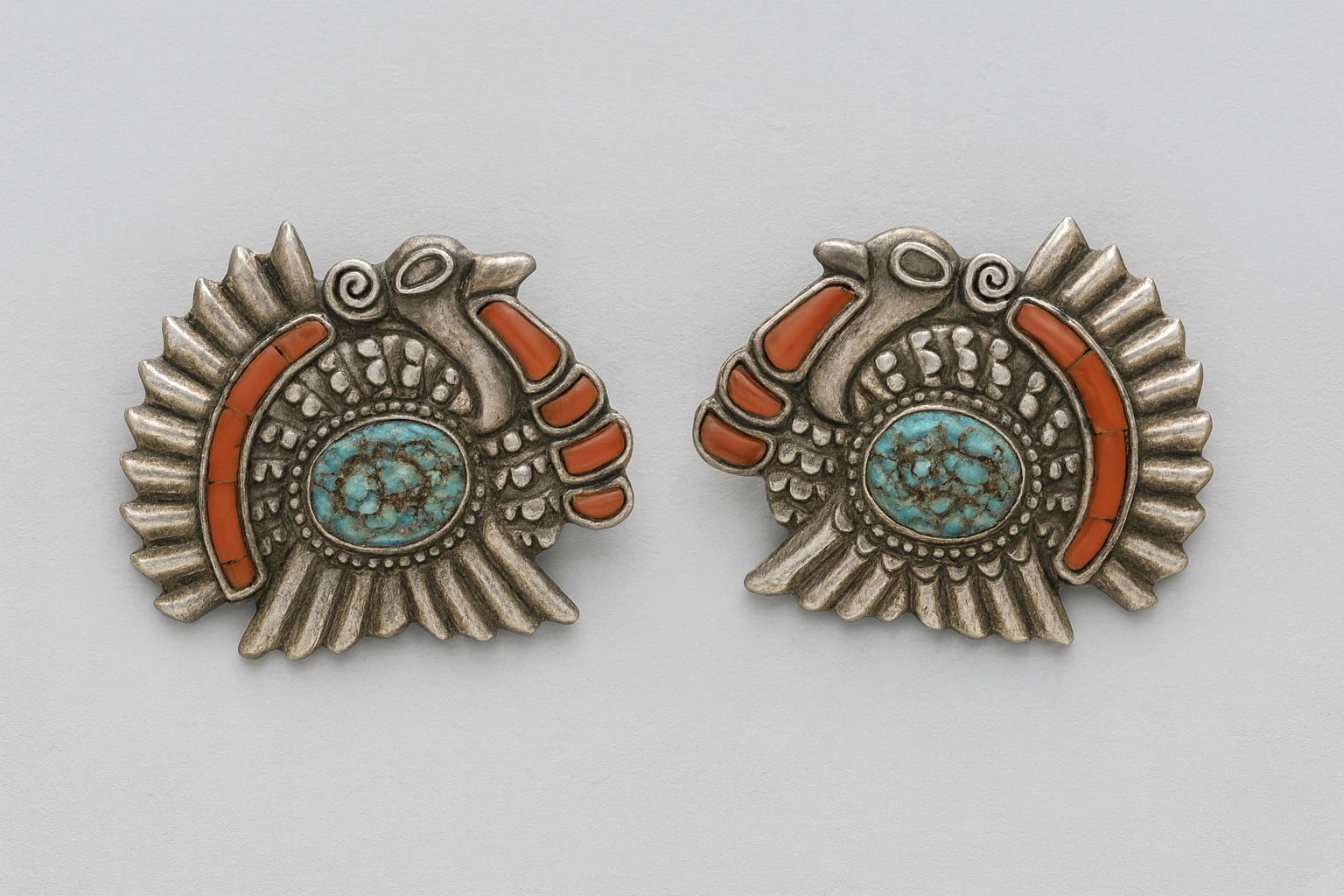
MATL (Matilde Poulat)
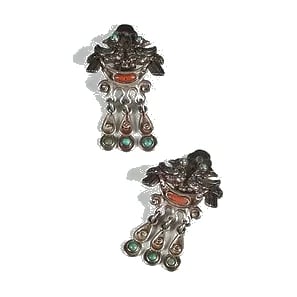
Turkey Earrings
1934 or later
Silver