Saves instantly, no account needed. Already a member? Sign in.
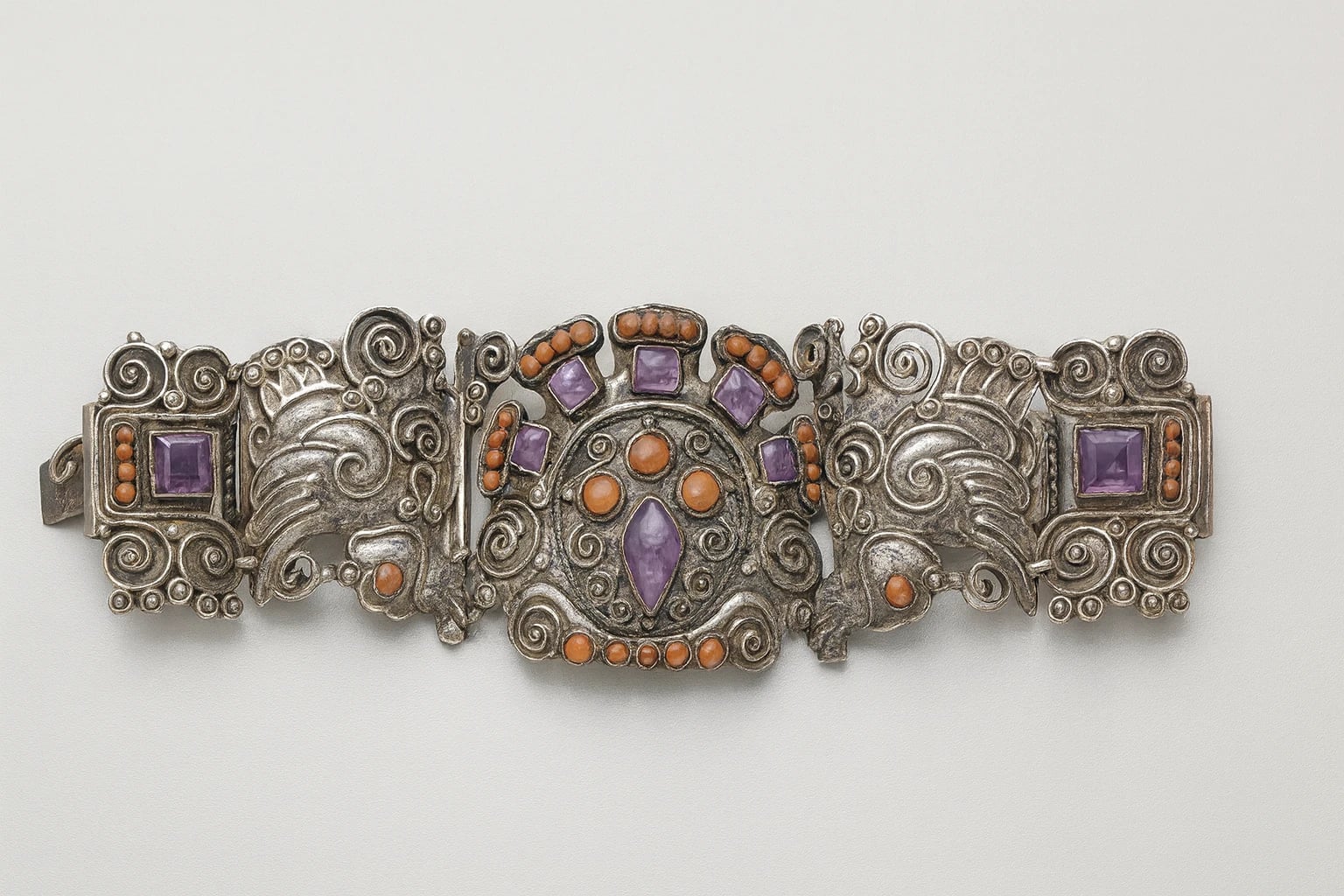
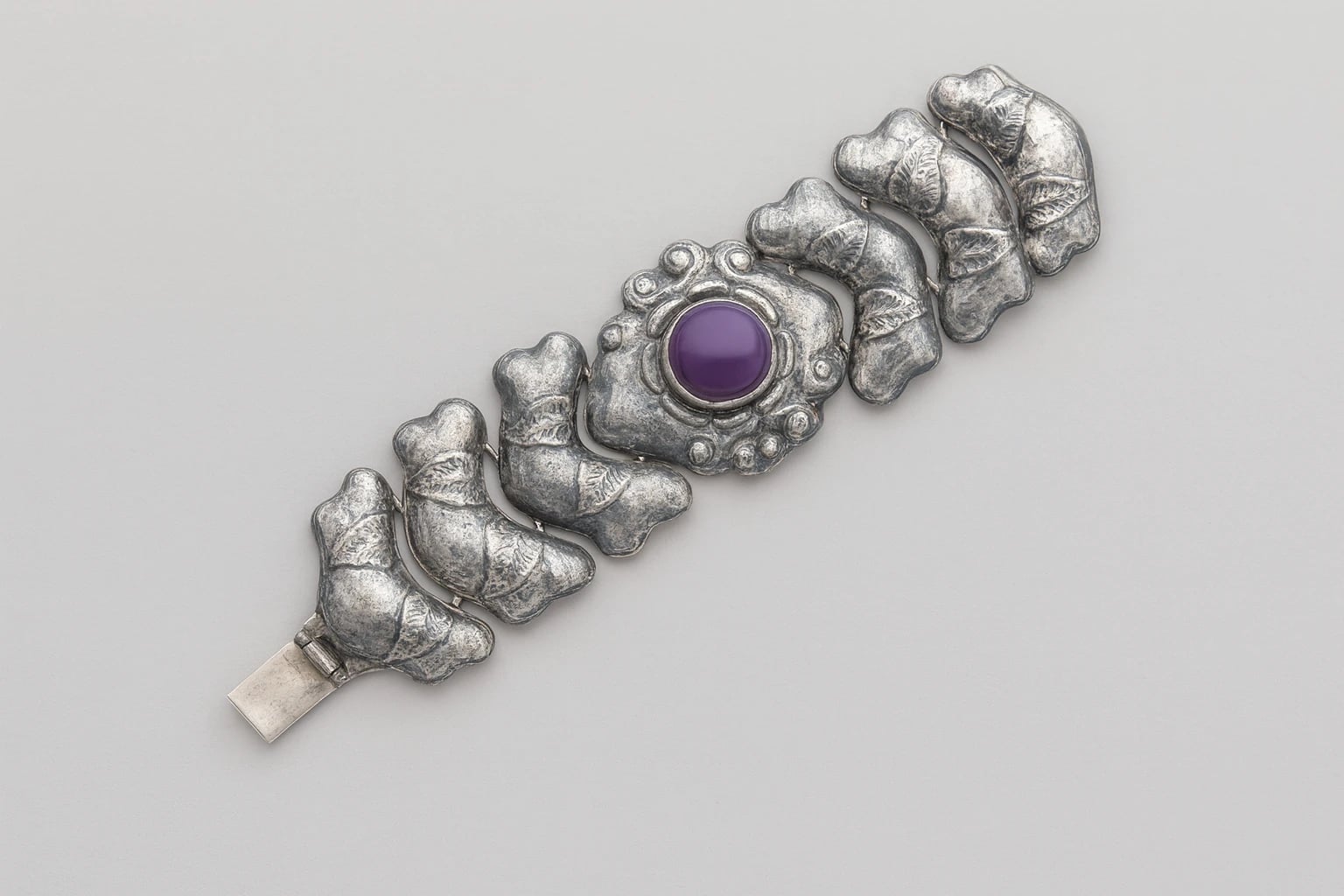
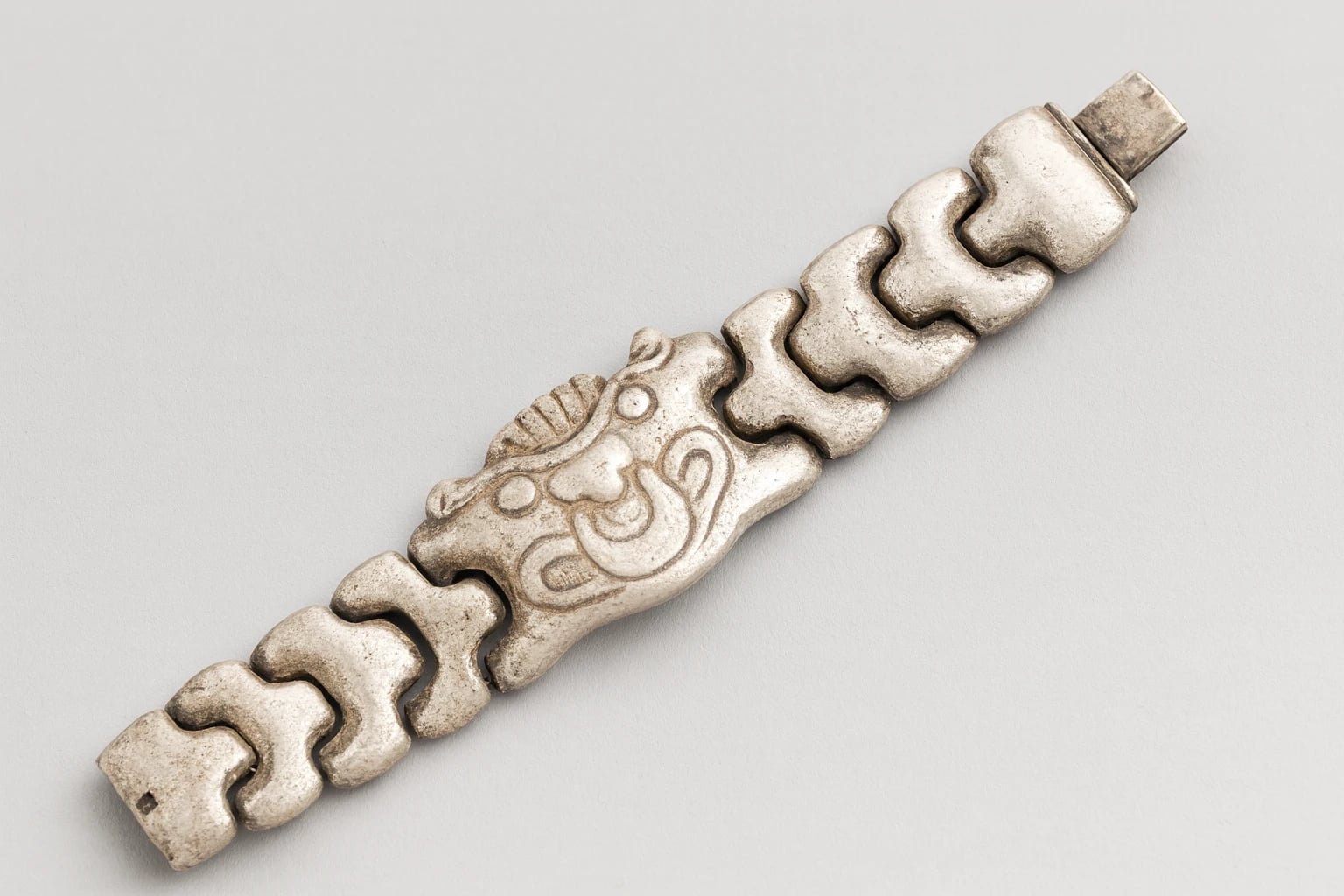
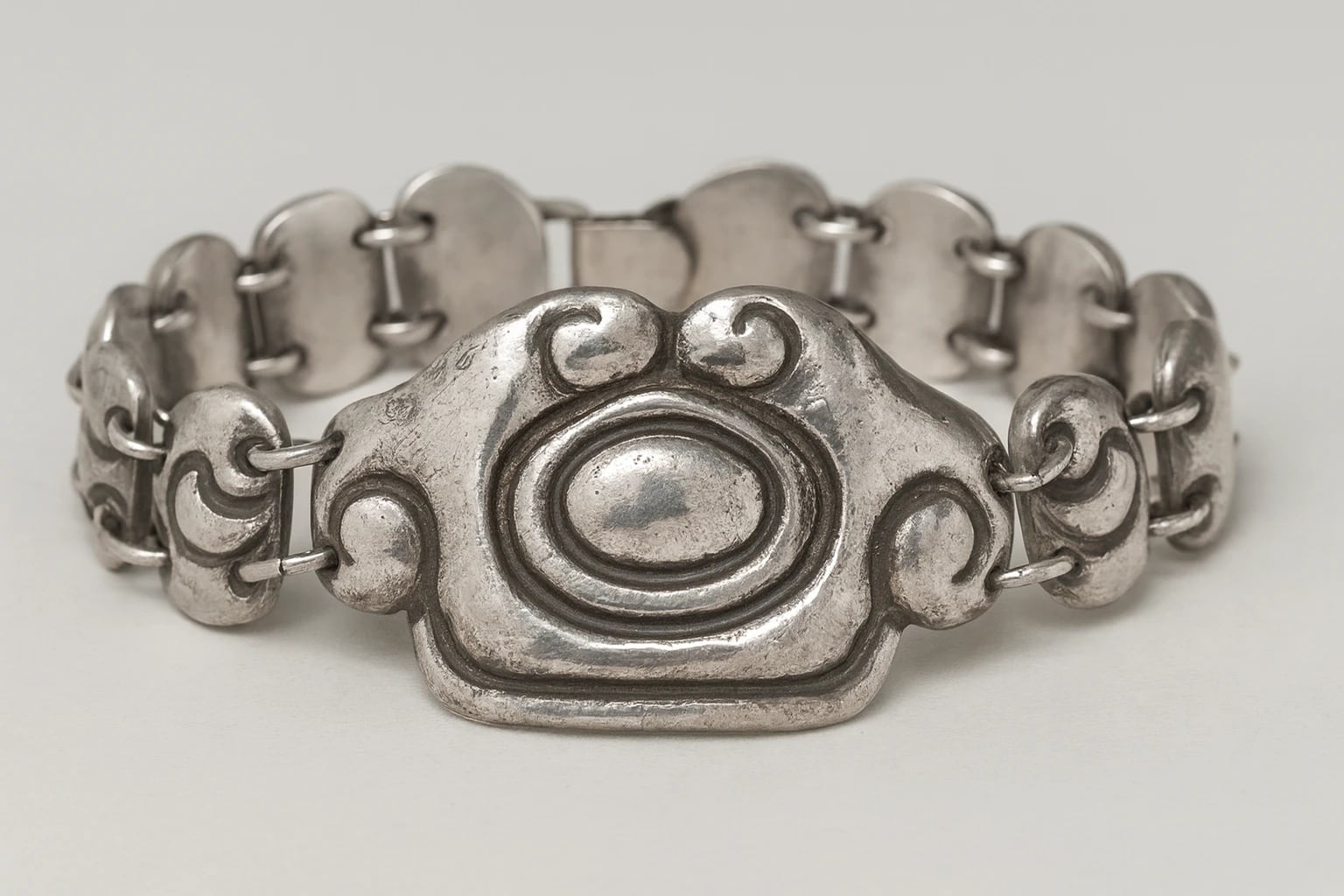
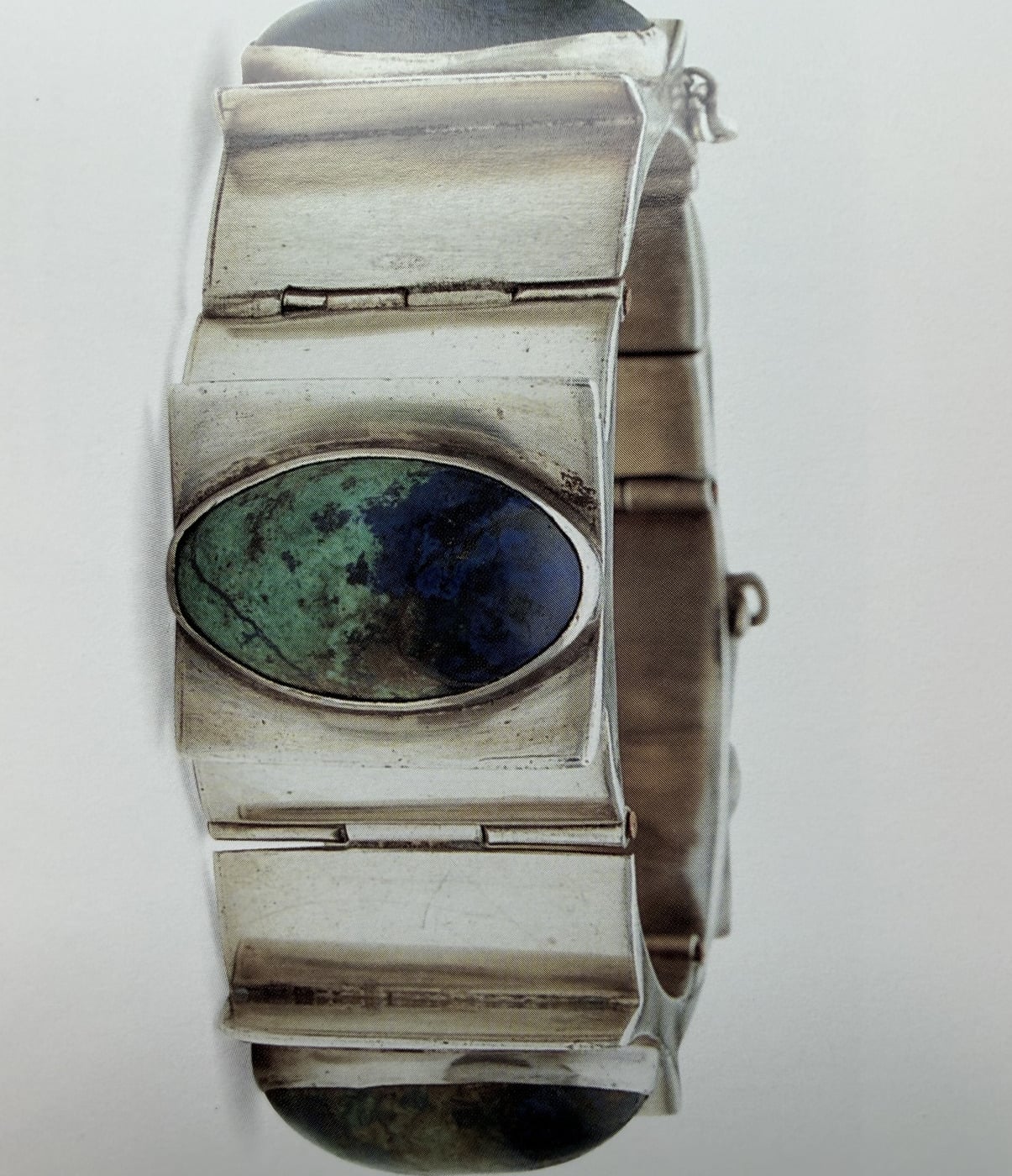
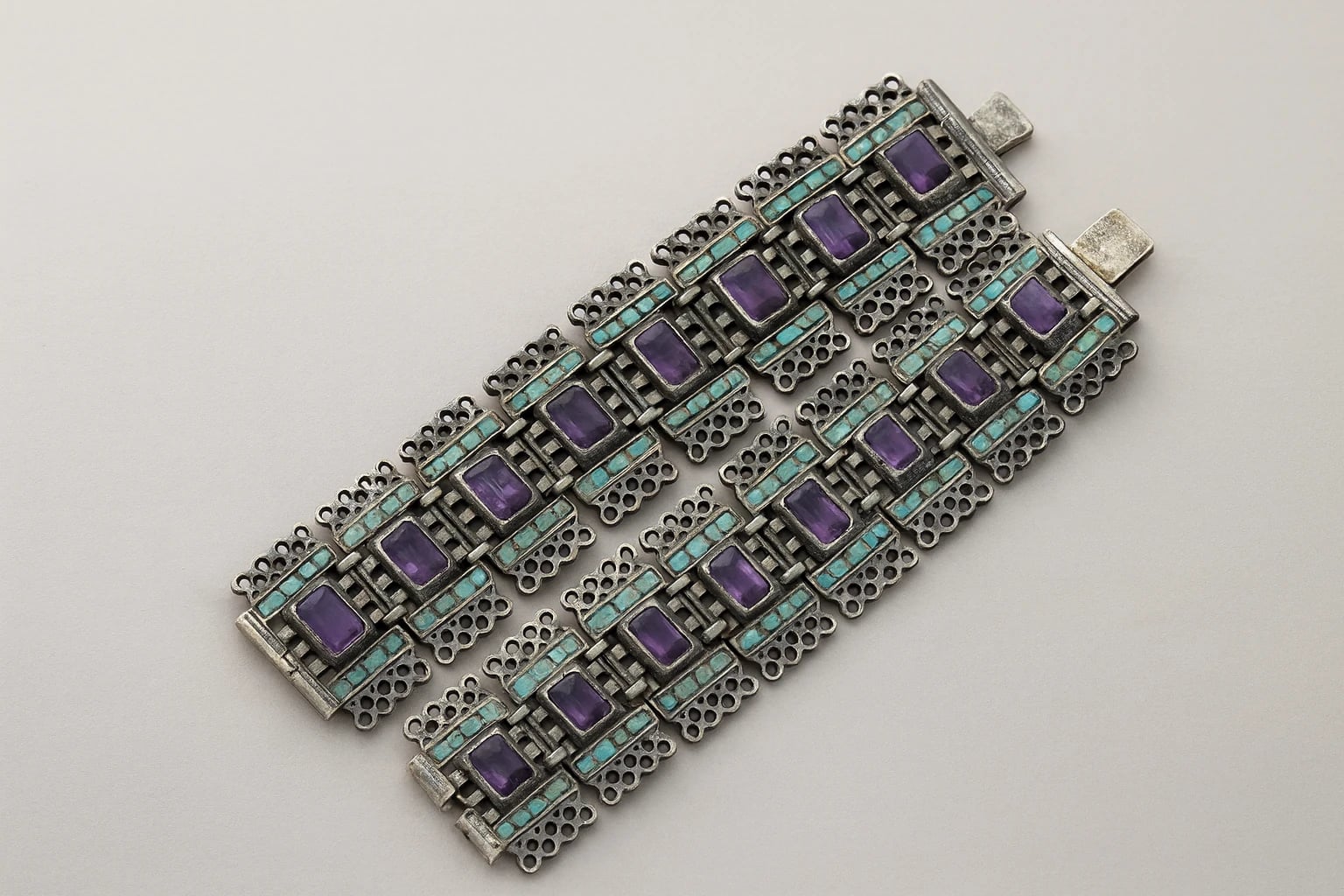
A row of rectangular stations, each set with turquoise and framed by dense silverwork, gives this bracelet its structure and its rhythm. The wide band reads as a sequence of small pictorial panels linked into a continuous surface, a format that lets the eye move station to station while the whole encircles the wrist. Color does the organizing work here: opaque blue-green turquoise anchors each unit, while amethyst introduces a cooler violet accent that interrupts the repetition without breaking it. This is the compositional logic that made the MATL workshop recognizable, a folk-derived ornament controlled by a designer trained as a painter.
The bracelet's density is deliberate. Rather than isolating stones against clear metal, the design surrounds each setting with scrolling and beaded silver, so that the turquoise sits within an active field rather than on a plain ground. The alternation of turquoise and amethyst sets up two registers of color and two degrees of transparency, the turquoise flat and mineral, the amethyst catching light through its facets. A wide station bracelet of this kind carries considerable visual weight across the top of the wrist, and the repetition of framed cabochons builds a horizontal momentum that a single centered ornament could not. The ornament is not applied decoration over a plain band; the settings and their silver surrounds are the structure.
Matilde Poulat, who trained at the San Carlos Academy and worked first as a painter and designer, opened her shop in 1934 and registered the name MATL, drawn from a Nahuatl word associated with water, as trademark number 142093. Her jewelry drew on Mexican colonial and popular religious imagery, doves, flowers, hearts, and foliate scrollwork, reworked into a distinctive and consistent decorative language. The pairing of turquoise with amethyst and coral is characteristic of that vocabulary, and the workshop's designs proved durable enough that her nephew Ricardo Salas continued them after her death in 1960, at times supervising several dozen silversmiths. Because the MATL mark spans Poulat's own production and the long continuation under Salas, the date of a given example depends on its specific hallmark rather than on the design alone. The marks recorded in Hougart's reference divide this history: the early script MATL fineness stamps, the registration stamps carrying 142093, and the post-1980 Salas-era stamps that add MS-12 or Salas to the MATL name.
Within the Mexican silver renaissance, the MATL workshop occupies a position distinct from the geometric modernism associated with Taxco. Poulat worked in Mexico City, drew openly on colonial and folk religious sources, and built a decorative rather than reductive idiom. A wide turquoise-and-amethyst station bracelet demonstrates how that idiom was extended from the pictorial brooches for which the workshop is best known into a fully worked band, where the pattern must sustain itself across a repeating format. For a collection tracing the range of the renaissance, the piece marks the ornamental, mestizo-revival current that ran alongside the modernist mainstream, and it shows a painter's sense of color and framing translated into set stone and worked silver.
Museum of Mexican Silver. “Multi-Row Rectangular-Station Bracelet with Turquoise and Amethyst.” Catalog no. MoMS-002212. https://museumofmexicansilver.com/pieces/matl-wide-rectangular-station-bracelet-with-turquoise-and-amethyst
See something wrong with this record? Suggest a correction and the piece details fill in automatically.
MATL (Matilde Poulat)
Graduated Scroll-Link Bracelet
1934 or later
Silver