Saves instantly, no account needed. Already a member? Sign in.
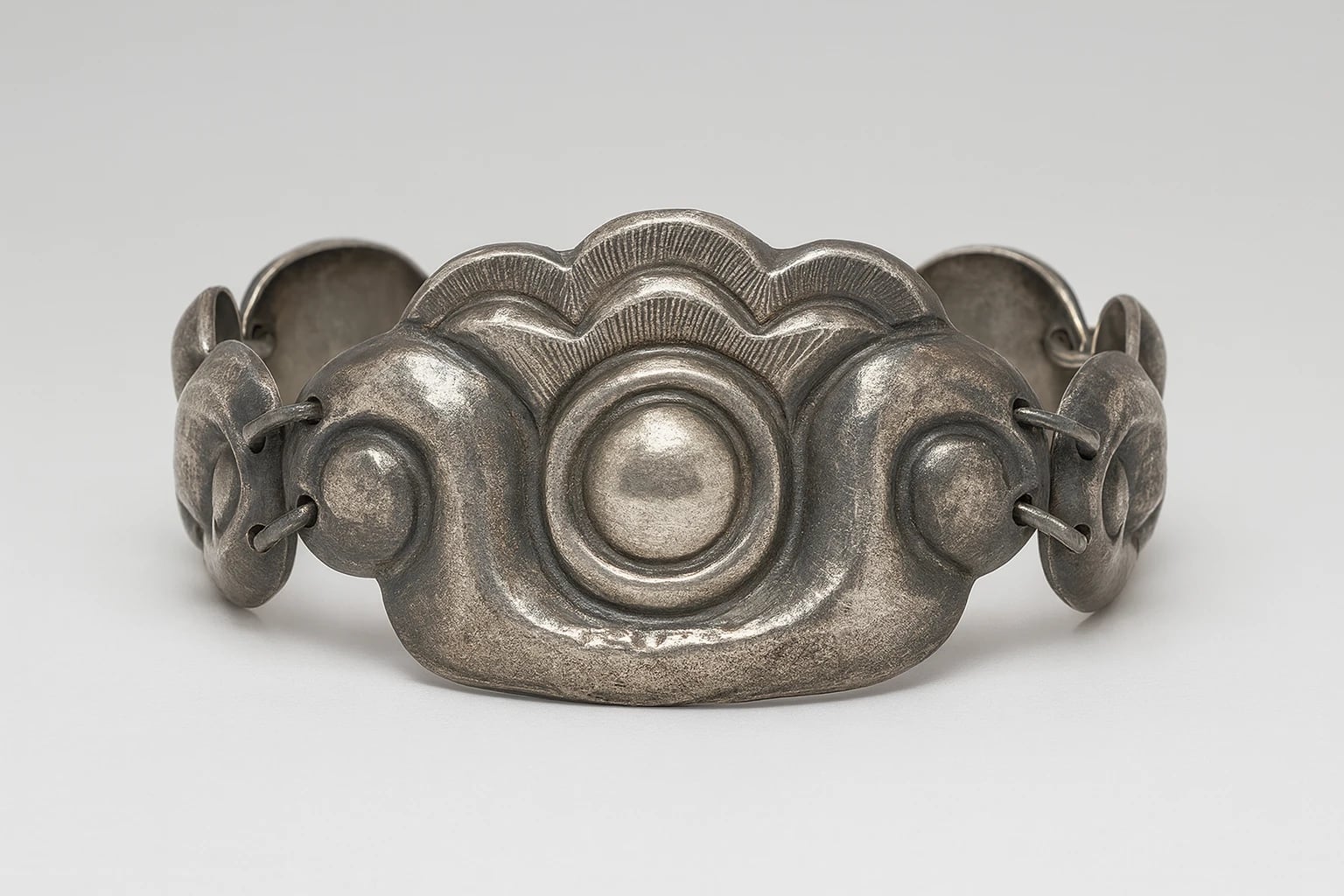
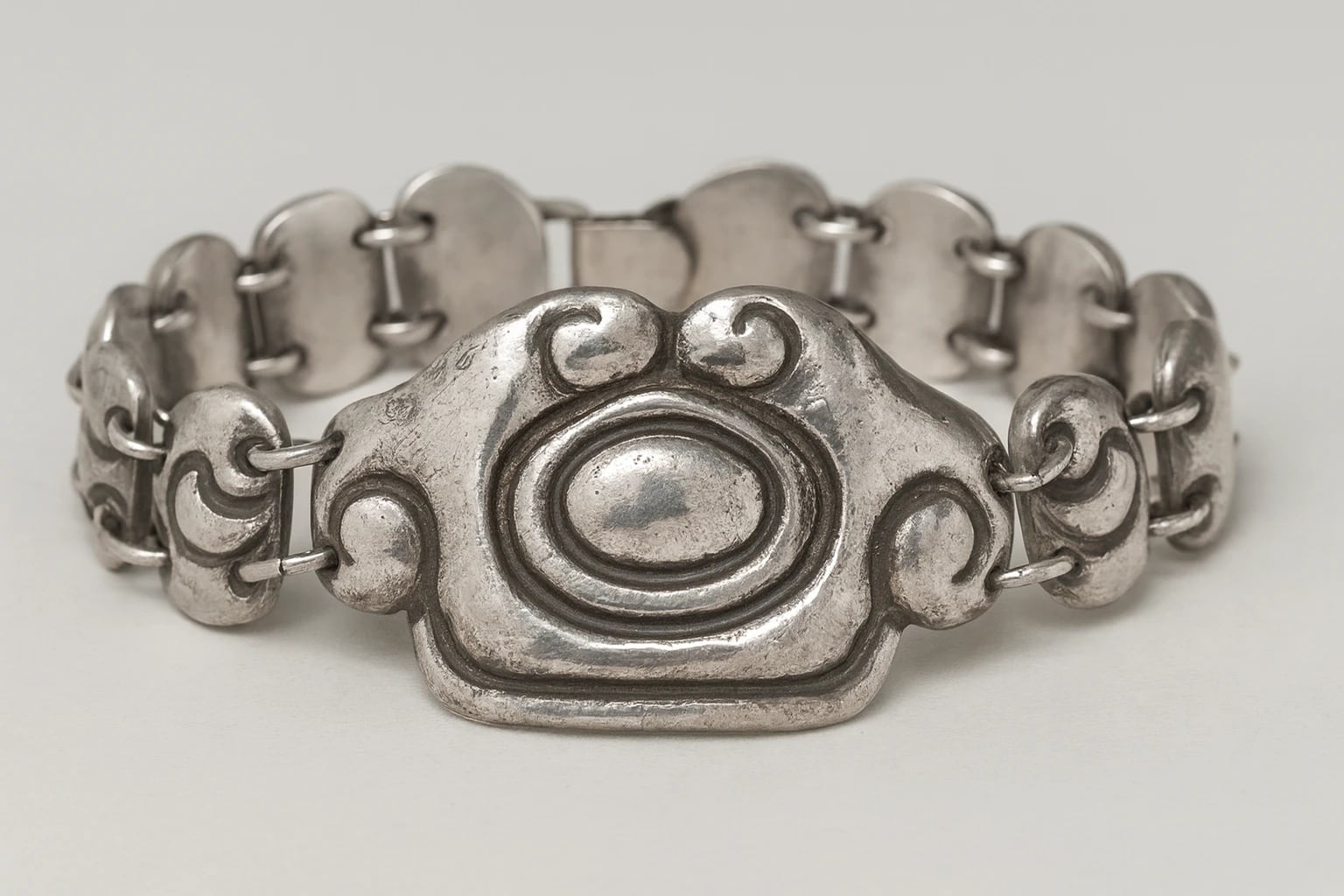
This bracelet belongs to the earliest language of Matl: low, rounded silver forms, darkened recesses, and a surface that keeps the pressure of the tool close to the eye. Made in the mid 1930s to early 1940, it predates the fuller, gem-set richness for which the workshop became widely known and shows Matilde Poulat working out a vocabulary in silver itself. The heavy script Matl mark with 950 fineness corresponds to the early period of the shop, which Hougart records among the Matl marks used from 1934 to 1948. Its old flat hook closure, handworked construction, and 950 silver place it within the formative years after Poulat opened her Mexico City shop in 1934.
The bracelet is organized around a broad central plaque, slightly wider and more emphatic than the articulated sections that continue around the wrist. A raised oval boss sits inside concentric ridges, while curled forms at either side pull the eye outward into the linked panels. Repoussé gives the forms their swelling volume, and chasing sharpens the transitions between raised silver and dark recess. The niello does not read as applied decoration after the fact. It gathers in the carved channels and makes the relief legible, turning shadow into structure. The resulting effect is tactile rather than glossy: the bracelet asks to be understood through pressure, depth, and the repeated action of a tool moving across metal.
The construction is important to its character. Instead of using a continuous cuff, Poulat’s design breaks the band into linked units, allowing the bracelet to curve by articulation rather than by a single fixed arc. The side panels echo the central plaque at reduced scale, so the wrist carries a sequence of related forms rather than a row of identical ornaments. At eight inches long and one and one eighth inches wide, the piece has enough breadth to read strongly on the body, but its linked format keeps the design from becoming rigid. The flat hook closure belongs to an older jewelry vocabulary, practical and unobtrusive, and it leaves the frontal relief to carry the visual weight.
Matilde Poulat’s work occupies a distinct place within the Mexican silver renaissance because it developed outside the dominant Taxco narrative while sharing the movement’s larger postrevolutionary search for Mexican forms in modern design. Morrill and Berk connect her jewelry to the new cultural vision of the 1920s and 1930s, when artists looked to ancient Mexican art and to pueblo traditions rather than European subjects. They identify the Mixtec gold jewelry found at Monte Albán in 1932 as a source for her work, and this bracelet shows how that inspiration could be translated without literal copying. Its concentric reliefs, curling profiles, and dense surface rhythms suggest an archaeological imagination, but the final design is not a replica of an ancient object. It is a modern bracelet built from hammered silver, hinge, hook, and repeated module.
Museum of Mexican Silver. “Repoussé Scroll Plaque Bracelet with Niello.” Catalog no. MoMS-002334. https://museumofmexicansilver.com/pieces/matl-bracelet-2
See something wrong with this record? Suggest a correction and the piece details fill in automatically.
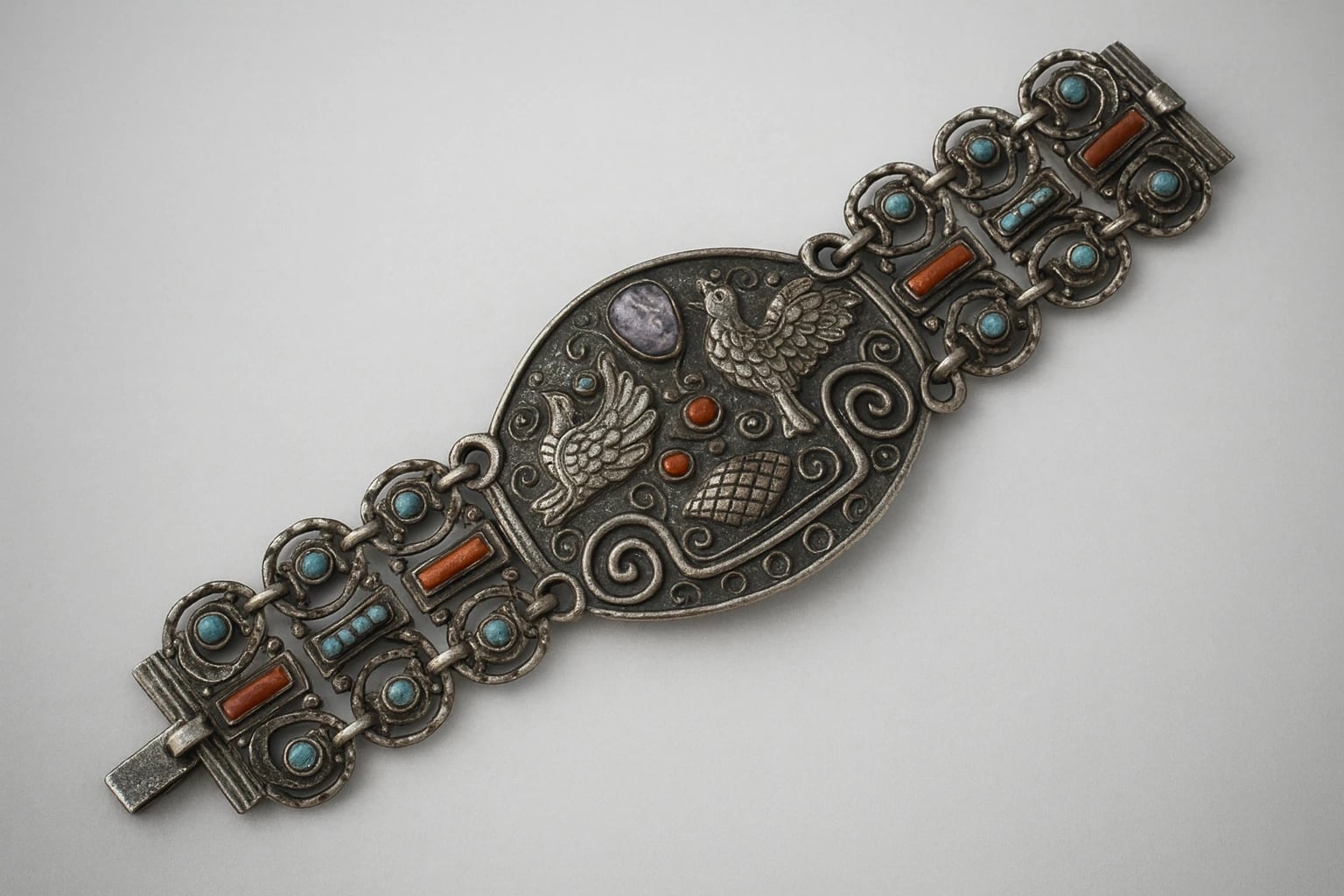
Later Matl work often gains its richness from coral, turquoise, amethyst, ivory, and complex figurative or devotional imagery. This early bracelet is more restrained, and that restraint makes it especially revealing. Silver, niello, relief, and articulation are enough. The piece shows Poulat’s command of surface before color becomes central to the workshop’s public identity, and it clarifies why Matl cannot be treated as a footnote to Taxco silver. In this object, Mexican modernism is carried through the wrist scale of jewelry: compact, handworked, historically aware, and fully dependent on the intelligence of metal.
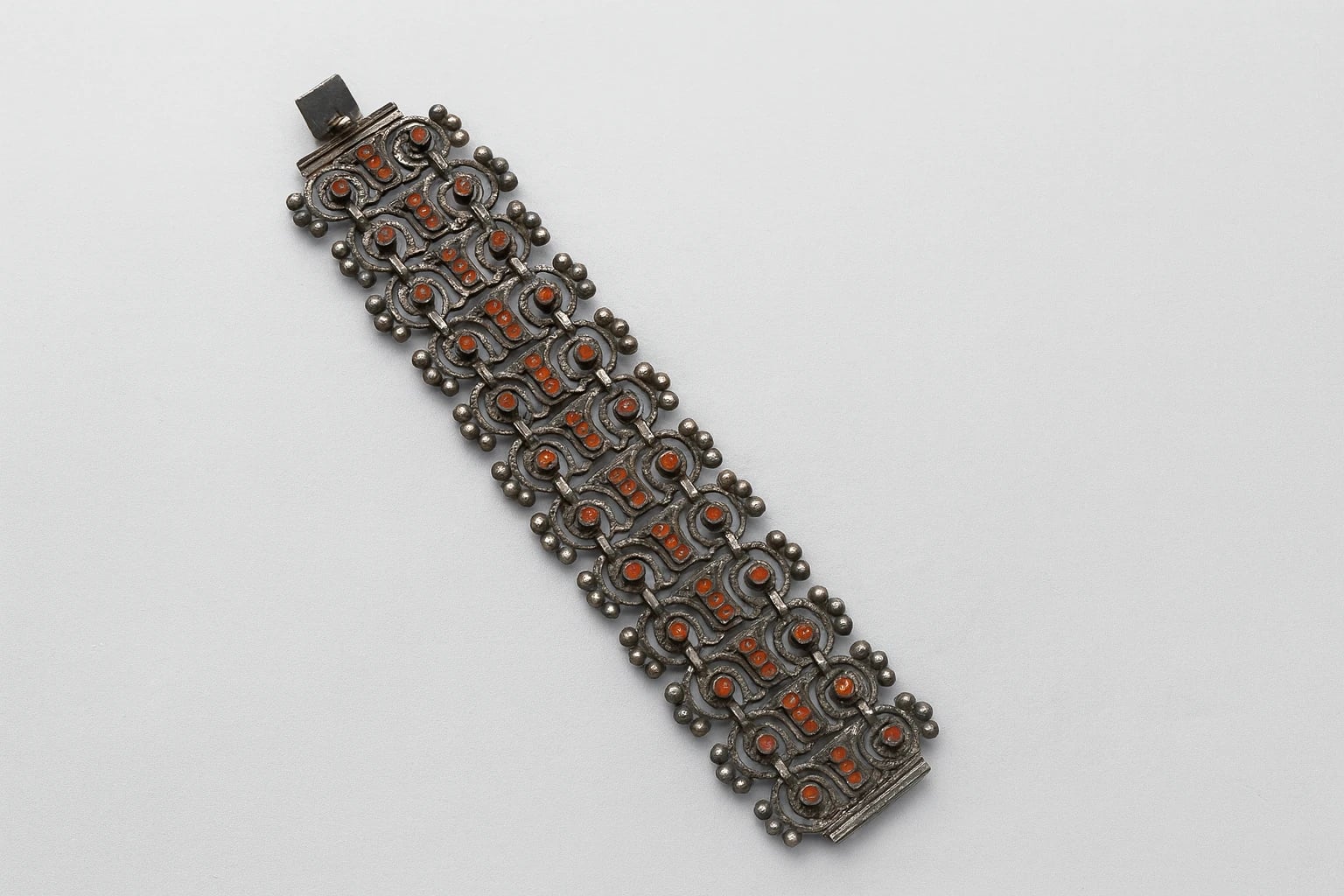
Double-Row Link Bracelet with Coral
1934 or later
Coral