Saves instantly, no account needed. Already a member? Sign in.
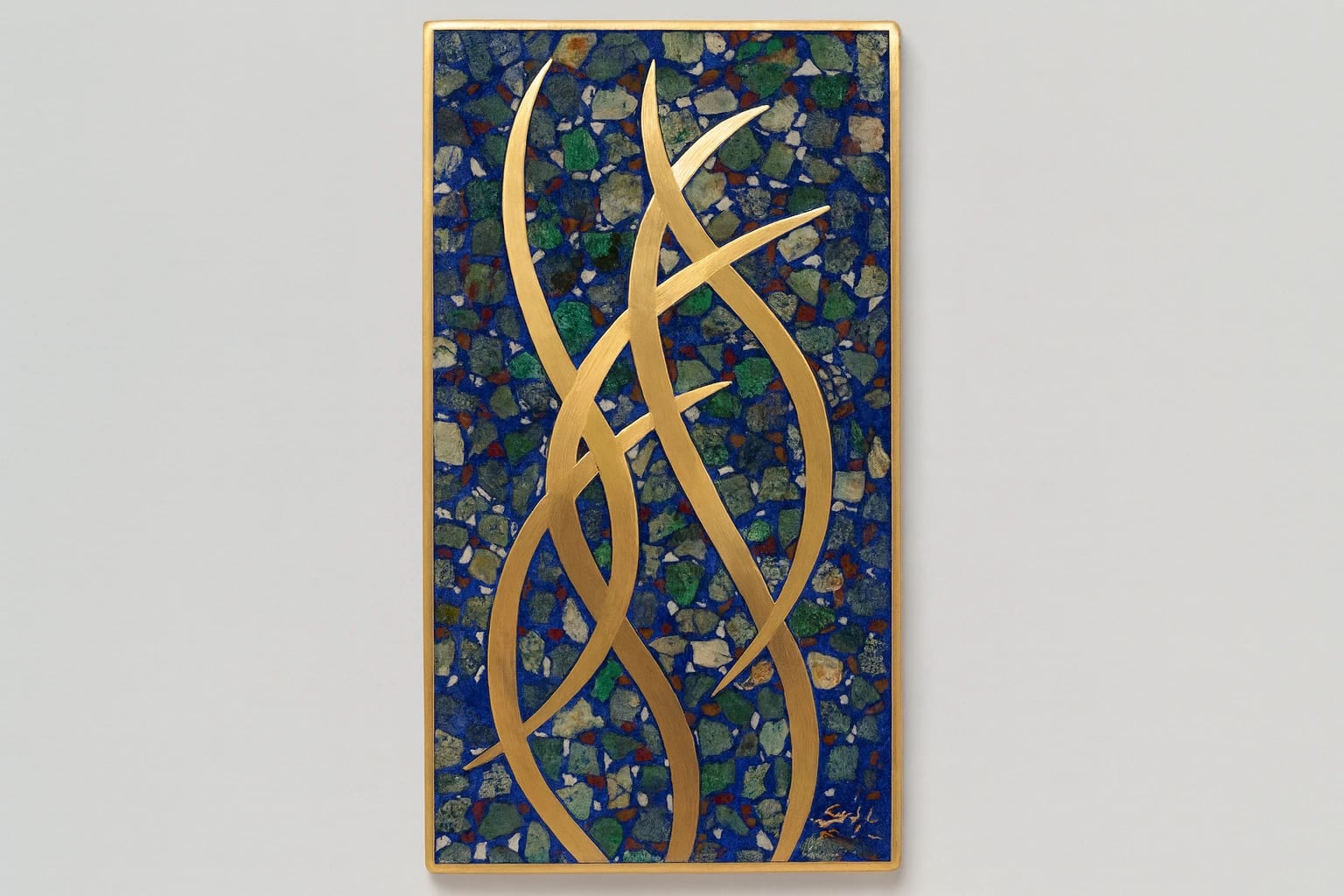
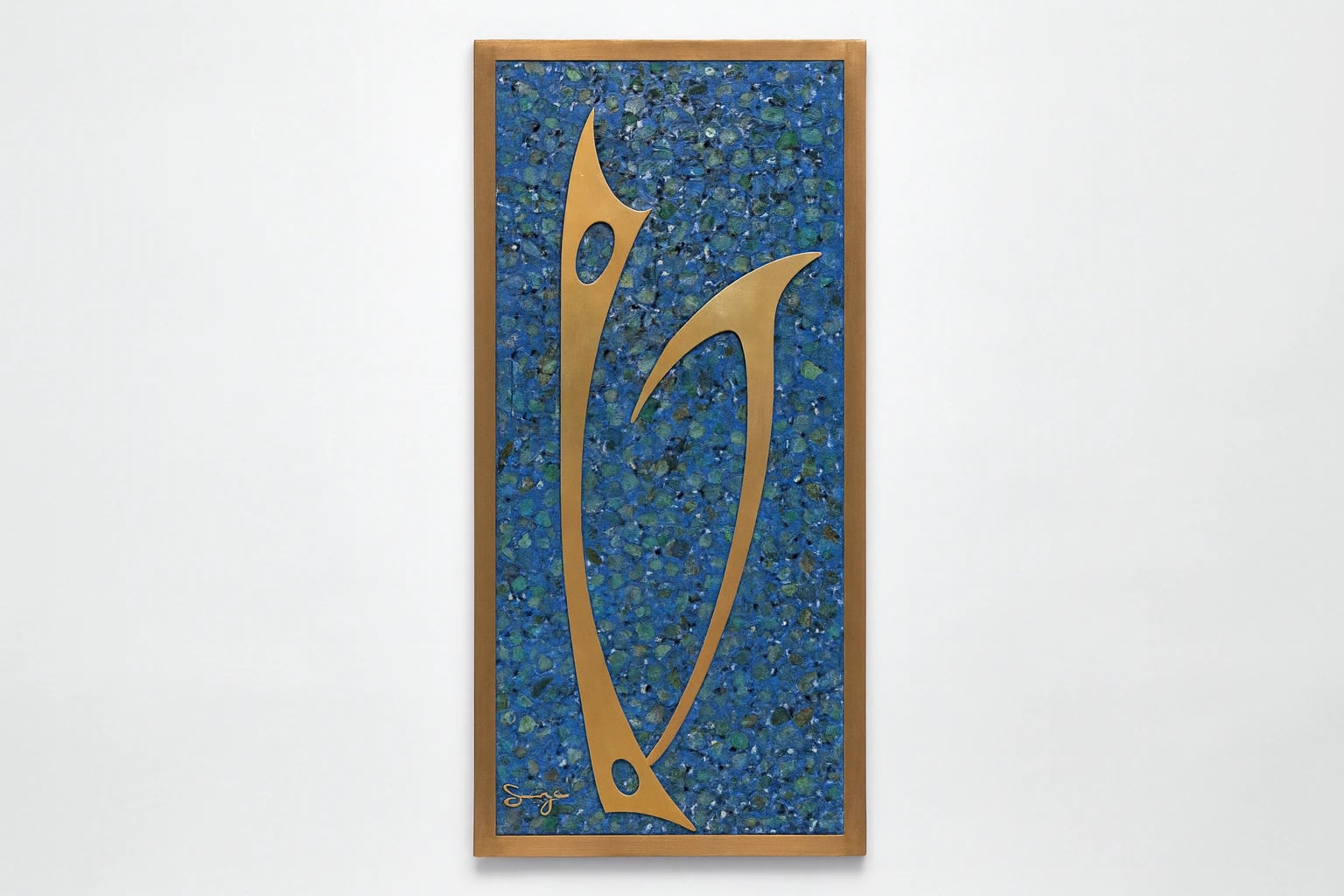
A blue mosaic field anchors this wall plaque, its small tesserae set in tight rows across a broad rectangular ground, interrupted by two long brass forms that curve and taper across the surface. The composition belongs to a strand of Sigi Pineda's work that moved beyond jewelry into objects for the wall and the table, where he could treat color and metal as a designer of two-dimensional fields rather than of body ornament. The plaque uses mosaic not as a set gem but as a field of color, a mass of blue built from many small units, against which the brass reads as line and gesture.
The relationship between the two materials organizes the piece. The mosaic supplies a dense, saturated ground, while the brass forms sit above it as polished, continuous shapes that catch light where the mosaic absorbs it. Pineda keeps the brass abstract, two elongated forms rather than any legible figure, so the eye follows their curvature across the blue and registers the negative space between them. This is a designer thinking about how a flat panel holds attention from across a room: the color carries at distance, and the metal lines give the field direction and movement. Hougart records that Pineda's work "reflects great design flow and very creative use of dimension," and the plaque shows that instinct applied to a wall surface, where depth is shallow and the drama comes from contrast and interval.
Pineda came to this kind of object through an unusually varied training. He worked as a young teenager at Los Castillo, then with Salvador Terán in Puebla and Felipe Martínez at Piedra y Plata, and he headed the enameling workshop at Margot de Taxco before opening his own shop, first called Plateros and later renamed Sigi, in 1952. Both the Los Castillo circle and Margot de Taxco were centers for mosaic and enamel work, techniques built on assembling color across a metal or stone ground, and this plaque reflects that lineage more than it reflects the forged and stone-set jewelry for which Taxco is better known. Contreras Osio places Sigi Pineda among the individual creative personalities who worked in Taxco across the twentieth century in techniques reaching well beyond jewelry, and he notes that object design in Taxco is best understood as a record of such individuals rather than a continuous industry. A mosaic wall plaque sits squarely within that observation: it is a designer extending his vocabulary into a form that had no fixed market or tradition to sustain it.
The plaque documents a less familiar side of Pineda's practice. It records how a Taxco designer trained in enamel and mosaic approached scale, color, and the wall as a surface for abstract composition. It preserves, in a single panel, the material intelligence that Pineda carried from Los Castillo and Margot de Taxco into work of his own name.
Museum of Mexican Silver. “Large Blue Mosaic Wall Plaque.” Catalog no. MoMS-002268. https://museumofmexicansilver.com/pieces/sigi-large-blue-mosaic-wall-plaque
See something wrong with this record? Suggest a correction and the piece details fill in automatically.
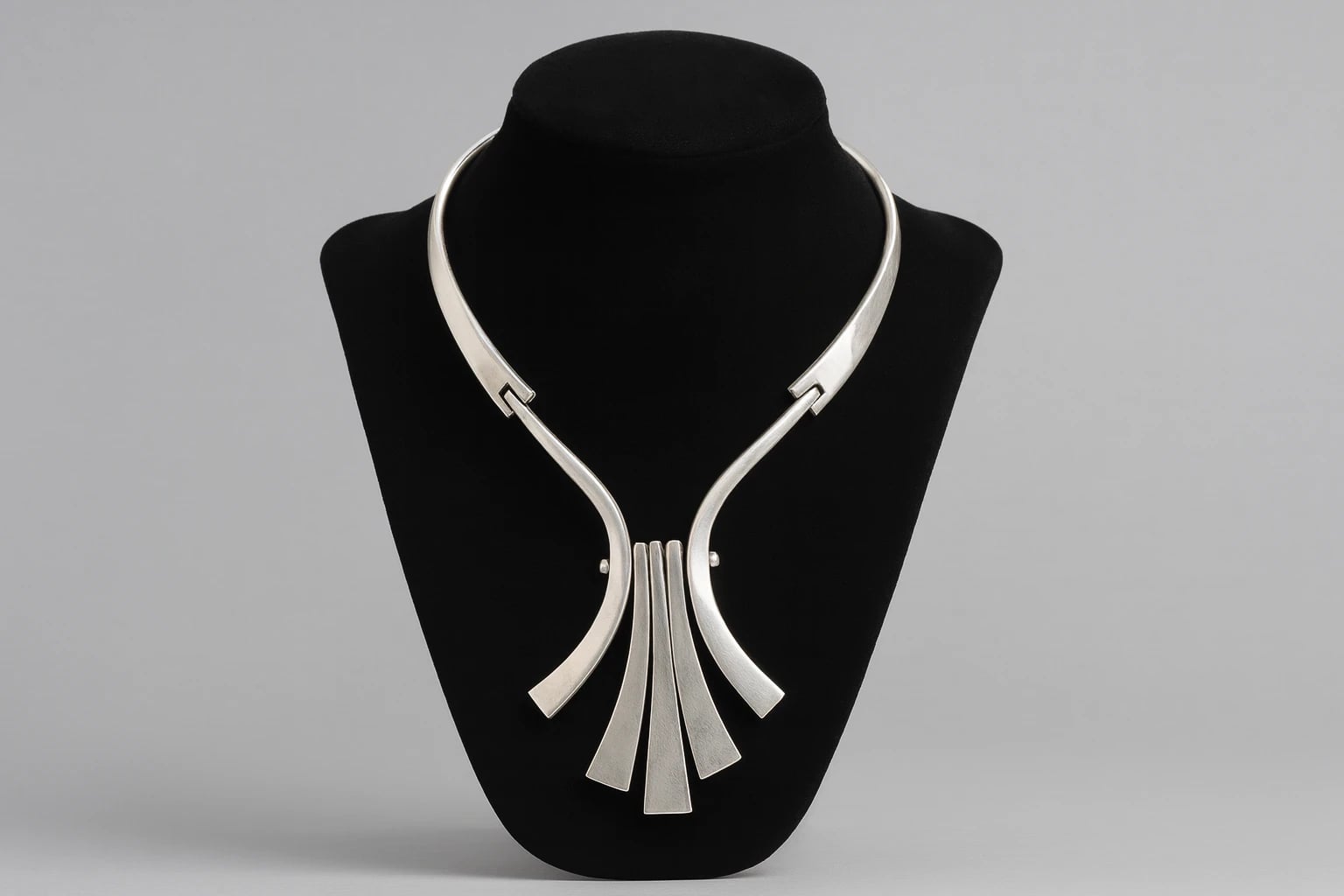
Sigi Pineda
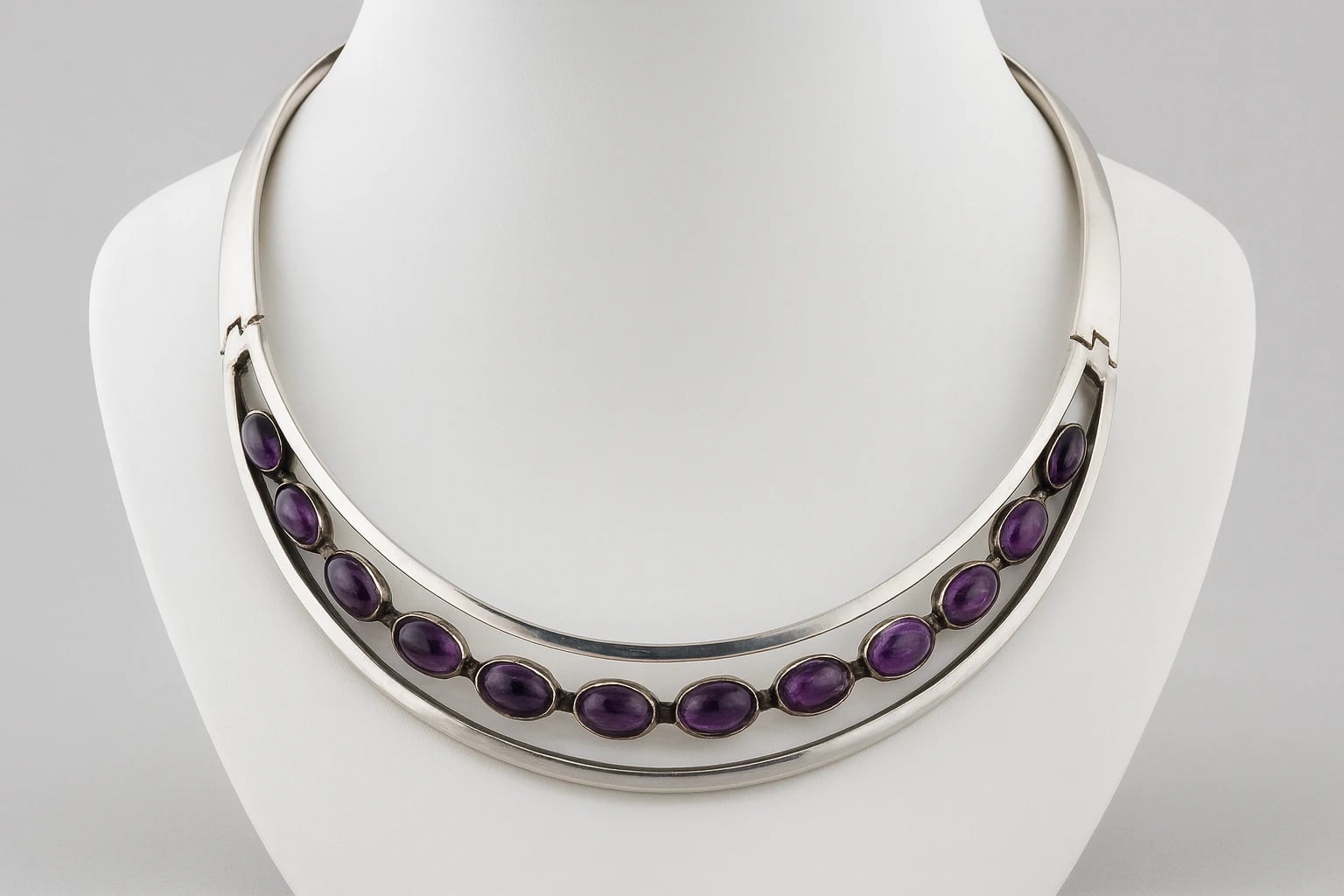
Modernist Sterling Necklace
1956 or later
Silver