Saves instantly, no account needed. Already a member? Sign in.
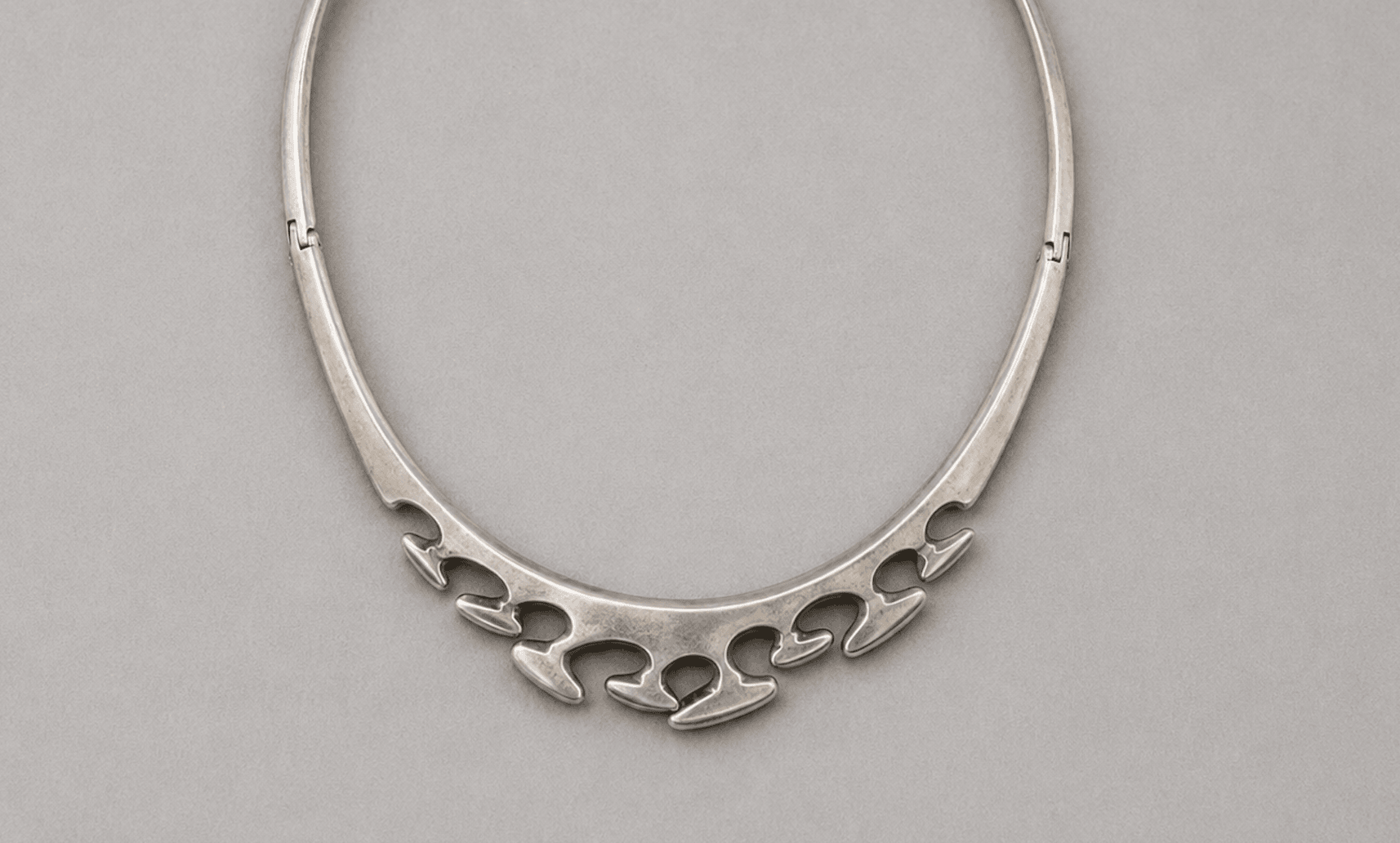
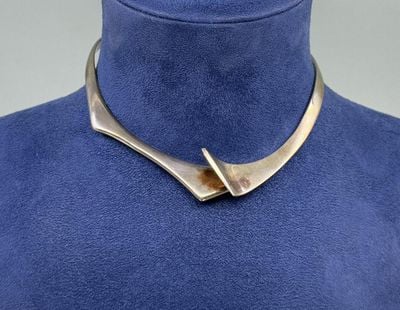
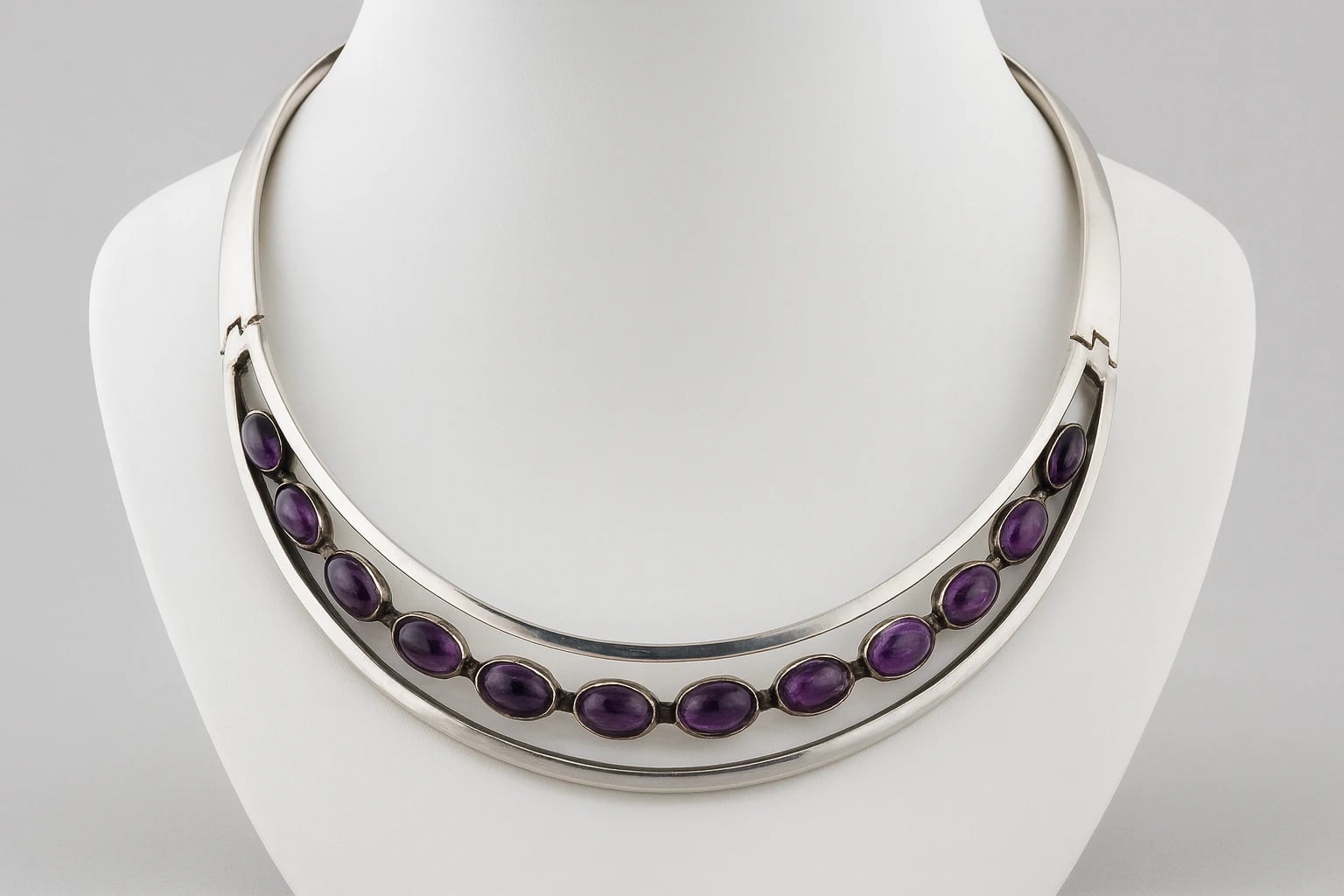
A choker built to sit close against the throat, this necklace organizes irregular silver flanges into a continuous band that moves with the neck rather than resisting it. Sigi Pineda designed the form so that its joints do the ornamental work: the hinges that let the segments pivot are not concealed behind the design but incorporated into it. The result is a rhythm of overlapping shapes that shift as the wearer turns, a quality Penny Morrill identified in related Sigi jewelry as a "jazzy motion" produced by oddly shaped bits of silver and their exposed articulation.
The construction depends on how each flange is cut and set. Rather than repeating a single module, the segments vary in outline, and their overlapping edges catch and release light along the band as it curves. Because the hinges carry both the movement and part of the visual pattern, the necklace reads as a single articulated object rather than a string of discrete links. Silver here is treated as a plastic material for shaping planes and reflections, not as a setting for stones. The polished surfaces of the flanges become the ornament, and the negative spaces between overlaps register as clearly as the metal itself.
Sigi Pineda came to this vocabulary through an unusually direct path in Taxco's workshop world. He began as a boy at Los Castillo, worked with Salvador Terán in Puebla and with Felipe Martínez at Piedra y Plata, and headed the enameling workshop at Margot de Taxco before opening his own shop in 1952, later renamed Sigi. His documented marks include the script Sigi over TASCO in an oval cartouche, sometimes with eagle 36 and an inventory or design number, and Hougart records the fineness variants Sigi used, including 935 and 950. That range of training left him fluent in enamel and in the sculptural handling of silver, and this choker belongs to the second current: dimensional metalwork that treats articulation as a design principle. The prevalence of Sigi's name also made his work a target for imitation, and Hougart flags several fabricated eagle-36 marks laminated onto Sigi-look pieces, a reminder that his mid-century designs were sought after enough to copy.
Within a collection of the Mexican silver renaissance, the necklace shows how a second-generation Taxco designer, shaped by the Castillo and Margot workshops, developed an independent formal language rather than restating earlier models. It sits alongside the hinged and overlapping Sigi jewelry documented by Morrill as evidence of a maker who thought about movement and mechanism as inseparable from ornament. The piece records a specific moment in Taxco modernism when hinges, flanges, and reflective planes carried the design ideas that painters and sculptors of the same postrevolutionary decades were pursuing in other materials.
Museum of Mexican Silver. “Modernist Sterling Choker Necklace.” Catalog no. MoMS-001555. https://museumofmexicansilver.com/pieces/sigi-sterling-choker-necklace
See something wrong with this record? Suggest a correction and the piece details fill in automatically.
Sigi Pineda
Modernist Amethyst Cabochon Collar Necklace
Amethyst