Saves instantly, no account needed. Already a member? Sign in.
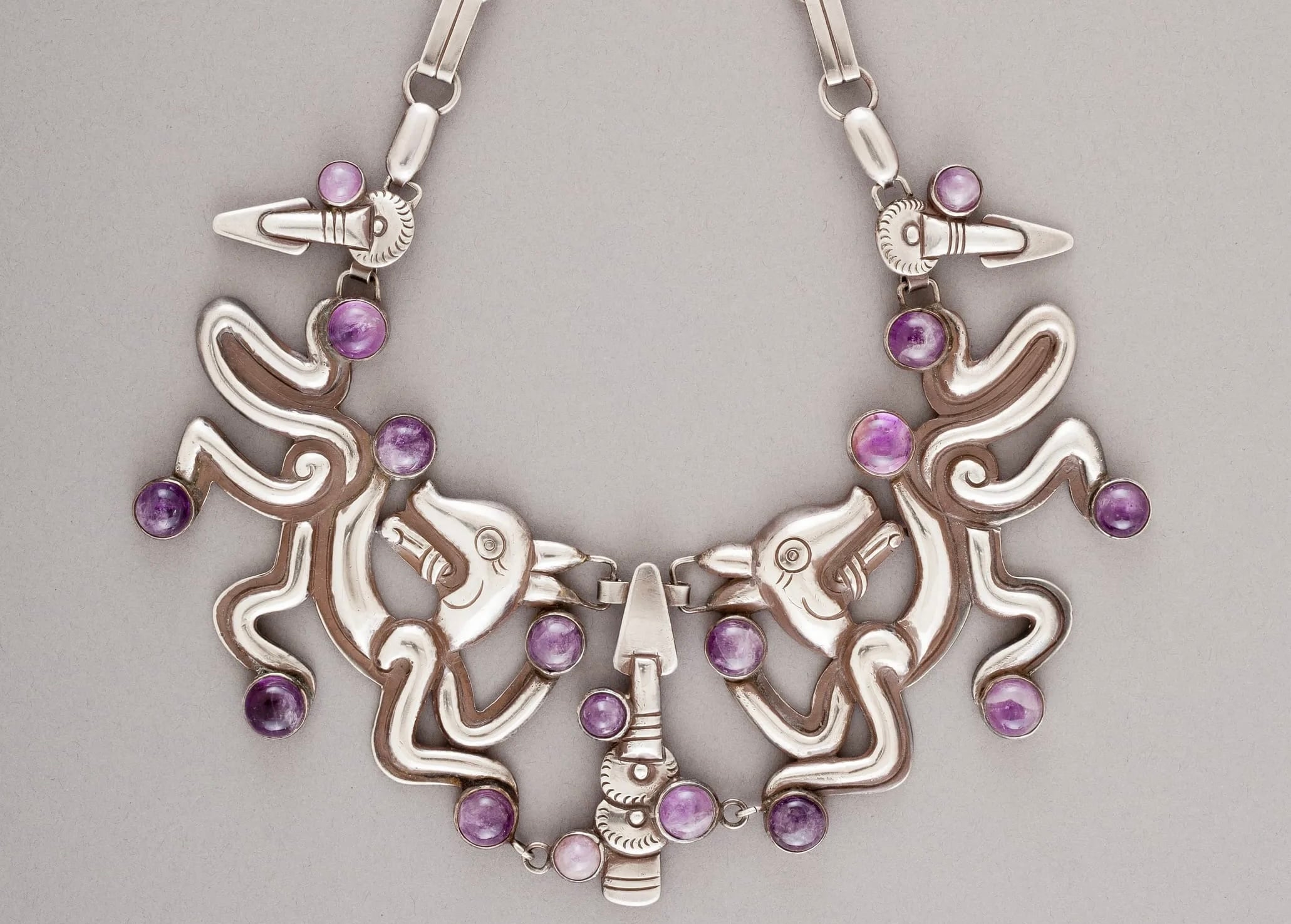
William Spratling’s Jaguar Necklace is one of the most famous and visually arresting designs of the Taxco silver renaissance. Known in Spratling’s own period terminology as tigres con amatista, the necklace is now generally understood as a jaguar design: as Penny Chittim Morrill and Carole A. Berk explain, “tigre” in Latin American usage refers here to the jaguar, and the necklace should therefore be read as the “jaguar necklace.” They describe the work as a “spectacular necklace,” noting its opposing animal forms, feathered-arrow center, oxidized linear detail, and amethyst cabochons terminating the feet and tails.
LACMA gives the necklace similarly elevated status. In its collection entry for the Jaguar Necklace, the museum calls it “one of William Spratling’s most important silver designs” and describes it as emblematic of Spratling’s engagement with Mesoamerican art. LACMA emphasizes the mirror-image quadrupeds, the movement created by the animals’ swirling forms, and the striking contrast of silver and amethyst.
The design belongs to the high point of Spratling’s first major period, when his Taxco workshop was translating Mesoamerican, folk, and modernist sources into bold handwrought silver forms. The necklace appeared in the context of Spratling’s 1944 Fine Mexican Silver catalogue, which Morrill and Berk describe as an “impressive” catalogue containing hundreds of inventory-numbered designs from Spratling y Artesanos. Its inclusion in that catalogue is important: it indicates that the necklace was not a unique one-off, but a formal workshop design intended for production. At the same time, its scale, complexity, large handwrought construction, and use of multiple amethyst cabochons place it among Spratling’s prestige jewels rather than his higher-volume commercial production.
No surviving production ledger has yet been identified for this necklace, so any count must be stated as an informed estimate rather than a documented number. The best working estimate is that approximately 15 to 40 original silver-and-amethyst examples were likely made in the 1940s, with a practical midpoint around 25. The lower bound reflects the fact that the necklace was a large, costly, labor-intensive showpiece. The upper bound reflects Spratling’s real workshop capacity during this period: by 1945, one source cited by Morrill and Berk reported more than four hundred craftsmen in the Spratling workshop producing silver jewelry and objects for 140 foreign and 26 Mexican accounts. In other words, the workshop was capable of repeating important designs, but this particular necklace would almost certainly have been produced in small numbers.
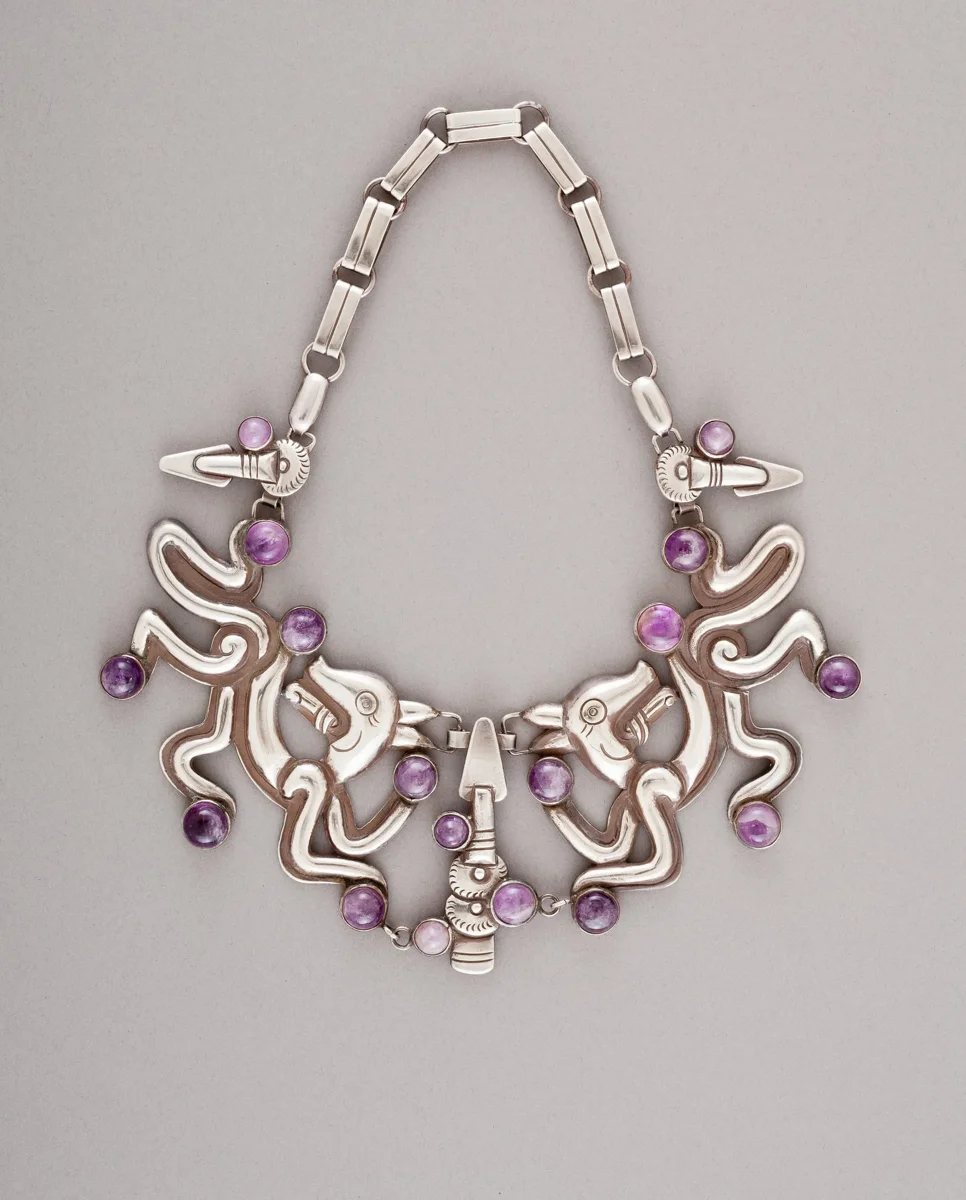
Double-Jaguar Necklace (Collar con jaguares enfrentados), circa 1940
Accession M.2013.4.4. Official museum record Photo: Los Angeles County Museum of Art.
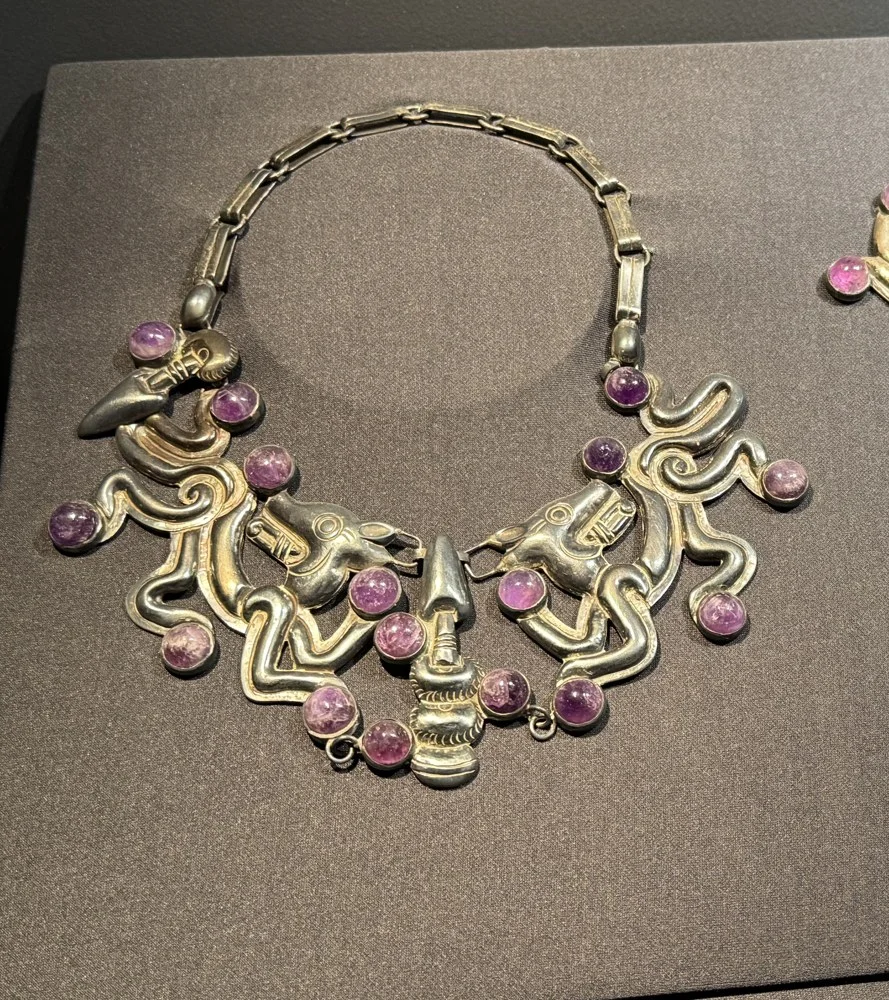
Collar jaguar (jaguar necklace), 1931-1945
Photo: Museum of Mexican Silver, taken in-gallery at Museo Franz Mayer, February 2026.
Verified against each institution's own collection records. All museum collections
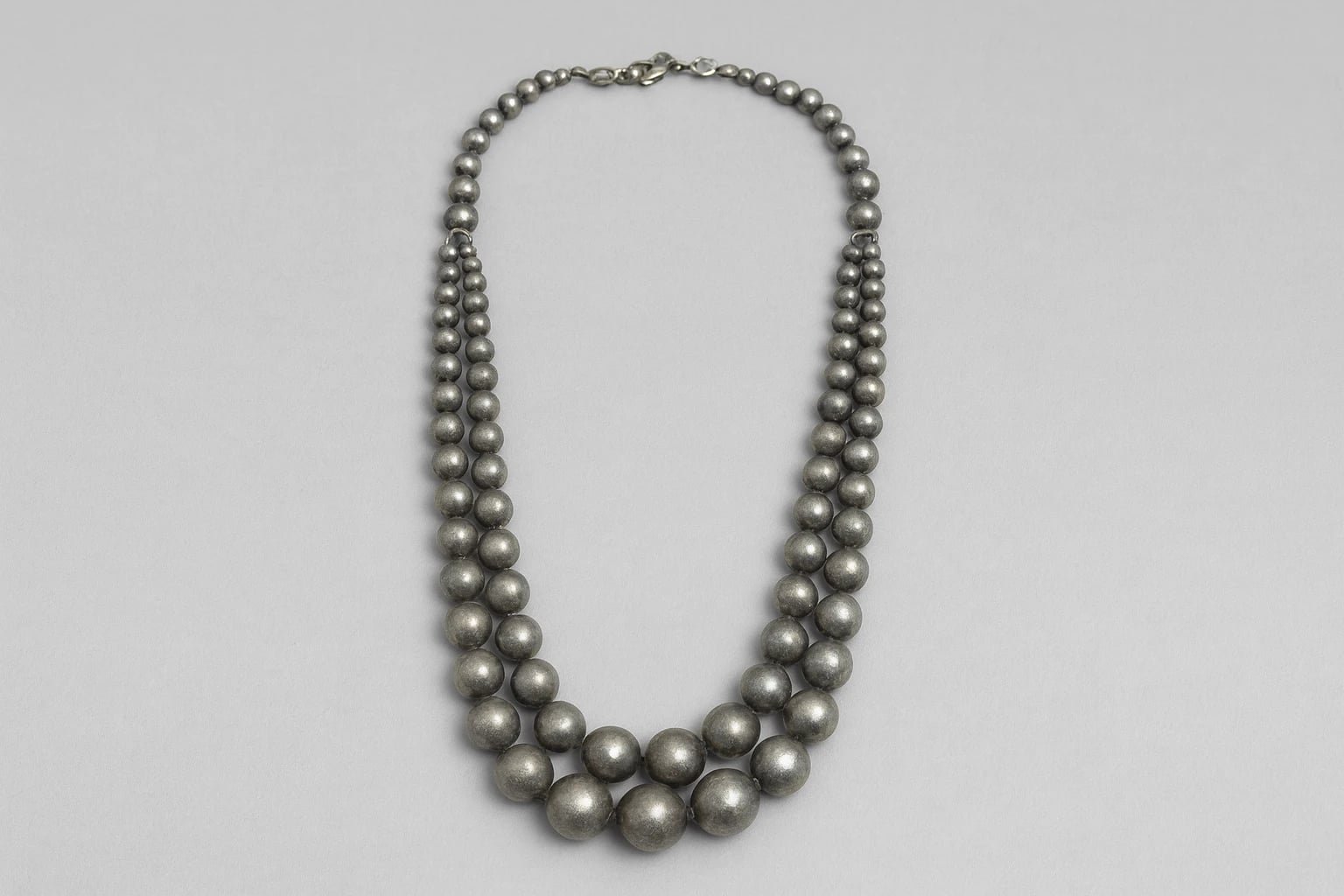
Museum of Mexican Silver. “Jaguar Necklace.” Catalog no. MoMS-000334. https://museumofmexicansilver.com/pieces/spratling-1017
See something wrong with this record? Suggest a correction and the piece details fill in automatically.
The likely survival figure is lower but still meaningful. A reasonable estimate is that approximately 10 to 25 original examples survive today. That range assumes that most examples were retained as valued works of wearable sculpture rather than melted or discarded, but also accounts for loss, damage, undocumented private ownership, and the normal attrition of jewelry over eighty years. Publicly traceable examples include the LACMA necklace, the one held by the Museo Franz Meyer, and one from the Crawford Collection sold in 2021.
In summary, the Jaguar Necklace is one of Spratling’s canonical masterpieces: a celebrated, museum-recognized design that bridges Mesoamerican source material, modernist abstraction, and the technical ambition of Taxco handwrought silver. It was likely produced in small numbers, probably no more than several dozen, and today survives in a limited population, much of it in private hands.
William Spratling
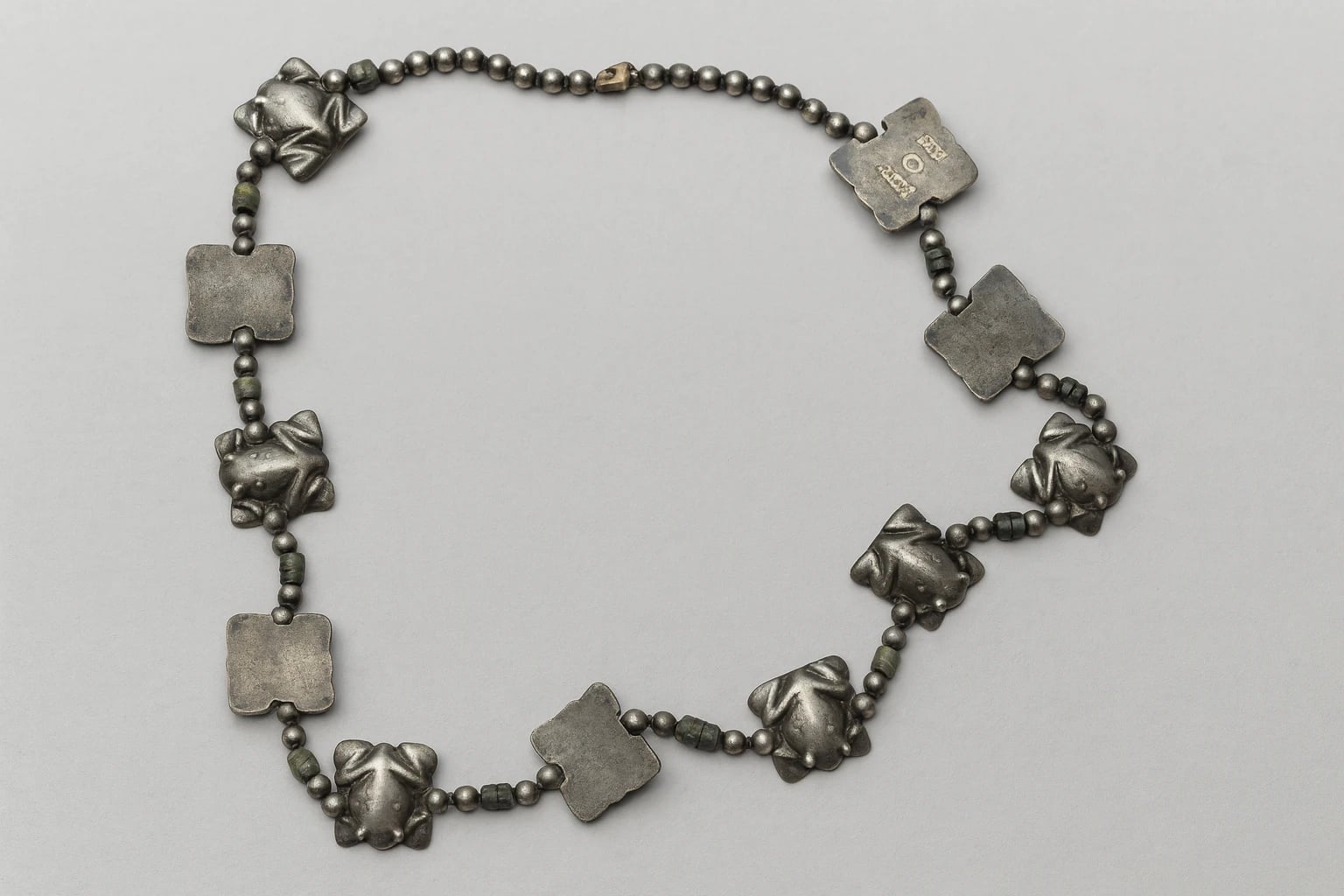
Turquoise Frog Necklace
First Design Period: 1931 - 1946
Silver