Saves instantly, no account needed. Already a member? Sign in.
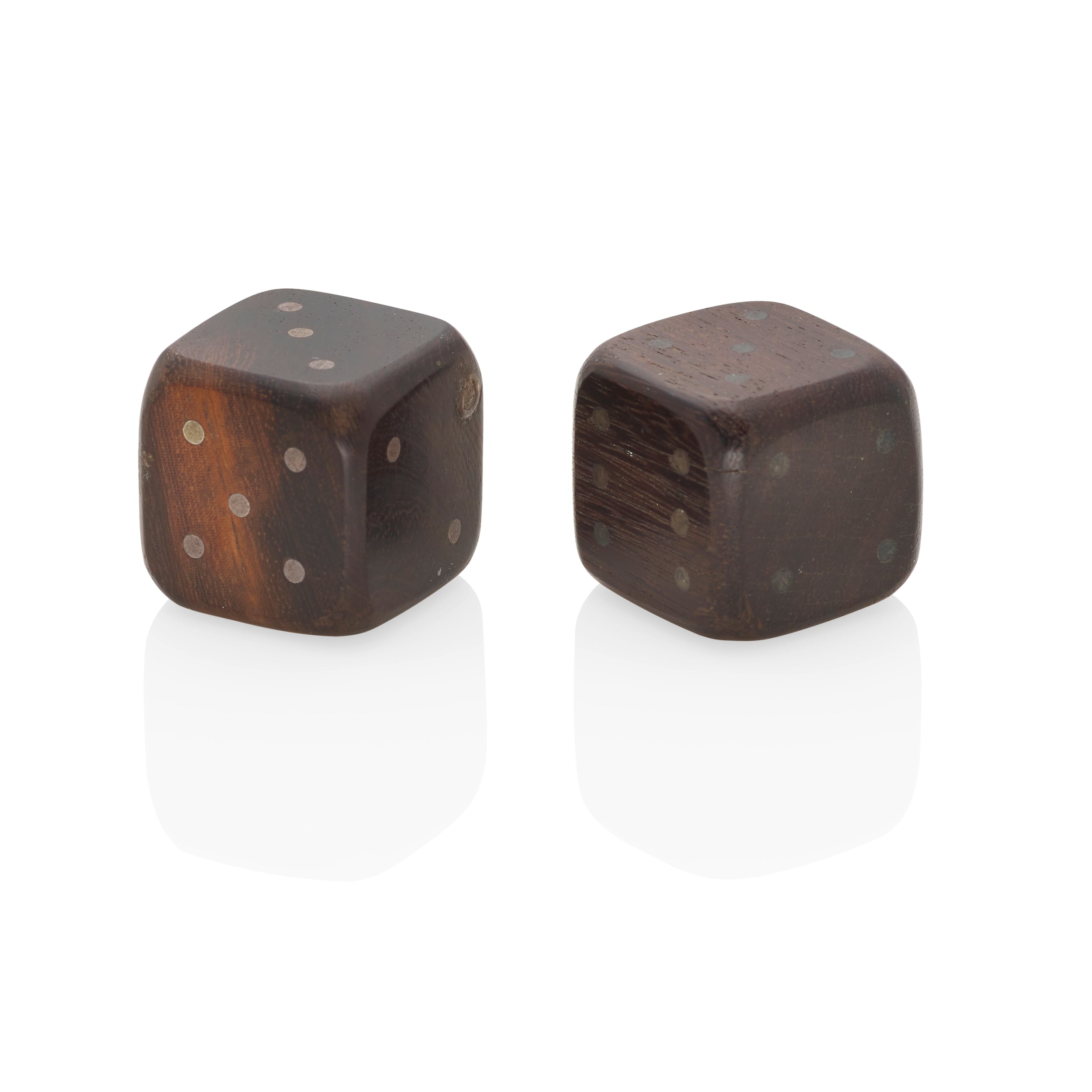
Silver dots set into dark wood mark one of Spratling's most characteristic formal gestures of this period — a reduction to circle and plane that Morrill and Berk identify as conveying "playfulness and sophistication." In these rosewood dice, the motif finds an apt subject: each face carries flush-set circular silver pips, the blocks themselves softly rounded at every corner, function and ornament held in a single object.
Rosewood was a deliberate material choice. Its density and warm grain contrast against the cool, reflective silver discs, the dark wood amplifying rather than competing with the geometry of each pip. Morrill and Berk's Mexican Silver (1994) connects this pairing — organic warmth set against precise silver — to the modernist aesthetic Spratling had long pursued, a formal sensibility that ran through his decorative wares from the 1950s onward.
Game and table objects in wood and silver are documented in a 1965 exhibition inventory recorded in Mexican Silver, which lists a wood-and-silver domino set among Spratling's table pieces — placing these dice within the same family of functional-decorative work he was producing in the final years of Las Delicias. Dated to circa 1964–67, they belong to a small category of Spratling objects that move beyond jewelry proper into considered objects for the table.
Museum of Mexican Silver. “Rosewood Dice with Inset Silver Discs.” Catalog no. MoMS-000895. https://museumofmexicansilver.com/pieces/spratling-2380
See something wrong with this record? Suggest a correction and the piece details fill in automatically.
William Spratling
Duck Head Necklace
First Design Period: 1931 - 1946
Silver