Saves instantly, no account needed. Already a member? Sign in.
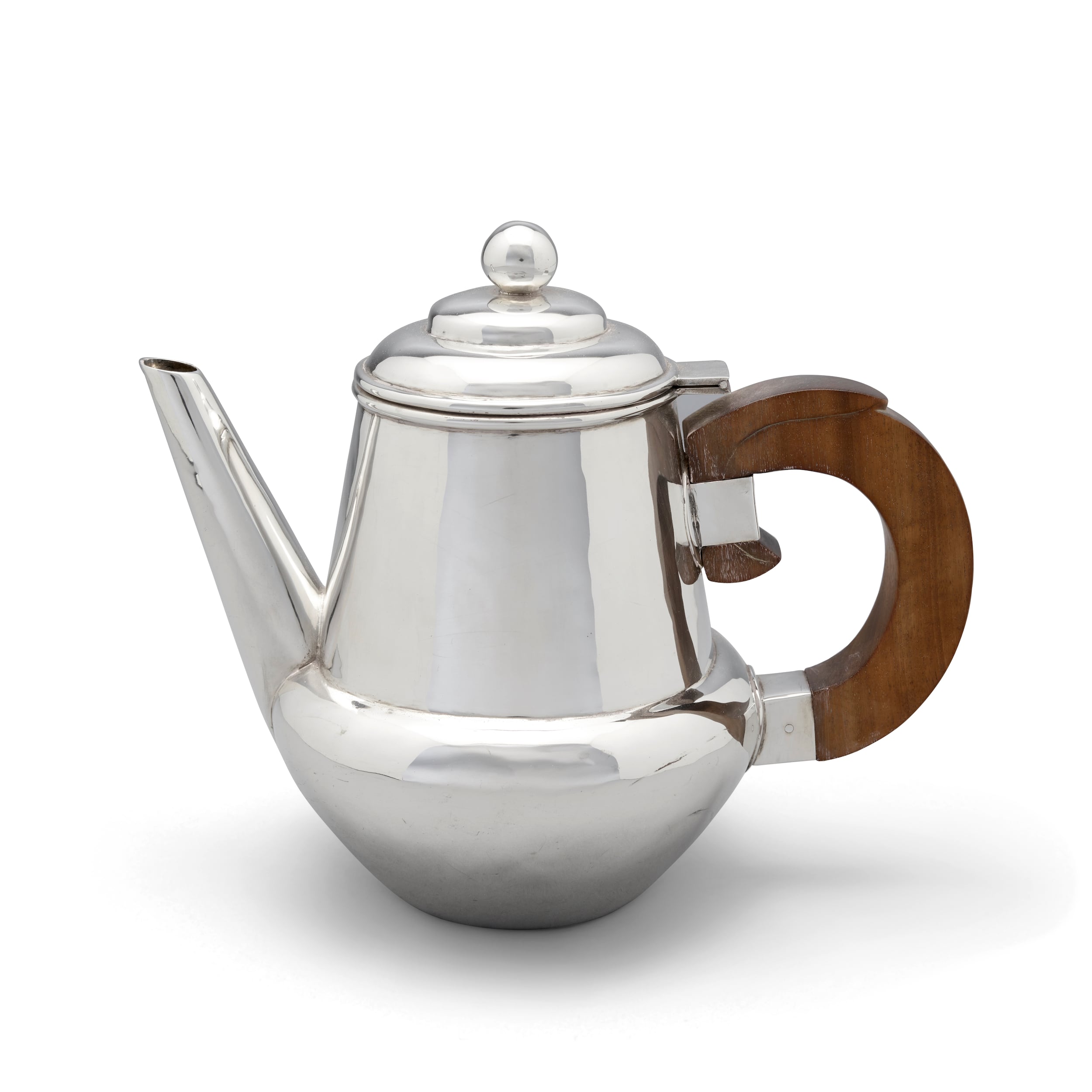
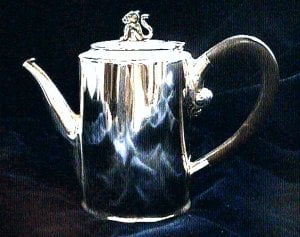
This coffee pot condenses one of William Spratling's most fully resolved hollowware ideas into a smaller, more intimate scale. The body is a plain cylinder of polished silver, gently swelling and unornamented, and the design concentrates its figurative interest at a single point: a small cast jaguar seated on the hinged lid, serving as the finial the hand grasps to open the pot. The jaguar was among the animals Spratling returned to throughout his career, drawn from the fauna and Pre-Columbian imagery of the Guerrero region that surrounded his Taxco workshop. Placed here, the creature does quiet double duty, functioning as a practical knob while carrying the cultural signature that distinguished Spratling's tableware from the international modernist silver it otherwise resembles.
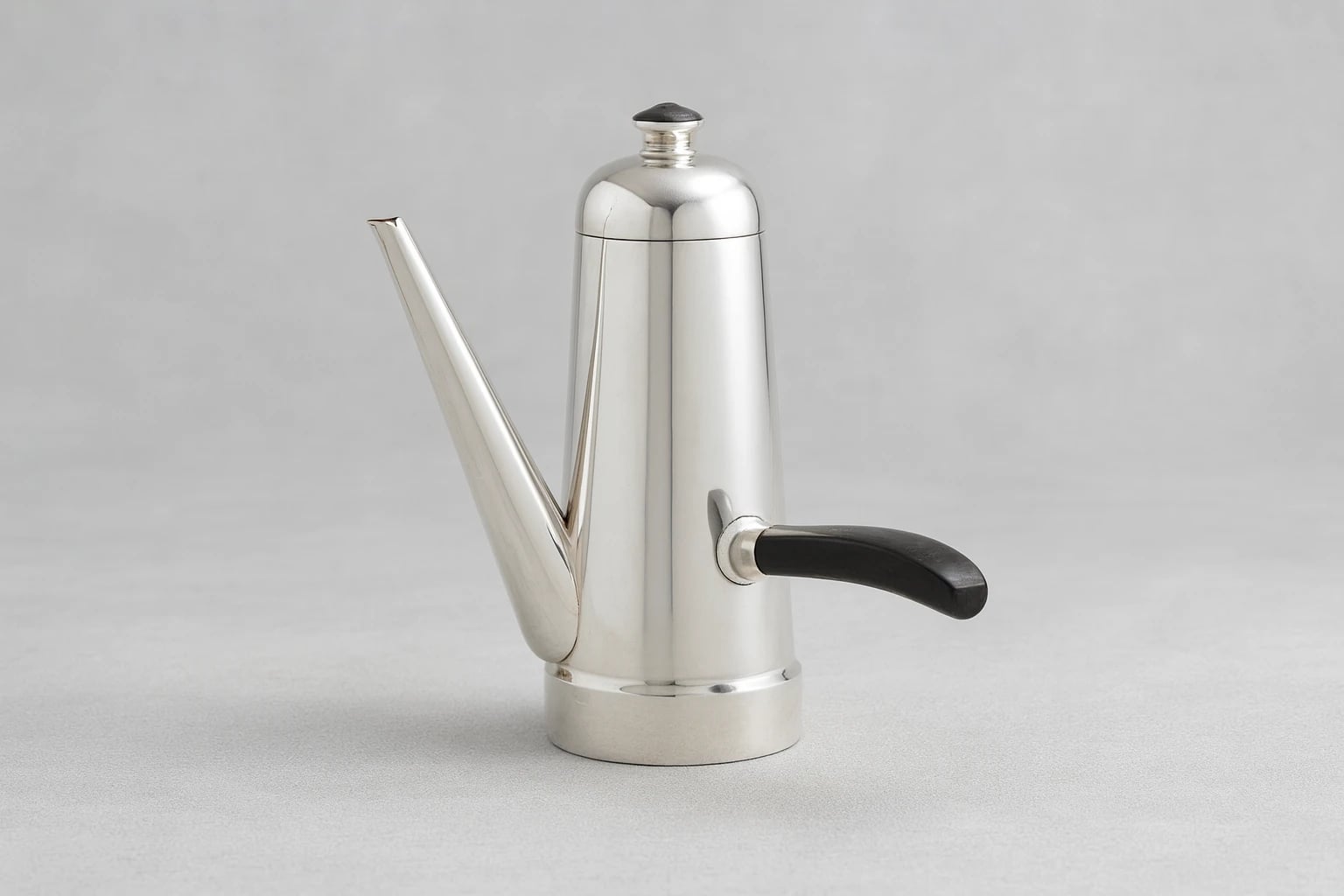
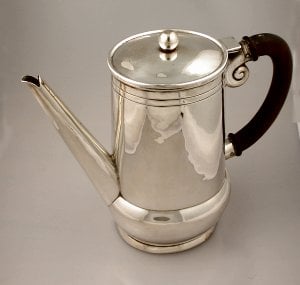
The pot's construction turns on a contrast of materials that Spratling made central to his hollowware. The handle is carved ebony, its dark, dense warmth set against the cool reflective surface of the silver body, while the spout emerges low on the cylinder and rises in a long, tapering curve. Penny Morrill has pointed out how closely this vocabulary parallels the tea and coffee services Jean Puiforcat designed in France between 1925 and 1935, where rosewood or amber handles and finials, simplified cylindrical bodies, and restrained trim produced a comparable balance and unity of composition. Spratling shared that geometric discipline and that instinct for combining materials, but where Puiforcat's accents remained abstract, Spratling crowned his cylinder with a jaguar. The substitution is small and decisive. It relocates the design from Parisian Art Deco to the Mexican silver renaissance without disturbing the modernist clarity of the form.
The marks on this example belong to the round legend reading William Spratling, Taxco, Mexico with the script WS and 925 fineness, a stamp the hallmark literature places in use from the mid 1950s through Spratling's late period. That dates the fabrication of this particular pot to the mature years of his workshop, when coffee and tea services were an established part of production. The inventory published for the 1965 traveling exhibition The World of William Spratling, organized by the McNay Art Institute, listed coffee and tea sets among the silver offered, and hollowware of this kind circulated through the museums that hosted the show. The design itself is well documented: the jaguar coffee pot appears in Cederwall and Riney's Spratling Silver, in La Platería Mexicana, and in Morrill's Maestros de Plata, a publication record that marks it as one of the recognized statements of Spratling's tableware. At seven inches, this version renders the design at reduced size, a scale suited to individual service rather than the full formal set.
Museum of Mexican Silver. “Smaller Sized Jaguar Coffee Pot.” Catalog no. MoMS-000761. https://museumofmexicansilver.com/pieces/spratling-2997
See something wrong with this record? Suggest a correction and the piece details fill in automatically.
Within a collection, the piece is useful precisely because it holds two histories in a single object. Read against Puiforcat, it shows how thoroughly a Taxco workshop absorbed the formal language of European modernist silver, the pared cylinder, the exotic wood handle, the refusal of applied ornament. Read against Spratling's own development, it shows the counterweight he supplied: a regional animal, modeled in the round and given the most functional position on the vessel. The jaguar is not decoration added to a modern form. It is the point at which the modern form declares where it was made.
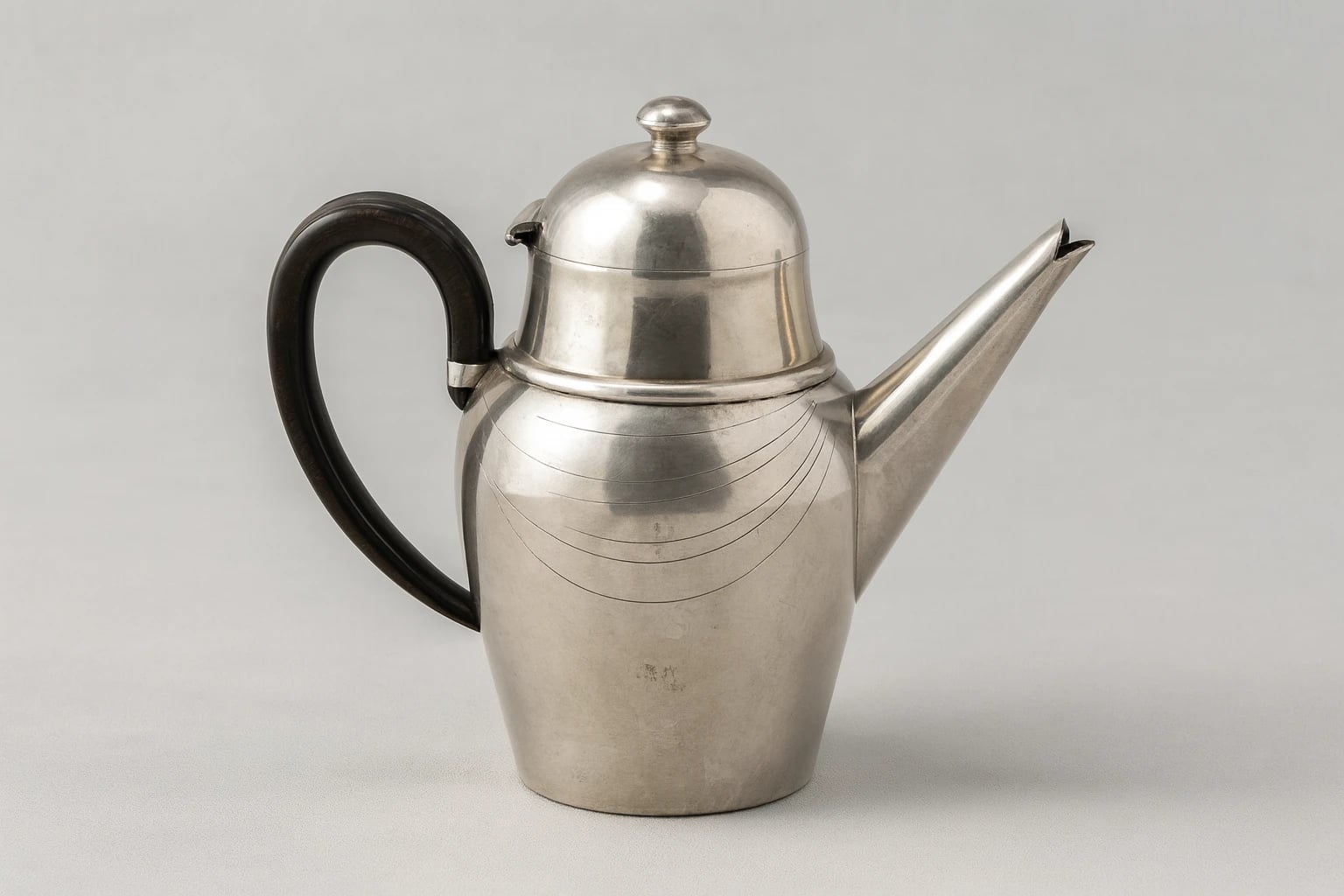
Early Rosewood Coffee Pot
First Design Period: 1931 - 1946
Silver