Saves instantly, no account needed. Already a member? Sign in.
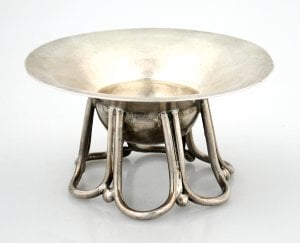
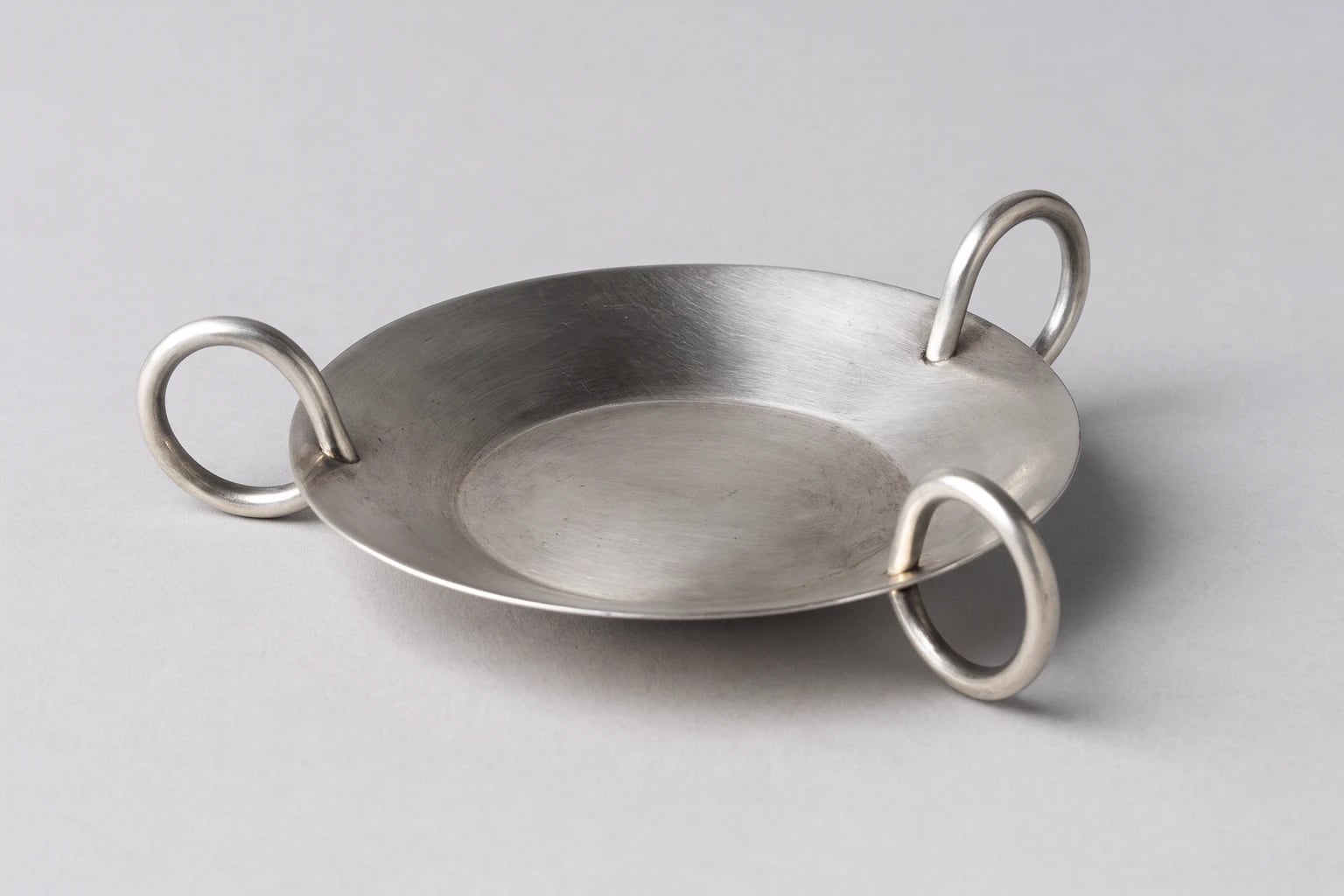
A shallow silver dish gains its structure from three looped handles set at even intervals around the rim, each rising and returning to the body in a single continuous curve. The design reduces the ashtray to two ideas: the flat circle that holds and the three loops that lift. Those loops do more than provide a grip. They convert a utilitarian object into an exercise in rhythm, spacing the interruptions of the rim so that the eye moves around the circle at a steady interval. This is silver holloware conceived as small sculpture, where function and geometry are resolved in the same gesture.
The circular pan reads as a plain reflective plane, its polish returning light across an uninterrupted surface. Against that flatness, the handles introduce the only sustained curvature in the piece, and their repetition at three points establishes a triangular order beneath the round outline. The looped form is efficient: a strip of silver bent back on itself gives the fingers a hold while lifting the rim clear of a surface. Spratling favored this kind of economy, in which a single repeated element organizes the whole object without applied ornament. The restraint is deliberate. Nothing distracts from the relationship between the disc and its three raised punctuations.
The ashtray belongs to Spratling's third design period, the years from 1951 through 1967 when he had returned to a smaller workshop on his ranch outside Taxco. Morrill records that in these final years Spratling had turned much of his attention to collecting ancient Mexican art and had ceded production control to Juan "Cancana" Gómez, with Don Tomás Vega serving as maestro of the taller. Objects from this period were made in modest numbers and stamped with the eagle mark, which Alberto Ulrich confirmed remained in use up to Spratling's death in 1967. The taller system that produced this piece was the same structure that allowed the Taxco School to flourish: a designer setting the form, master smiths translating it into finished silver. Holloware such as this shows Spratling applying the clarity he brought to jewelry to the objects of everyday domestic use, where a cigarette rest could still be an occasion for controlled design.
Within Spratling's output, functional silver of this kind documents how thoroughly he extended a modern sensibility across categories that other makers treated as afterthoughts. The ashtray sits alongside his flatware, boxes, and serving pieces as evidence that the renaissance in Taxco silver reached the table and the smoking stand, not only the body. Its interest lies less in rarity than in demonstrating a characteristic method: strip an object to its essential geometry, then let a single repeated form carry both use and rhythm. It records the habits of the late Spratling workshop and the way a plain circle of silver could be organized into something considered.
Museum of Mexican Silver. “Looped Handle Ashtray.” Catalog no. MoMS-000720. https://museumofmexicansilver.com/pieces/spratling-3026
See something wrong with this record? Suggest a correction and the piece details fill in automatically.
William Spratling
Footed Square Ashtray
Third Design Period: 1951 - 1967
Silver