Saves instantly, no account needed. Already a member? Sign in.
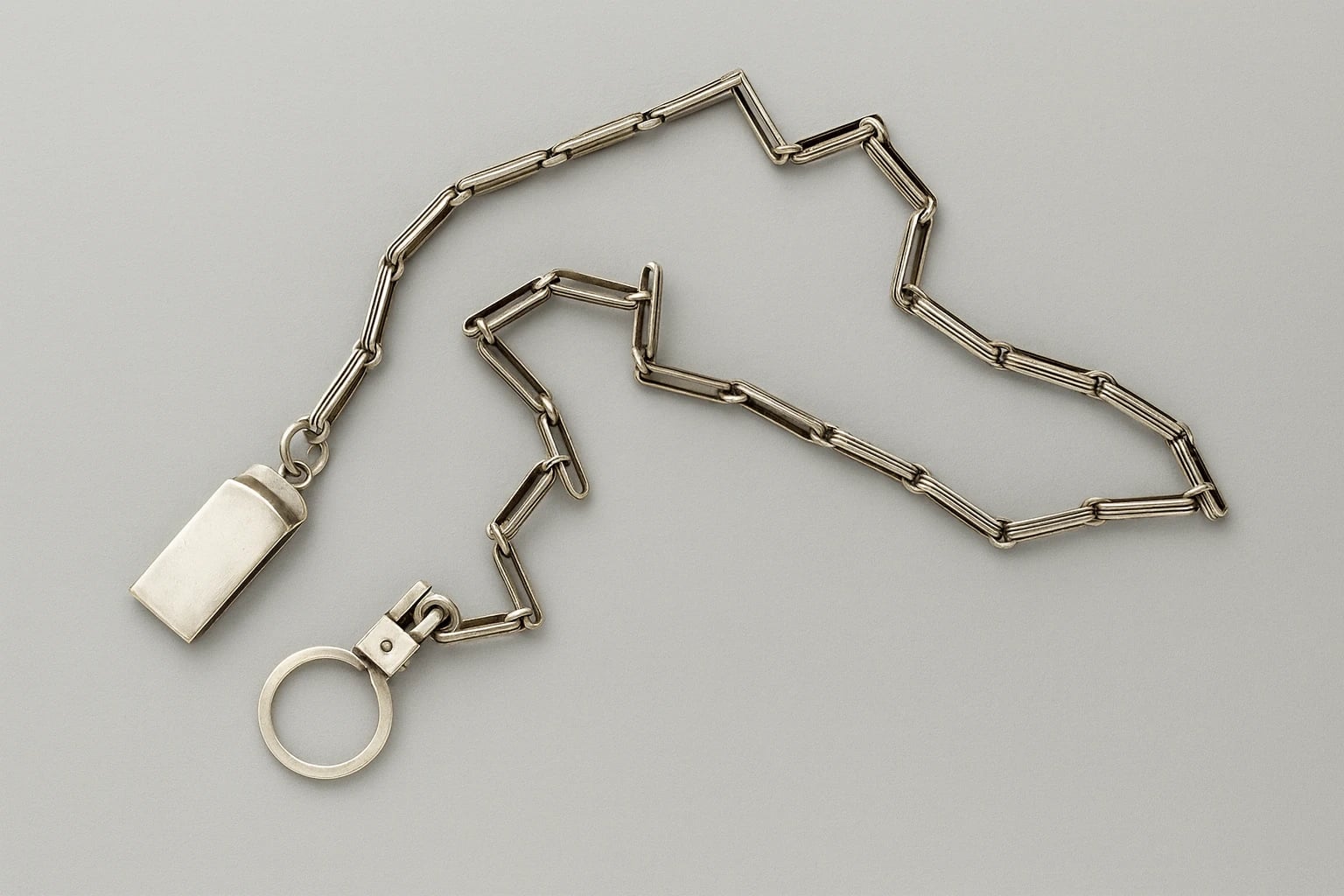
A watch fob chain built entirely from elongated, striated links carries a functional object into the vocabulary of Spratling's silver design. The chain does not disguise its purpose. It ends in a broad U-shaped fastener at one terminal and a ring fitted with a push-button slide mechanism at the other, both of which anchor a watch to a garment. What distinguishes the piece is the treatment of the links themselves, each drawn out and scored with parallel striations so that the chain reads as a continuous run of textured metal rather than a series of anonymous loops. The result is an accessory for a man's pocket watch handled with the same formal attention Spratling gave to jewelry meant for display.
The striations do the essential work. Parallel grooves cut or drawn along each link catch and break the light, so that the surface animates as the chain moves and turns. Because the links are elongated rather than round, the chain has a directional rhythm, a sense of forward travel from fastener to slide ring. The two terminals are deliberately unlike each other in form and function. The U-shaped fastener presents a wide, closed curve, while the push-button slide ring introduces a small mechanism that a wearer operates with the thumb to adjust or secure the chain. Spratling's workshop understood that a fob chain is handled as much as it is seen, and the design accommodates that handling without concealing how the object works.
Spratling founded the Taller de Las Delicias in Taxco in 1931 and organized a production system in which designers, maestros, and executing silversmiths collaborated under his direction and mark. A fob chain of this kind reflects that system's range, since the taller produced hollowware, flatware, and functional accessories alongside the jewelry for which it became internationally known. The workshop trained a generation of silversmiths, among them Enrique Ledesma, who worked at Las Delicias before passing through Los Castillo and Taller Borda and eventually opening his own shop around 1950. Objects such as this locate Spratling's practice within the broader concerns of the Mexican silver renaissance, where the smith's attention extended to the objects of daily use, not only to ornament. The precise mark, fineness, and date of fabrication would refine the placement of this example within Spratling's long output, which runs across marks from the early Taxco WS stamps of the 1930s through the eagle-numbered marks of the 1950s and 1960s.
For a collection tracing the reach of the Taxco School, a functional accessory treated with this level of formal care records a dimension of Spratling's practice that jewelry alone cannot show. The chain demonstrates how the workshop approached utility, applying a consistent design intelligence to an object built to hold a pocket watch. It preserves a form of men's silver that has largely disappeared from use, and it shows the taller extending its textural and structural vocabulary into the ordinary equipment of a wardrobe.
Museum of Mexican Silver. “Striated Link Watch Fob.” Catalog no. MoMS-000832. https://museumofmexicansilver.com/pieces/spratling-3029
See something wrong with this record? Suggest a correction and the piece details fill in automatically.
William Spratling
Banded Rosewood Salad Spoon
First Design Period: 1931 - 1946
Rosewood