Saves instantly, no account needed. Already a member? Sign in.
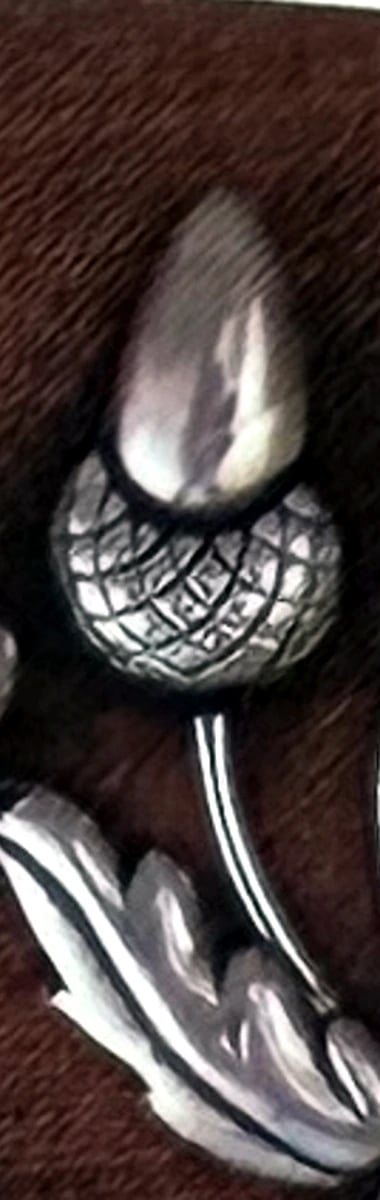
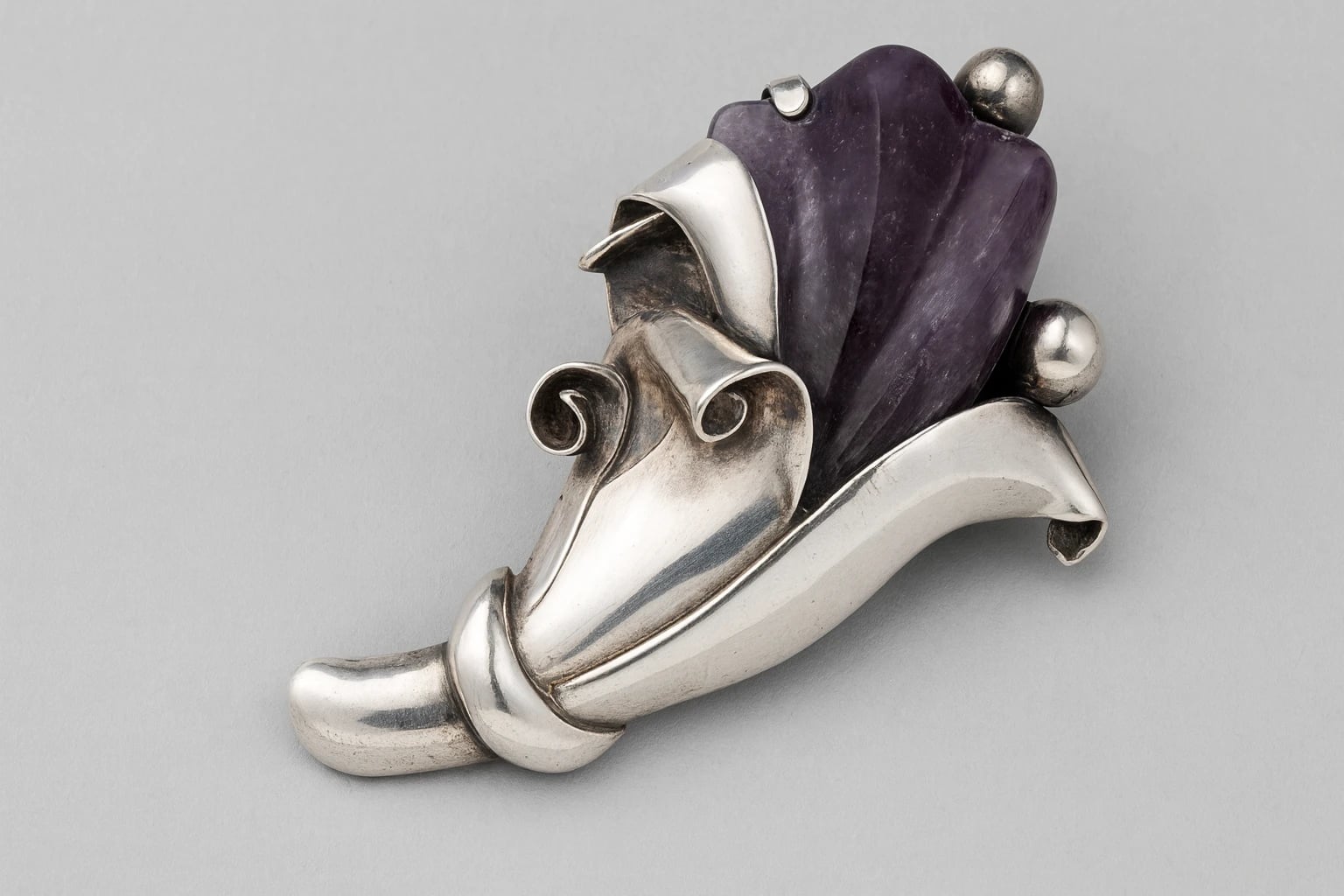
A faceted amethyst crystal sits at the heart of this brooch, framed by silver leaves and petals worked into an organic, naturalistic bloom. The design lets the stone lead, with the metalwork arranged around it as a living floral composition rather than a rigid setting. The floral brooch was a Vidaurreta specialty: Morrill records that while working in Mexico City he produced large repousse cuff bracelets, elaborate and naturalistic flower belt ensembles with matching pins, and many different floral brooches (Morrill, p. 114).
Vidaurreta's significance in the Taxco story is outsized relative to his surviving output. He established his first workshop in Mexico City in 1936 and sold his work to Fred Davis at Sanborn's (Morrill, p. 114), and it was under his tutelage that the young Antonio Pineda learned silver design that same year (Stromberg, p. 73). His naturalism, organic, botanical, three-dimensional, ran counter to the geometric currents of the school and shaped designers who became far more famous than he.
The amethyst-and-silver flower brooch is a compact statement of that sensibility, the cool metal foliage drawing out the saturated purple of the stone.
Dating to 1948-1950, the brooch is recorded in Gobi Stromberg's Silver Seduction: The Art of Mexican Modernist Antonio Pineda (2008, p. 89, plate 74) and carries the Valentin, 940, Taxco, Mexico marks with the Mexican eagle assay stamp.
Museum of Mexican Silver. “Amethyst Flower Brooch.” Catalog no. MoMS-001580. https://museumofmexicansilver.com/pieces/vidaurreta-brooch-amethyst-flower
See something wrong with this record? Suggest a correction and the piece details fill in automatically.