Saves instantly, no account needed. Already a member? Sign in.
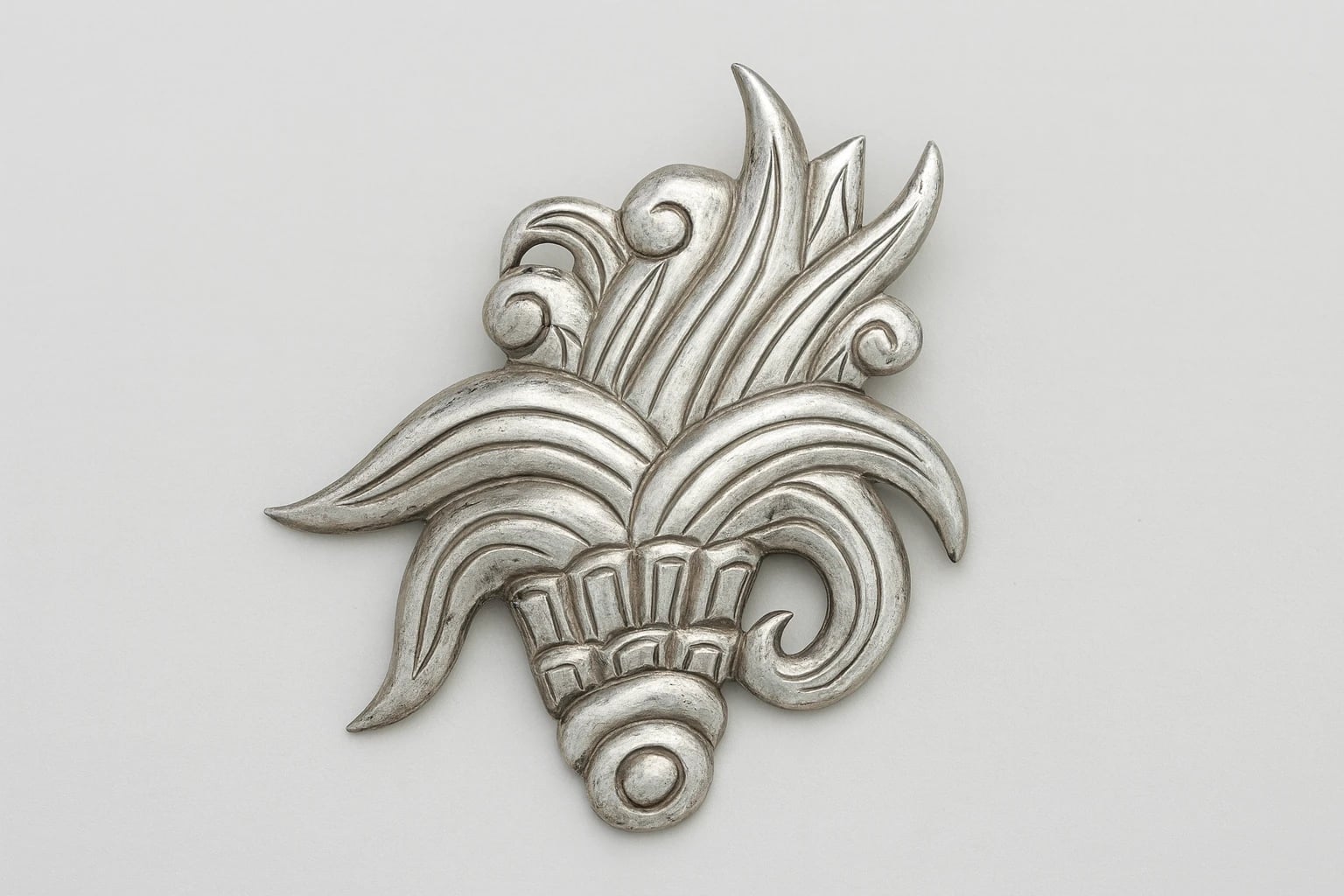
This brooch is a superb example of Héctor Aguilar’s ability to convert a familiar ornamental form into a forceful Taxco modernist object. The subject is nominally a cornucopia—the classical horn of abundance—but Aguilar treats it less as a literal vessel of fruit or plenty than as an exploding silver form: half vegetal, half heraldic, almost architectural.
The design is built around a dynamic upward thrust. From the lower knop, a fan of chased silver ribs rises and splits into flame-like leaves, scrolls, and curling tendrils. The piece has the theatrical silhouette of a plume or crest, but its vocabulary remains rooted in traditional ornament: acanthus leaves, volutes, shell-like curves, and the harvest symbolism of the cornucopia. This is exactly where Aguilar is strongest. He does not merely copy antique ornament; he thickens it, simplifies it, and gives it the bold scale and sculptural presence associated with the Taxco School.
The surface work is important. The ribs are deeply chased, giving the brooch a carved, almost repoussé-like dimensionality. The high points catch light; the recesses retain dark oxidation. That contrast is not decorative incidental—it is the mechanism by which the piece reads as sculpture. Aguilar’s better work often depends on this aggressive use of relief, line, and shadow, and this brooch sits squarely in that language.
The form also reveals Aguilar’s position between Spratling’s weight and Vidaurreta’s baroque naturalism. Morrill and Berk note that Aguilar left Spratling’s Las Delicias to form Taller Borda, taking silversmiths with him, and that his early work retained the “weight and muscularity” of Spratling’s designs. They also note that Valentin Vidaurreta supplied many of the elaborate floral designs for which Taller Borda became known. This brooch feels like a collision of those two streams: Spratling’s mass and Aguilar’s boldness, filtered through a more florid, vegetal, almost baroque sensibility.
The lower and upper scrolls are especially good. They prevent the piece from becoming a flat fan. The left side sweeps outward horizontally, while the right side curls inward, creating a counter-rotation that gives the object movement. The result is not symmetrical, but it is balanced. That asymmetrical balance is one of the reasons the brooch feels modern rather than merely decorative.
As a wearable object, it would have had real presence. This is not a small accent brooch; it is a chest-scaled silver emblem. It belongs to the mid-century Mexican category of jewelry as portable relief sculpture—objects intended to be worn, but conceived with the ambition of architectural ornament, metal sculpture, and modern design. In the Taxco context, this matters. The Taxco School’s major achievement was not simply making attractive jewelry; it was transforming silver jewelry into an independent modern art form, through handwrought fabrication, bold scale, and a sophisticated synthesis of Pre-Columbian, colonial, popular, and international modernist vocabularies.
Museum of Mexican Silver. “Cornucopia Brooch.” Catalog no. MoMS-001982. https://museumofmexicansilver.com/pieces/aguilar-940-silver-cornucopia-brooch-pendant-37
See something wrong with this record? Suggest a correction and the piece details fill in automatically.
The cornucopia subject also carries useful interpretive weight. In European tradition it signifies abundance, fertility, harvest, and prosperity. In Aguilar’s hands, however, the abundance is not literal fruit spilling from a horn; it is the silver itself bursting into leaves, flames, scrolls, and ribs. The material becomes the offering. That is a very Taxco idea: silver as both medium and message.
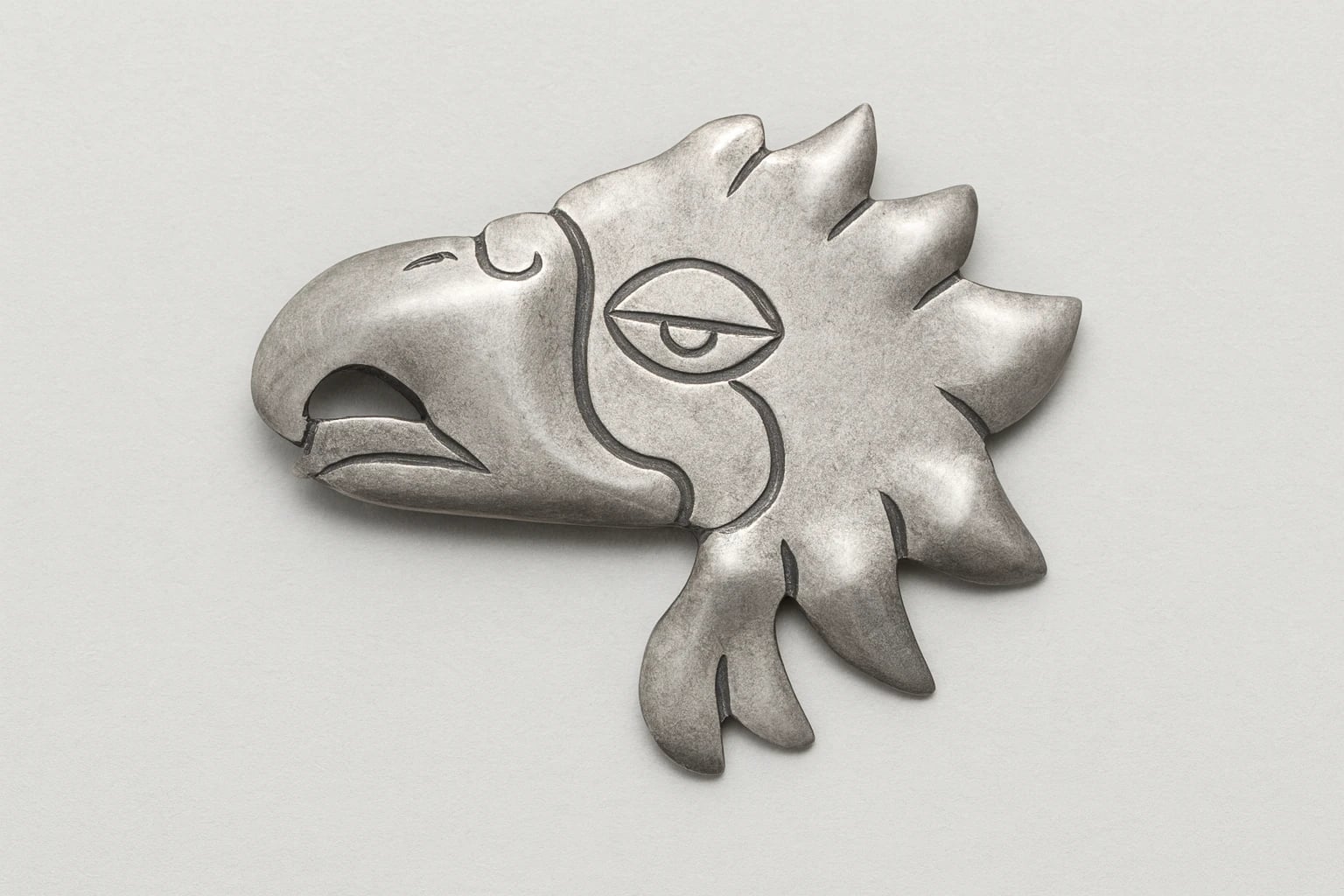
Héctor Aguilar
Eagle Head Brooch
c. 1940
940 silver