Guide · April 21, 2026
Mexican Silver Hallmarks: How to Read Taxco Marks, Eagles and Numbers
A Golden Age hallmark tells you who made the piece, where, what the silver content is, and, after 1948, which workshop was registered to the Mexican government. Here's how to read each part.
8 min read
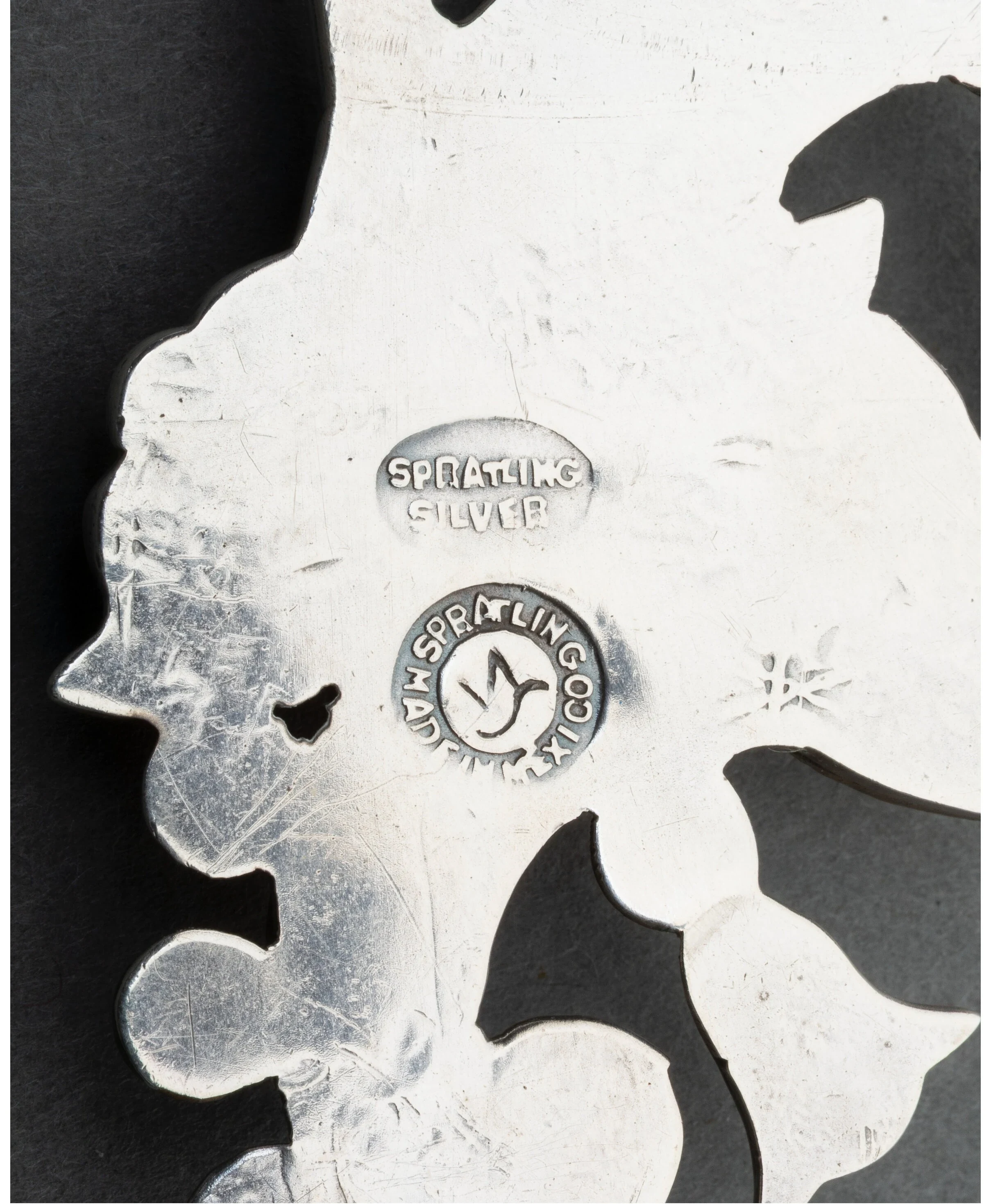
A hallmark on a piece of Taxco silver is a small stamped record. It identifies who made the piece and, after 1948, it records that the workshop was registered with the Mexican government to produce legal-standard silver. In between those two things sits the number that tells you how much silver is actually in the alloy. Reading the parts together is how you date a piece, attribute it to a workshop, and sanity-check the silver claim.
This guide walks each component, then works through a William Spratling mark line by line. Every claim is sourced to Penny Chittim Morrill's Mexican Silver (Schiffer) or Gobi Stromberg's Silver Seduction: The Art of Mexican Modernist Antonio Pineda (Fowler Museum, 2008), the two canonical references for the Taxco Golden Age. Page numbers are cited inline.
What does a Taxco silver hallmark contain?
Before 1948, a Taxco maker's hallmark was essentially a signature: the artisan's initials or name, often with the place of manufacture and a number expressing the silver content. After 1948 the Mexican federal government introduced a second stamp, the eagle registration mark, meant to guarantee the silver purity and levy tax on it. Kim Richter, writing in Stromberg's Pineda monograph, walks through the five components of a typical Pineda hallmark (p. 81):
- Place of manufacture, usually "TAXCO," "HECHO EN MEXICO," or "MADE IN MEXICO"
- Silver quality, a three-digit number reflecting parts of pure silver per thousand (925 = sterling; 970 was Pineda's most common; 980 also appears)
- Eagle registration mark, the government stamp plus the workshop's assigned eagle number (Pineda's was Eagle 17)
- The maker's personal mark, for Pineda after 1953, "Antonio" in an arched crown cartouche
- An inventory or design number, Pineda used letter pairs to encode form factor: 99 rings, 89 brooches, 82 buckles, 77 necklaces, 22 bracelets (Stromberg/Richter, p. 81), appended to a digit sequence
Not every workshop used all five. Small shops often skipped the inventory number entirely. What the components have in common is that each one is a separate punch, a hallmark is a composition of marks, not a single stamp.
What do 925, 940, 970, and 980 mean on Mexican silver?
The three-digit number is a purity claim: parts of pure silver per thousand parts of alloy. Several values turn up repeatedly in Golden Age Taxco:
- 925, sterling. The U.S. standard, 925 parts silver per thousand (Stromberg/Richter, p. 79). Most post-1945 Taxco work ran at 925. Morrill's figure captions show TAXCO 925 and STERLING stamps across Spratling's post-1944 output (e.g., Morrill p. 72).
- 970, Antonio Pineda's house standard. Richter: "The quality of the silver content in Pineda's work was usually indicated by the number 970, meaning that it was 97% pure silver" (Stromberg, p. 79).
- 980, "Spratling Silver." In the Montgomery Ward Christmas 1943 catalogue, Spratling Silver was described as "a silver purer and finer than sterling with less tendency to oxidize and discolor the skin and with a softer luster when finished. Spratling Silver is 980/1000 pure silver while sterling, according to U.S. government standards, is only 925/1000 pure silver" (quoted in Morrill, p. 45). A TAXCO 980 stamp shows up across multiple unrelated makers in Morrill (Rafael Dominguez p. 152; Valentín Vidaurreta p. 115; Serafín Moctezuma p. 38), suggesting 980 was a common Golden Age mark for pre-sterling-era Taxco output, not exclusive to Spratling.
- Other values, Morrill's own reference gallery documents an unattributed "Taxco 960 brooch in silver and onyx, c.1945" (plate XXVII-4, p. 244), and oddities like "ESTEREO MADE IN MEXICO 580" (Los Castillo, p. 87) and "METALES CASTILLO 883" (Los Castillo, p. 92) turn up where the number appears to reference a mixed-metal line (Los Castillo's Metales Casados) rather than a silver-purity claim.
The number alone doesn't prove purity, an unscrupulous workshop can stamp whatever it wants, which is exactly why the 1948 eagle registration was introduced.
What is the eagle mark on Mexican silver?
Starting in 1948, the Mexican federal government required every registered silver workshop to apply an eagle stamp along with a numerical code identifying the workshop. Per Richter (Stromberg, p. 81):
Eagle marks were simple to obtain from the government, and shops used many different eagle marks at various times. Major silver workshops received a number that was imprinted with their specific eagle mark, while small shops were not given individual numbers and instead used the "Eagle #3."
The eagle was simultaneously a tax instrument, the government levied a fee on registered silver output, and a consumer guarantee that the silver content was honest.
The one eagle-to-workshop assignment that both canonical texts confirm is Eagle 17 for Antonio Pineda, called out by Richter as Pineda's "most common" number and dated 1948-1979 (Stromberg, p. 81). Richter also documents the generic Eagle 3, used by small shops that were not given their own registration (Stromberg, p. 81). Other workshop-to-eagle assignments circulate in collector references, our hallmarks corpus catalogs the post-1948 Eagle marks tied to each Golden Age workshop, but they are not enumerated together in either Morrill or Stromberg, so cross-check any specific attribution against the actual mark rather than a claimed assignment.
The system was short-lived. Richter records that the eagle mark was "officially abandoned by 1979-1980," at which point the Mexican government introduced the letter-number registration system that is still in use today (Stromberg, p. 81).
What do post-1980 letter-number marks like TS24 mean?
The post-1980 system assigns each silver manufacturer a two-letter prefix plus two or three digits. Richter gives the exact anatomy: "TS24, where the 'T' stands for Taxco and 'S24' for Spratling" (Stromberg, p. 81). Other T-prefix codes follow the same logic.
This matters for collectors in two directions.
First, a TS24 stamp is not a warning sign. It is Spratling's legitimate post-1980 government registration code, the one his successor workshops (Sucesores de William Spratling, a.k.a. "DT" for Don Tomás Vega, Morrill pp. 246-247) have been required to use since the eagle was retired. Pieces carrying TS24 are legally registered post-1980 Spratling-workshop silver, not counterfeits.
Second, the letter-number system strips the visual identity the pre-1980 hallmark carried. Morrill puts the point sharply:
The advent of the new system in c. 1980 of identifying silversmiths with numbers and letters is an unfortunate one. Without the signature of the maker, the new marks further remove the artisan from the buyer, increasing the level of anonymity (Morrill, p. 244).
In practice, pre-1980 pieces are what most collectors mean when they say "Golden Age Taxco", the era when a maker's initials were the primary identifier, and the government stamps were supporting evidence.
How do you read a William Spratling hallmark?
The image at the top of this guide is the composite mark Spratling used on his cataloged work between roughly 1940 and 1944. Morrill describes it exactly (p. 45):
The mark which is consistently found on pieces that appeared in the catalogues is the "WS" surrounded by a narrow band on which is inscribed, "Spratling Taxco Mexico." This mark is coupled with an oval indentation in which the words, "Spratling Silver" appear. The latter oval mark indicated the silver content as 980.
Decomposed, the mark tells you:
- Maker, the WS monogram in the center of the circle. Spratling's personal signature; the only element that individually names the artisan.
- Place, SPRATLING TAXCO MEXICO around the circle's border. Identifies both the workshop (Spratling) and the town (Taxco, Mexico) of manufacture.
- Silver content, SPRATLING SILVER in the oval above, which the 1943 Montgomery Ward catalogue copy confirms was Spratling's brand name for 980/1000 silver.
- No eagle, the eagle registration system began in 1948, after this mark. On Spratling pieces dated 1948 or later you'll see an eagle stamp added to the composite.
For the full chronology of Spratling marks, from the 1931 print-brand monogram through the late-period script marks, see the William Spratling profile.
How do you spot fake or misread Taxco hallmarks?
Worn stamps get transcribed wrong. A 5 can pass for a 3, a 9 for a 6. Auction cataloguers read hallmarks in good faith and sometimes miss. If a design attribution depends on a single digit of a stamp, cross-check against a cataloged example before trusting it. The Margot 5194 and 5537 anomalies documented in the Margot design-numbers guide are likely this kind of misread.
A "TAXCO" stamp alone is not an attribution. Morrill's own Ch. XXVII reference gallery (pp. 244-247) includes pieces cataloged as unattributed Taxco silver, the place stamp was used by workshops whose maker marks have been lost or were never applied. An unattributed Taxco stamp says "made in Taxco," not "made by [someone specific]."
Known counterfeits exist and are cataloged. Pre-1980 Aguilar pieces, for example, have a widely-documented "fake tail" variant in circulation: a hand that copies the HA monogram but renders the descending stroke of the "A" incorrectly. Our hallmarks reference flags these and other known-counterfeit examples alongside the legitimate chronologies.
Post-1980 letter-number codes are not fakes. A TS24 is Spratling's legitimate registration under the post-1980 system (Stromberg, p. 81). T-prefix codes on other Taxco workshops follow the same construction, T for Taxco plus a workshop identifier, and pieces bearing them are post-Golden-Age but legally registered silver, not counterfeits. They're different from pre-1980 pieces, not suspect.
Missing eagle on a post-1948, pre-1980 piece labeled "Taxco" is worth checking. The eagle was the registration proof; a workshop producing silver legally in Mexico during that window would have had an assigned number. The absence is not automatic evidence of forgery, but it's a prompt to look more carefully at the other elements.
Where can you look up a specific Taxco hallmark?
- Browse the full hallmark corpus, every cataloged mark across all eight Golden Age workshops, organized by artist and period, with the known counterfeits flagged.
- Reading Margot de Taxco's design numbers, the companion guide on how Margot's 5xxx stamps work (design number, not item number).
- Each artist profile carries a mark chronology section, for example, Spratling's twelve documented marks from 1931 through the late successor period, or Pineda's five dated marks with the Eagle 17 reference image.
Sources
- Penny Chittim Morrill and Carole A. Berk, Mexican Silver: 20th Century Handwrought Jewelry & Metalwork (Schiffer, revised). Spratling Silver mark and 1943 Montgomery Ward quote at p. 45. Chapter XXVII (Hallmarks), pp. 242-247, including the post-1980 letter-number critique at p. 244 and the full reference list of Golden Age maker marks pp. 245-247.
- Gobi Stromberg, Silver Seduction: The Art of Mexican Modernist Antonio Pineda (Fowler Museum at UCLA, 2008). Kim Richter, "A Chronology of Pineda's Hallmarks," pp. 79-81. Eagle-mark institution and abandonment dates, TS24 decomposition (T = Taxco, S24 = Spratling), and the anatomy of a Pineda mark (place, silver quality, eagle registration, maker's mark, inventory number) all from p. 81.
- William Spratling quoted in the Montgomery Ward Catalogue, Christmas 1943, via Morrill p. 45: "Spratling Silver is 980/1000 pure silver while sterling, according to U.S. government standards, is only 925/1000 pure silver."