Guide · April 21, 2026
Reading Margot de Taxco's design numbers
A 5xxx number on a Margot piece identifies a design, not a specific item. Here's what the stamp actually tells you, and what to watch for when it doesn't.
4 min read
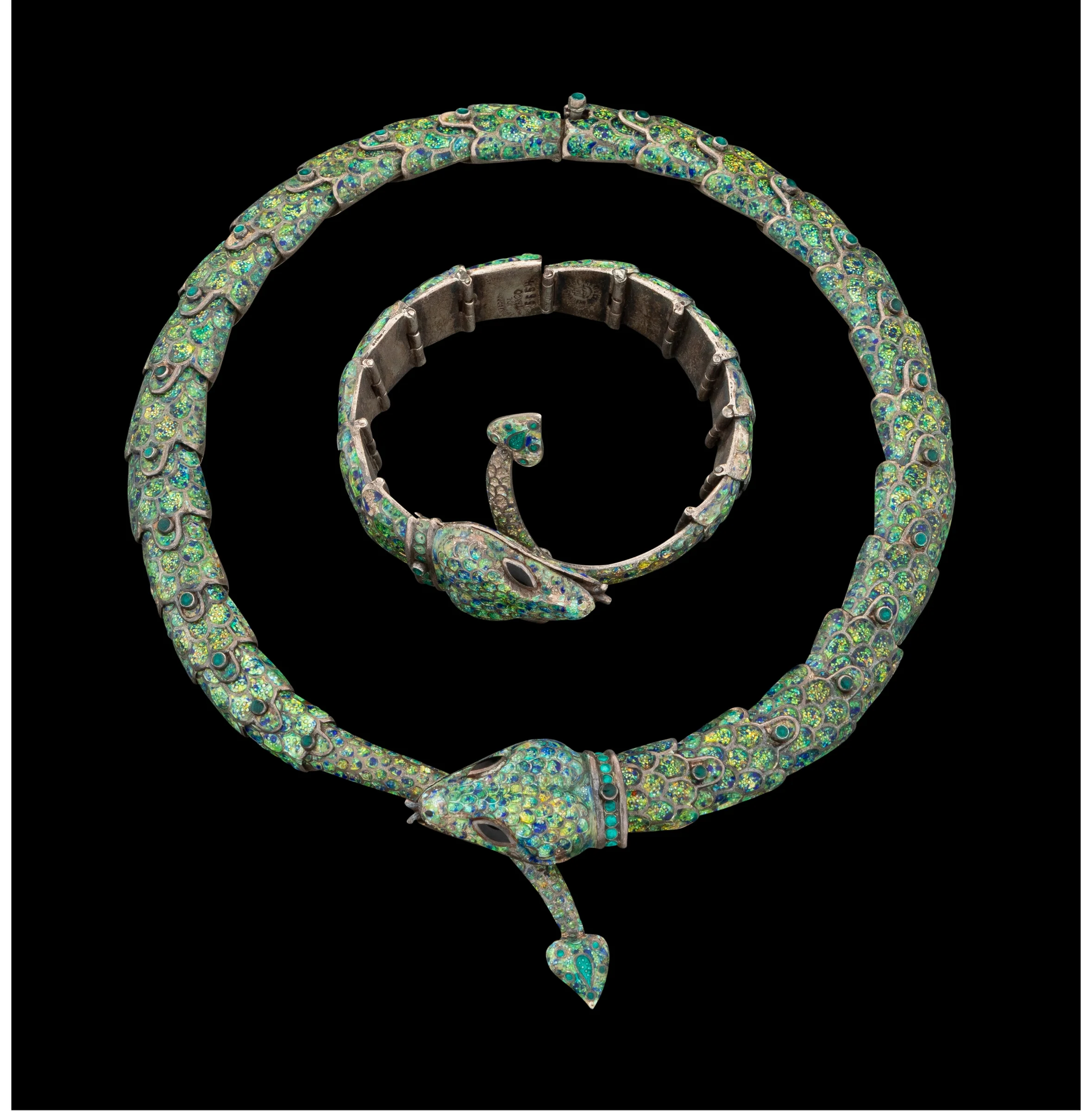
A five-thousand-series number on a Margot de Taxco piece identifies a design, not a specific item. When a design was issued as a matched set, every form factor in that set — necklace, bracelet, earrings, brooch, cuff links — was stamped with the same number. Two apparent counterexamples in the auction record look like cataloguing errors rather than the rule breaking.
This guide walks the evidence: two parures where every form has been photographed and documented, a handful more where dealers have recorded the shared-number pattern, and the cases where the stamp appears to contradict itself.
What does the number on a Margot de Taxco piece mean?
Penny Chittim Morrill — the definitive scholar on Taxco silver, author of Schiffer's Mexican Silver and the Margot monograph Margot Van Voorhies: The Art of Mexican Enamelwork (2010) — documents Margot's output as a numbered design catalogue, not a serial-number register. All-sterling designs ran roughly 5100 through 5790; enamel designs ran 5109 through 5922. Inside that index, a given number points to one design. The number does not change when the same design was executed as a bracelet rather than a necklace.
That makes the stamp useful in a specific way: if you can read the 5xxx number on a piece, you can look up the design. If the design you see doesn't match, you have a reason to doubt the hallmark read or the attribution, not the numbering system.
What is Margot de Taxco design #5554?
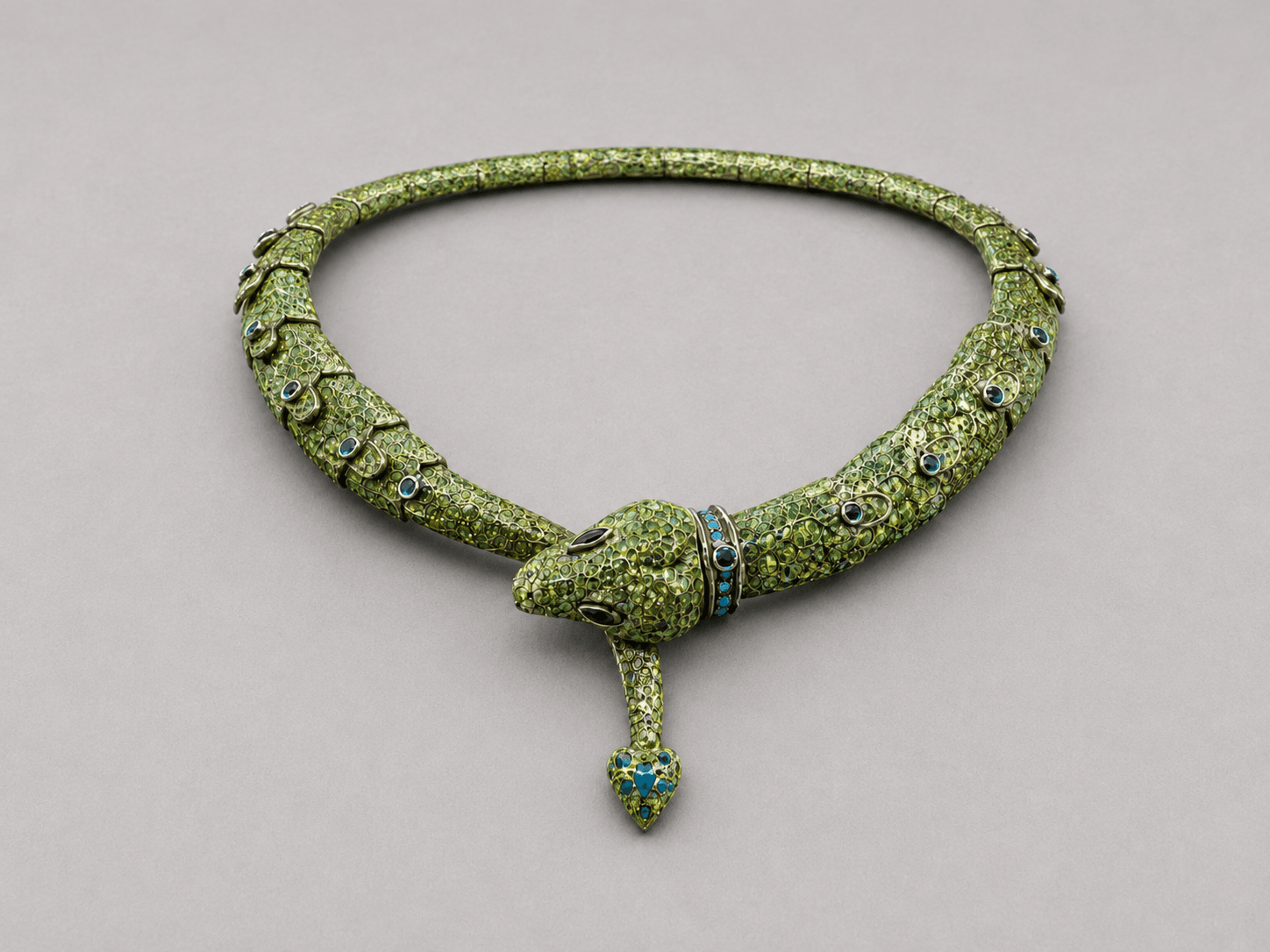
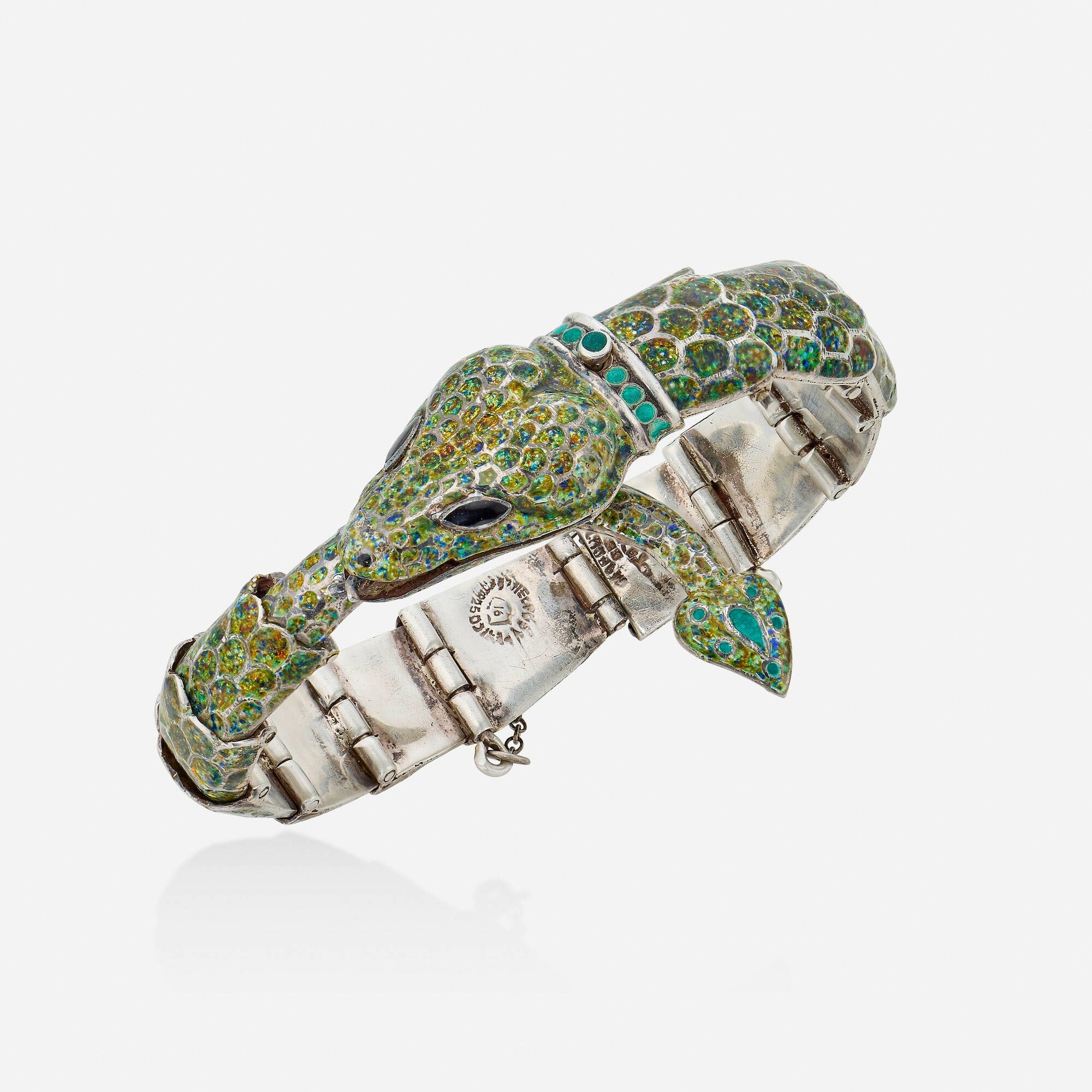
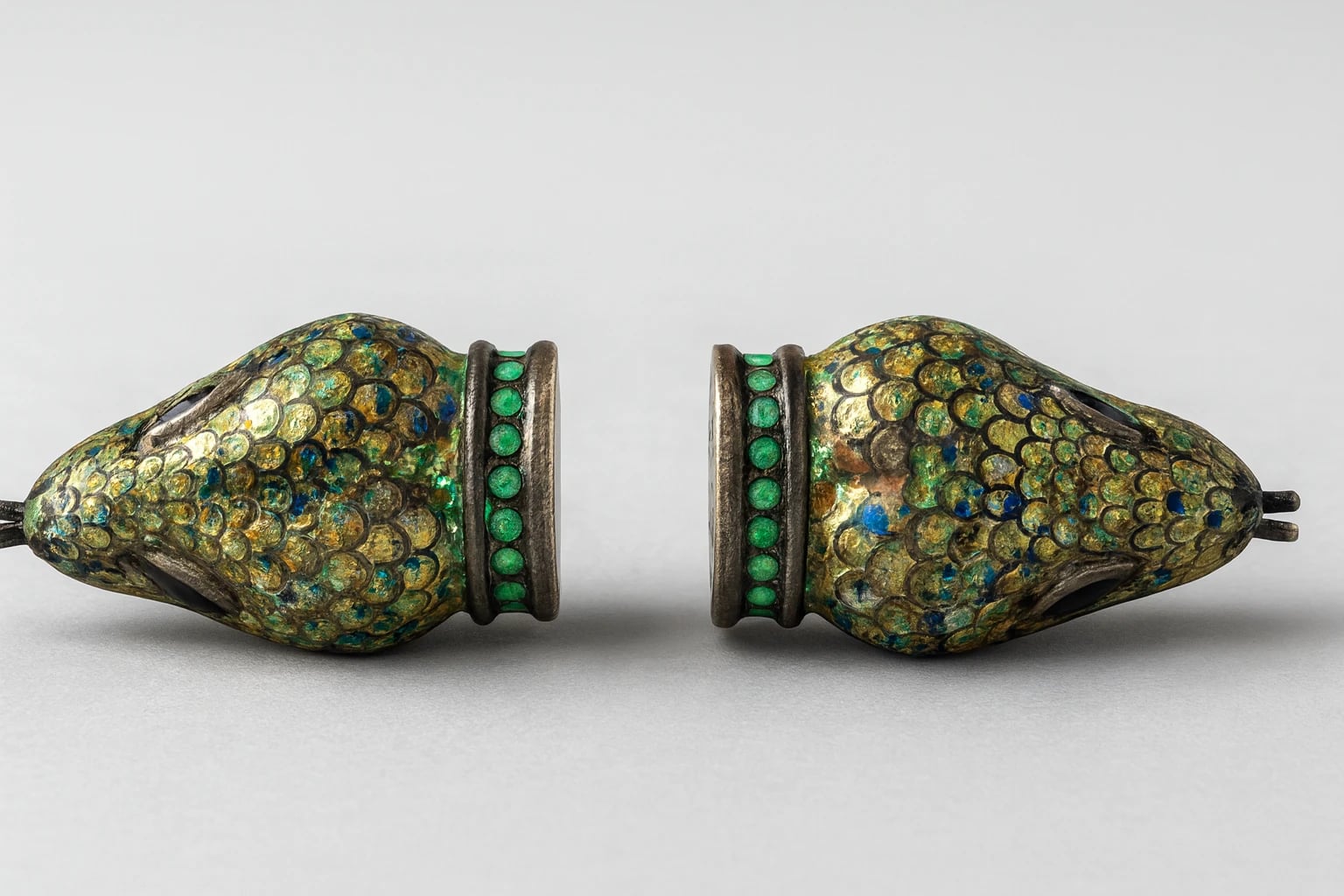
Heritage's 2020 sale of design #5554 is the clearest public proof. A single auction lot included the champlevé serpent necklace, the matching bracelet coiled inside the chain, and the cuff links. All three carry the same enamel-over-silver scale pattern. All three are stamped 5554. A later 1stDibs listing that reunited the set cited Morrill pages 138–139 and 175 explicitly, confirming the design was issued as a coordinated parure.
Surviving examples carrying design #5554:
What is Margot de Taxco design #5207, the Double Fish parure?
A Rago/Phillips lot catalogued as Margot Van Voorhies Carr's "Double Fish" set sold as a single parure: sterling and amethyst necklace, earrings, and cuff bracelet, each stamped 5207, dated to the 1950s. The auction lot notes cite Morrill's Dreaming in Silver, page 241, as illustrating a similar 5207 necklace.
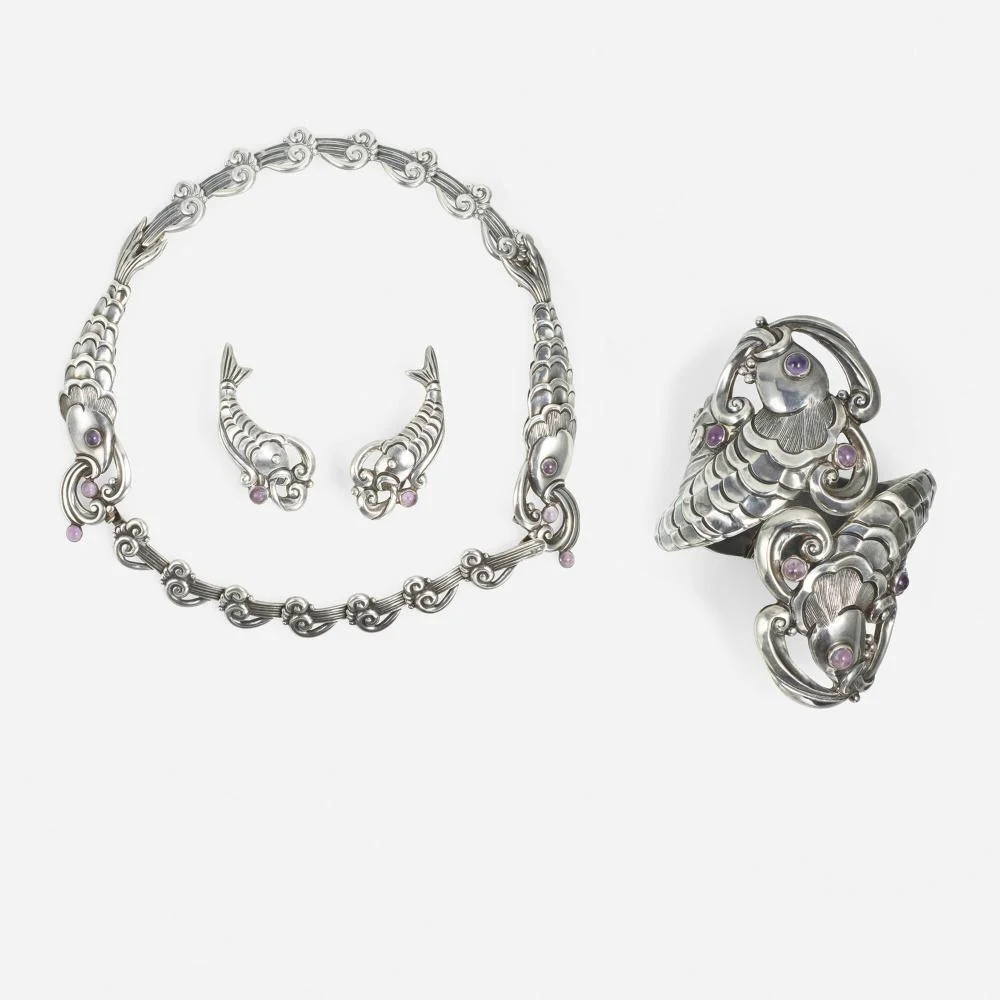
Three form factors, one number:
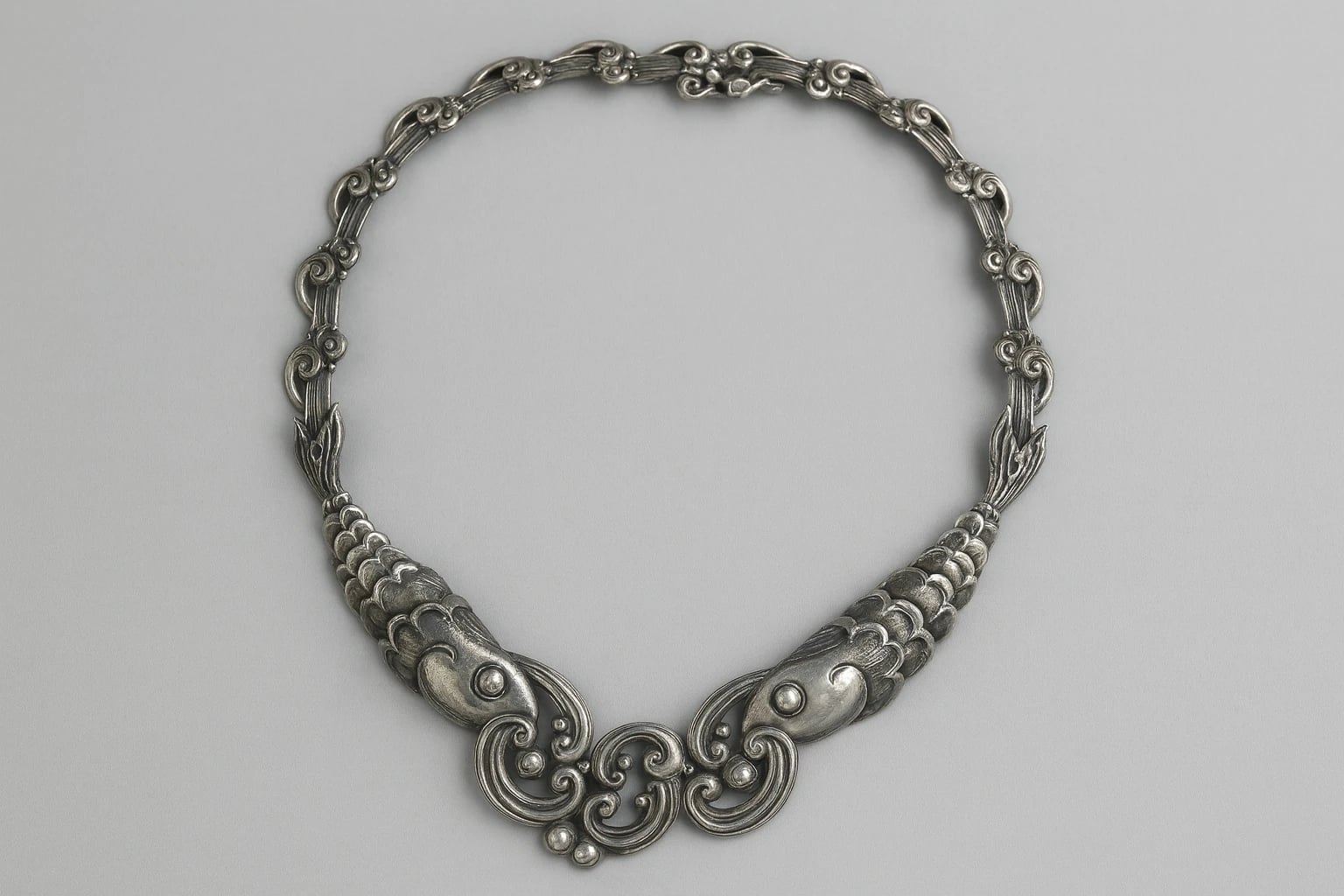
Necklace
Margot de Taxco
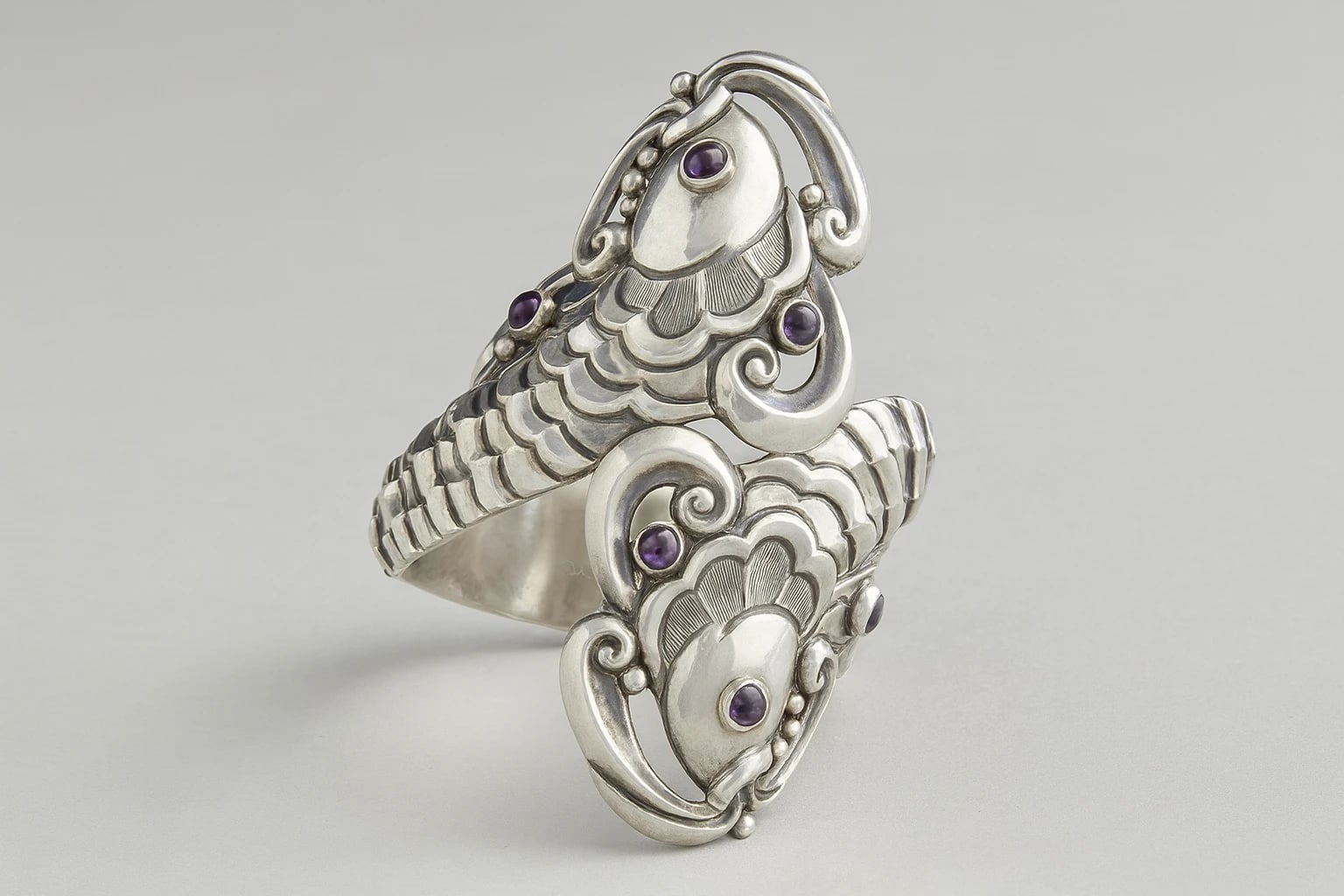
Cuff bracelet
Margot de Taxco
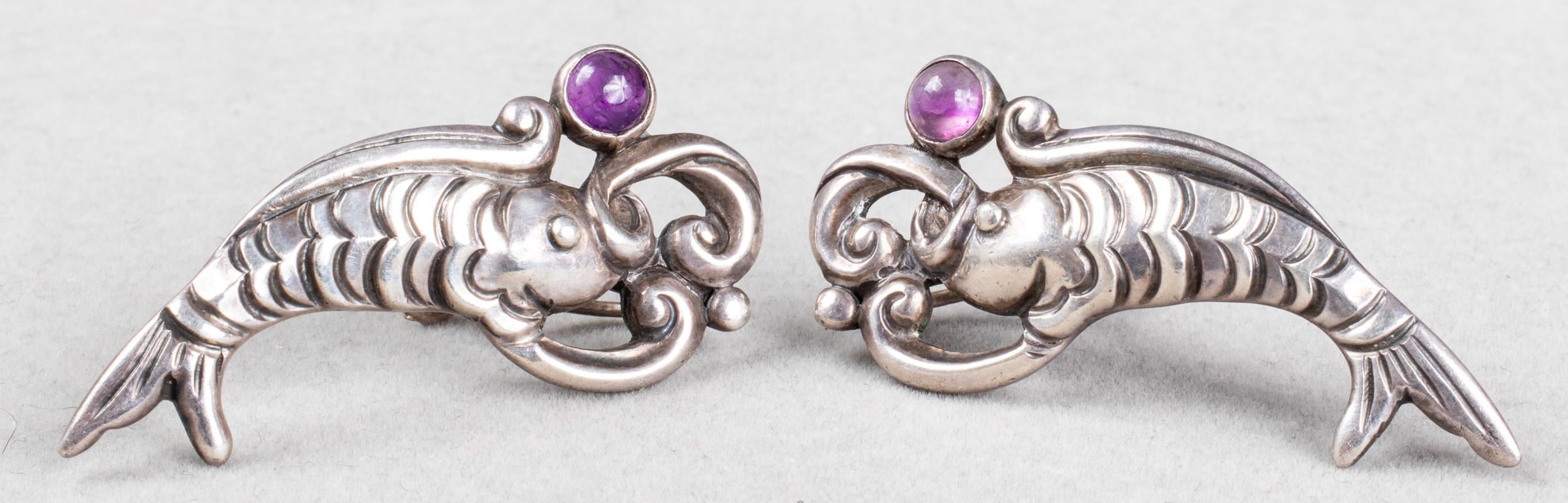
Earrings
Margot de Taxco
A separate #5207 B variant (koi with amethyst drops) is documented elsewhere — within-design variant suffixes are normal.
Which other Margot sets share one design number?
Dealers regularly list multi-piece Margot sets sharing one stamp. A few well-documented examples:
- #5778. Sterling panel necklace, bracelet, and earrings, all stamped 5778 (GemSetLove).
- #5158 / #5158A. Multi-piece silver set; the "A" suffix indicates a within-design variant (Trocadero / Look At That Necklace).
- #5339. Silver swirls clamper bracelet, photographed with matching items under the same design number (Lisa Kramer Vintage).
These are independent dealer references, not catalog entries. They would only make sense if the number were identifying a shared design rather than one item.
Why do some Margot numbers appear on different designs?
Two cases in the public auction record carry the same 5xxx number on visibly different designs.
Design #5194. Heritage catalogued a rose-form-link silver necklace stamped 5194. Invaluable's sale history includes a heart-and-cherubs brooch also stamped 5194. The two are unrelated visually — one is a chain of sculpted rose-form links, the other a flat brooch with cast figurative decoration.
Design #5537. An ecclesiastical St. Christopher enamel pendant appears with a 5537 stamp in two independent Invaluable sales. A separate lot describes a fleur-de-lis brooch with black and gold enamel, reading the hallmark as MARGOT DE TAXCO 5537 MADE IN MEXICO STERLING. Two distinct designs, same number.
Three possible explanations, roughly in order of likelihood:
- Hallmark misread at the auction house. Stamps on worn or small pieces get transcribed wrong. A 5194 can be read as a 5149; a 3 can pass for a 5.
- Number reuse across Margot's thirty-year production span. Less likely given the documented range, but not impossible — especially at the edges of the index.
- A misattributed piece inside a lot. The most visually mismatched anomaly is the one most likely to turn out to be a non-Margot item catalogued with the rest.
The tie-breaker in every case is the original drawing. If a piece claiming a particular 5xxx number doesn't match Morrill's cited plate for that number, it's the piece that's wrong, not the numbering system.
Do Antonio Pineda's numbers work the same way?
Pineda used a similar four-digit-plus-letter system. Whether it follows the same design-level convention as Margot's is not yet confirmed. Gobi Stromberg's Silver Seduction: The Art of Mexican Modernist Antonio Pineda (2008) is the canonical source; a companion guide is in the works.
Sources
- Penny Chittim Morrill, Margot Van Voorhies: The Art of Mexican Enamelwork (Schiffer, 2010). Design #5554 documented pp. 138–139, 175.
- Penny Chittim Morrill and Carole A. Berk, Mexican Silver: 20th Century Handwrought Jewelry & Metalwork (Schiffer, revised).
- Penny Chittim Morrill, Dreaming in Silver. Design #5207 "Double Fish" illustrated p. 241; cited in the Rago/Phillips lot for the complete 5207 parure.
- 1stDibs — Margot de Taxco Champlevé Serpent Set (design #5554)
- GemSetLove — choker, bracelet and earring set, design #5778
- Trocadero / Look At That Necklace — Design #5158A bracelet
- Lisa Kramer Vintage — Silver Swirls Clamper Bracelet #5339
- Carmel Fine Silver Jewelry — biographical overview of Margot van Voorhies Carr