Saves instantly, no account needed. Already a member? Sign in.
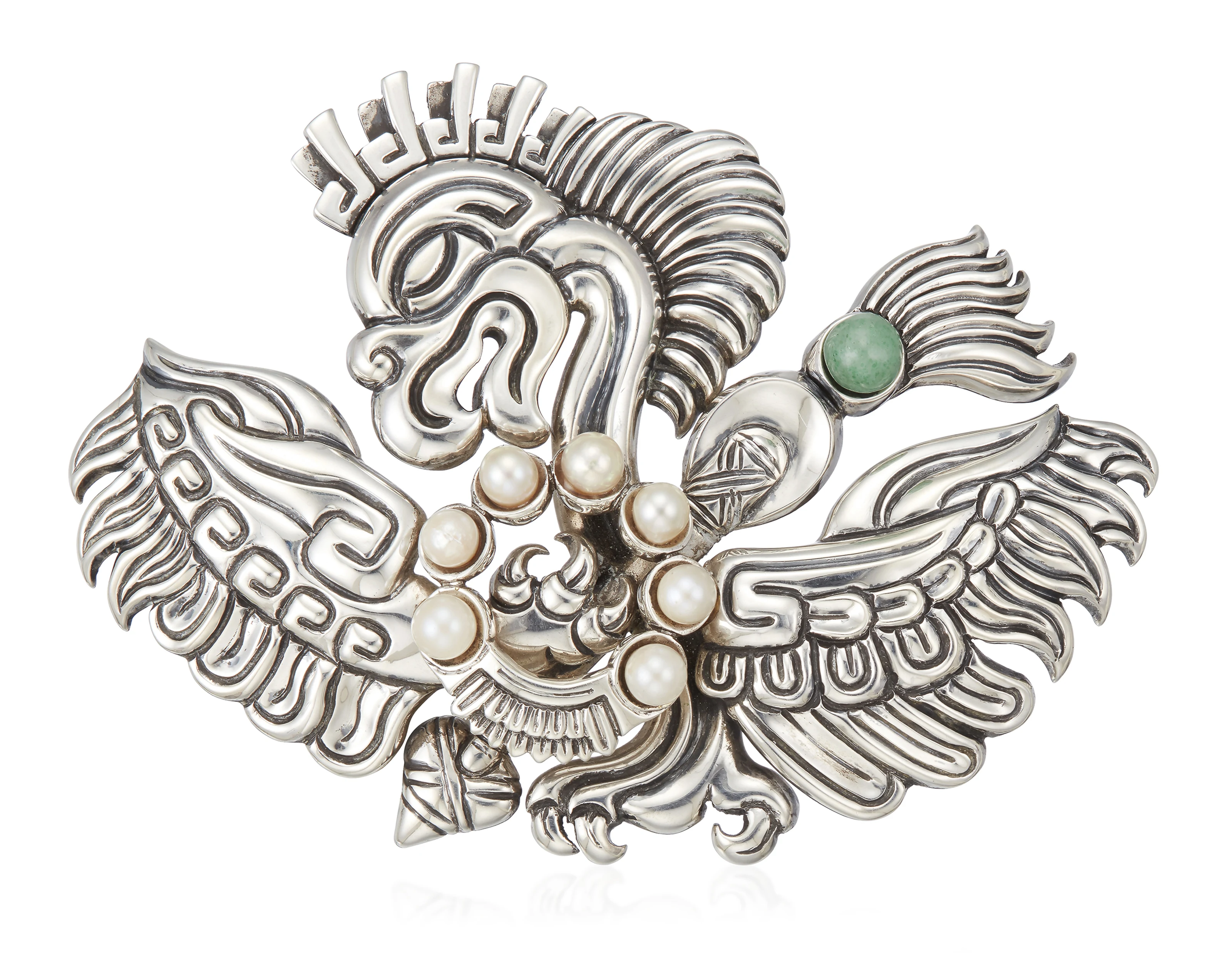
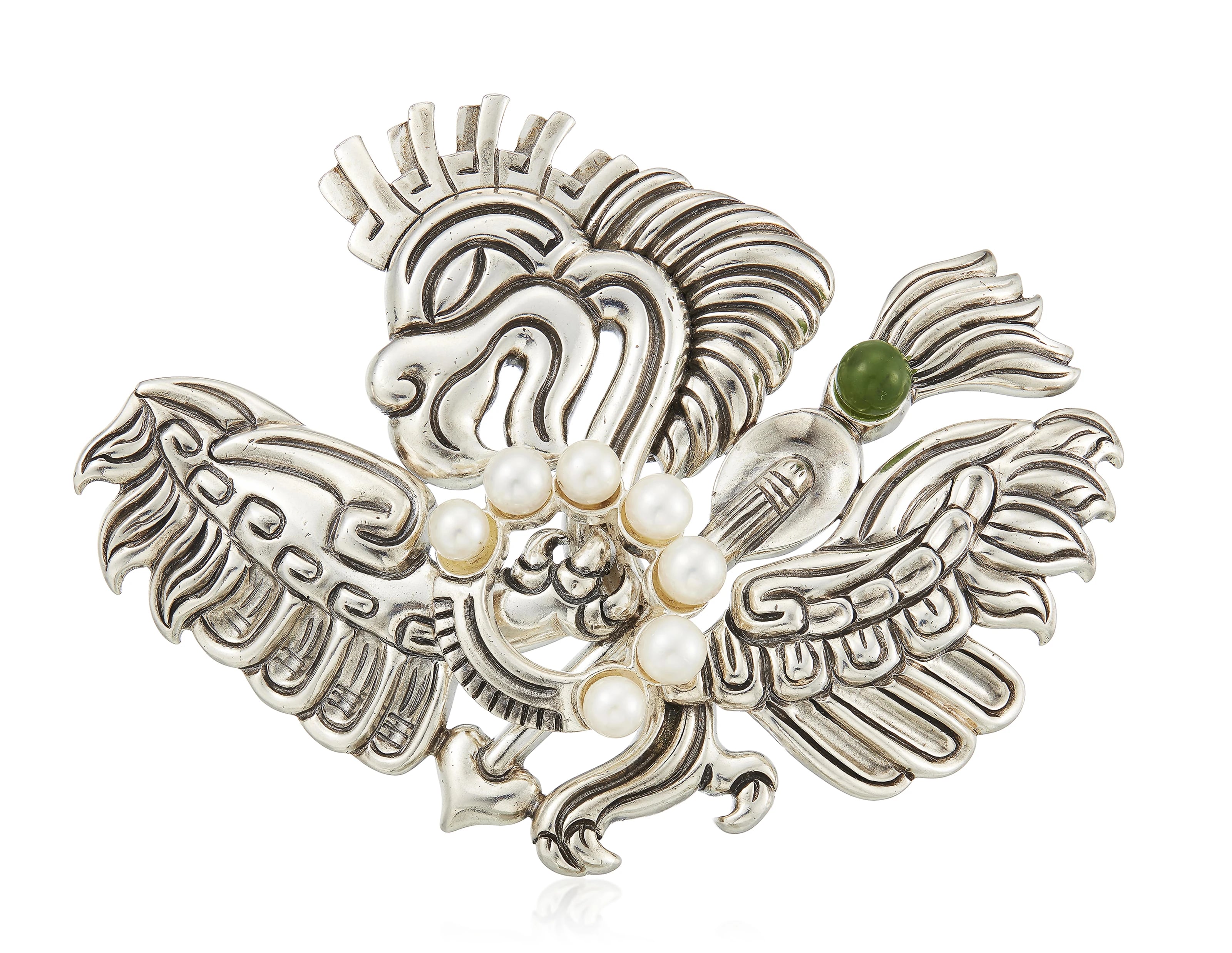
Few objects in twentieth-century Mexican silver carry as much specific weight as this eagle. The form, a stylized eagle worked in heavy 970 silver and set with cultured pearls and jade, is the design with which Antonio Pineda entered the "Neo-Pre-Columbian" idiom most associated with William Spratling rather than his own sleek modernist line, and it is the design tied to his standing in Mexico's national silver competition. The eagle, a Mexican national icon, was a shrewd subject for that arena, and the literature records that Pineda won the national competition four times over his career (Stromberg, Antonio Pineda, 2008, p. 45). To hold the bird in silver is to hold the moment a modernist chose, deliberately, to speak the older Pre-Columbian language and to win on its terms.
The eagle is built as a single dense composition: a crested, glyph-like head rendered in raised repoussé scrollwork, two outspread wings carved into long ranked feathers with deeply oxidized channels between them, and talons gathered at the base. A cluster of cultured pearls is massed at the breast where a bird's plumage would catch light, and a single jade bead sits as a lone note of green against the silver. The repoussé relief and the blackened recesses give the whole a sculptural depth that reads from across a room, the legibility a competition piece needs. Pineda's command of this kind of dimensional silverwork came from two distinct apprenticeships, the Pre-Columbian sensibility and technical training he absorbed in Taxco and the large-scale naturalistic modeling he learned in Mexico City, and both are visible here in the confident scale and the disciplined feathering (Morrill & Berk, Mexican Silver, 1994, p. 142).
The marks confirm the workshop and the standard. Struck ANTONIO TAXCO with the crowned "Antonio" maker's mark, HECHO EN MEXICO, the spread-eagle assay stamp numbered 17, and 970, the piece carries the high-purity 970 silver and the crown hallmark Pineda's shop adopted in the early 1950s and used thereafter (Stromberg, Antonio Pineda, 2008, p. 48). That 970 standard, richer than ordinary sterling, was part of how Pineda signaled ambition in his most serious work. Pineda's full output was honored in 2008 with the first retrospective devoted to him, "Silver Seduction: The Art of Mexican Modernist Antonio Pineda," at the Fowler Museum at UCLA, the catalog that documents this eagle design and its place in his career.
What makes this object matter is the convergence: a celebrated maker, the highest silver standard he worked in, a nationally resonant subject, and a design recorded in the scholarship as the one with which Pineda met Mexico's national competition on the terrain of Spratling's Pre-Columbian revivalism. It is Pineda stepping outside his own modernist signature to prove he could win at the older game, and the surviving silver eagle is the evidence.
Museum of Mexican Silver. “Cultured Pearl and Jade Eagle Brooch.” Catalog no. MoMS-002099. https://museumofmexicansilver.com/pieces/antonio-pineda-cultured-pearl-and-jade-eagle-brooch-2
See something wrong with this record? Suggest a correction and the piece details fill in automatically.
Antonio Pineda
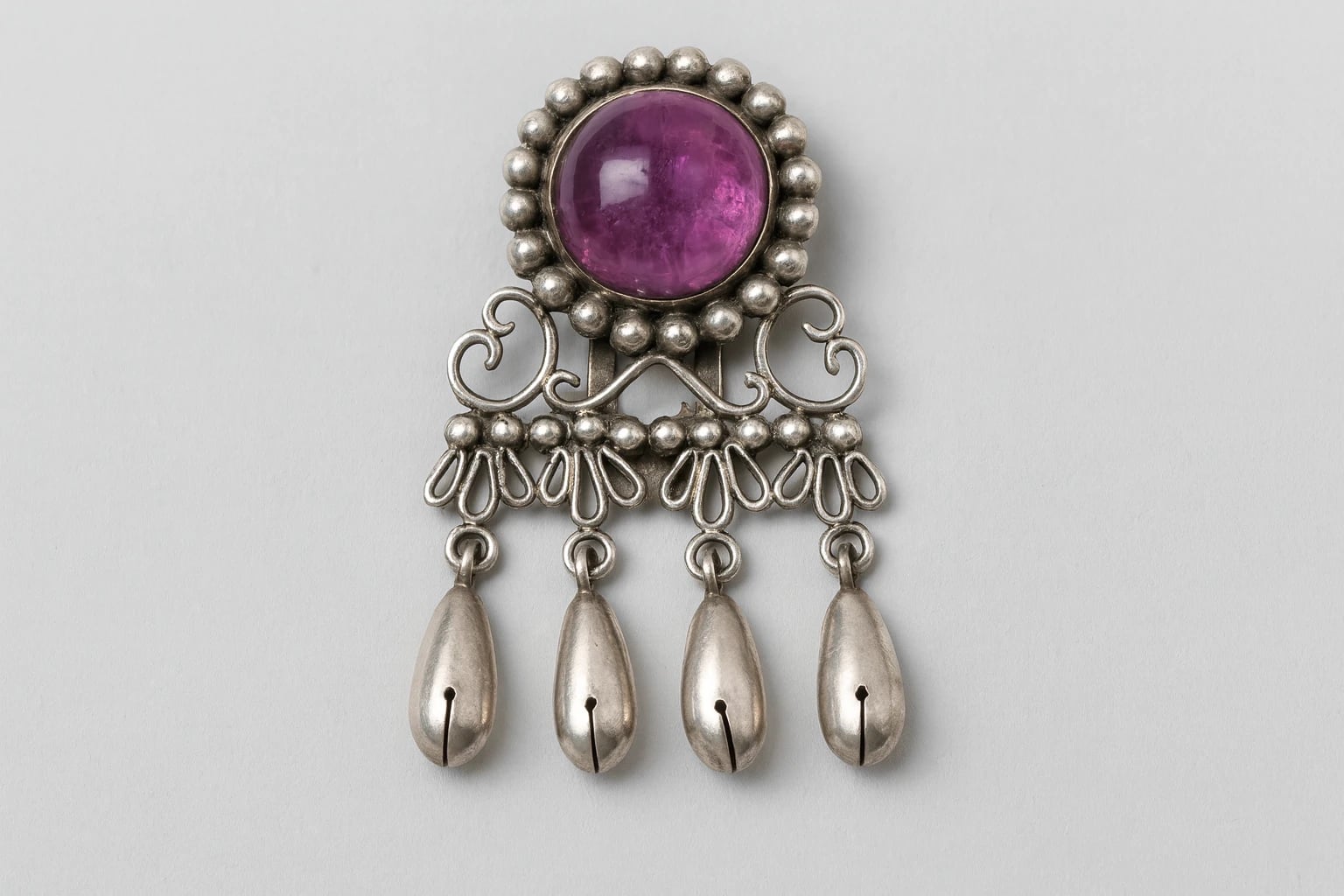
Cascabeles Dress Clip with Amethyst
Silver