Saves instantly, no account needed. Already a member? Sign in.
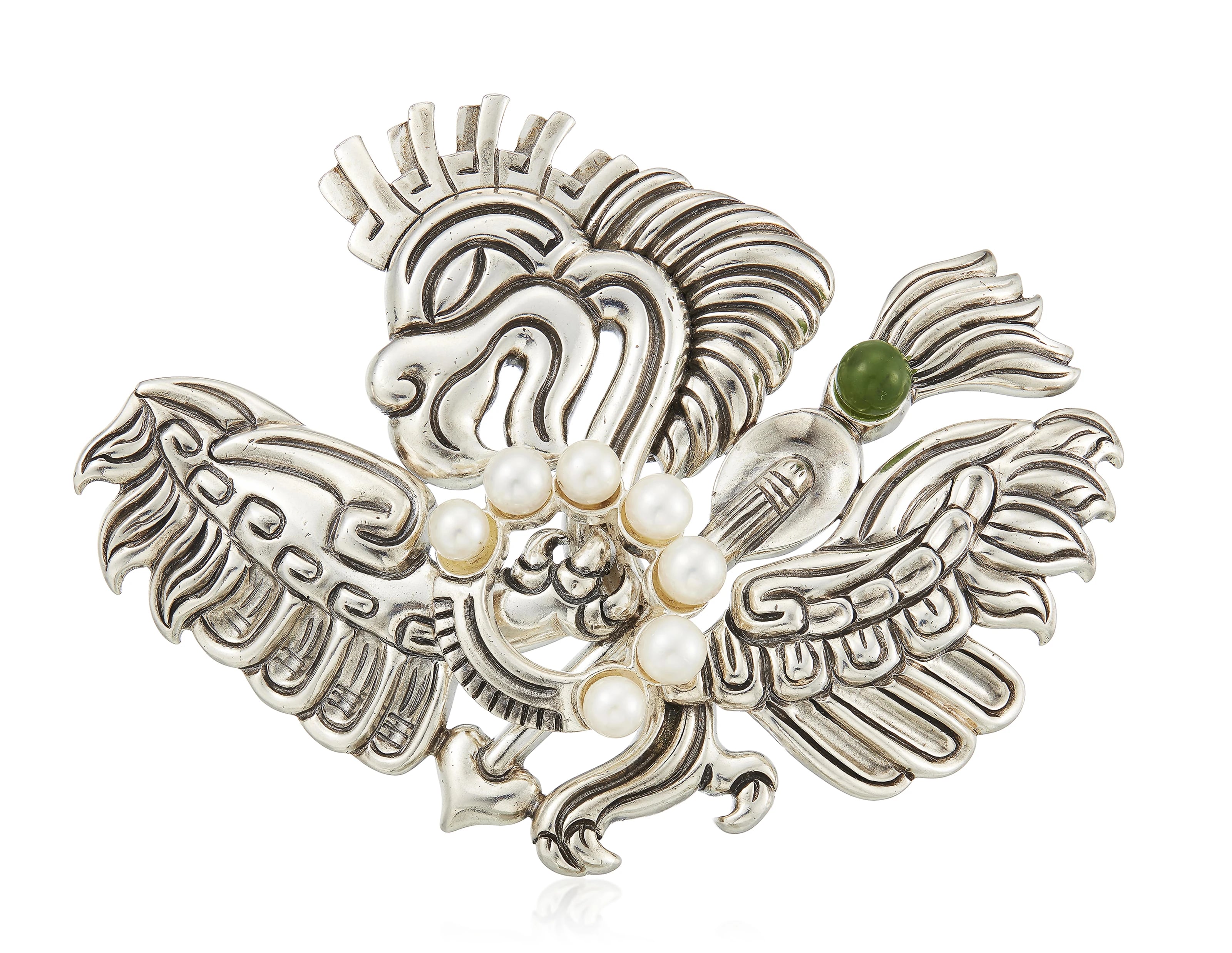
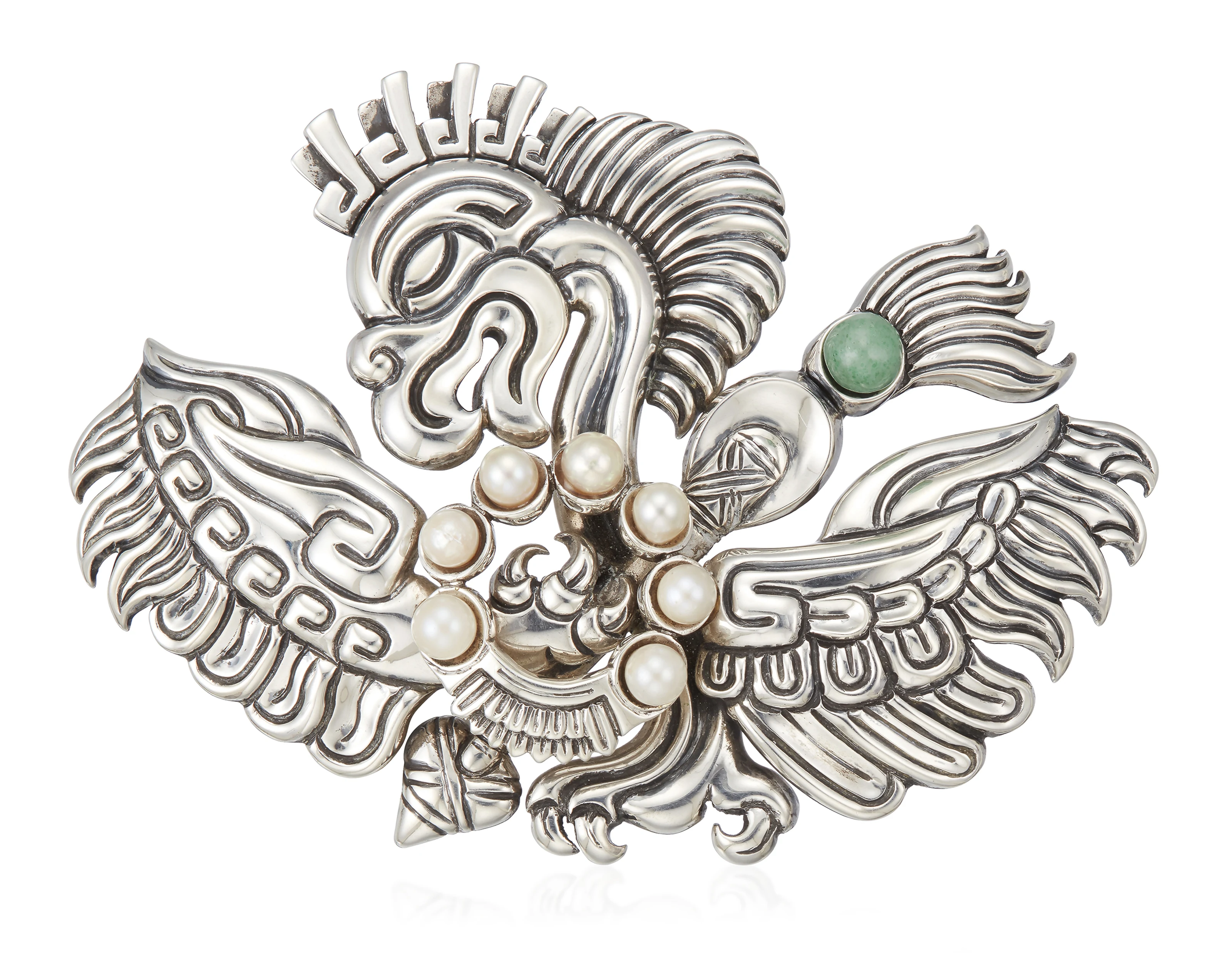
Few motifs in mid-century Mexican silver carry the freight this one does: the eagle, the national emblem, rendered not as a heraldic device but as a pre-Hispanic deity head crowned in a fan of plumes, wings thrown wide and worked in deep repoussé. The form belongs to a documented Antonio Pineda design. In 1953, the year he served as president of the organizing committee for Taxco's sixteenth annual silver fair, Pineda won the first Galardón Nacional, Mexico's National Prize, and the piece he chose to enter was an eagle brooch set with jade and pearl, executed in the "Neo-Pre-Columbian" idiom that William Spratling had made famous (Stromberg, Antonio Pineda, 2008, pp. 45, 48). That a designer celebrated for sleek, sober modernism reached instead for a nationalist pre-Columbian icon was, as his biographer notes, a shrewd reading of the room: the eagle was perfectly suited to impress in a national competition, and Pineda would go on to take the prize four times. This brooch carries that same eagle, that same pairing of jade and pearl, at very nearly the same scale the published example records.
The construction rewards close looking. The eagle's head turns in profile beneath a stepped, fretted headdress, the surface alive with the grecas and scrolled volutes that Pineda drew from pre-Columbian ceramic decoration and monumental stonework. Cultured pearls cluster across the breast, their soft luster set against the matte silver, while a single jade bead reads as the bird's eye, a quiet green accent in a composition otherwise carried by light and shadow. The wings, splayed and feather-by-feather defined, give the piece its breadth and the substantial heft one expects of a presentation-grade object. It is signed ANTONIO TAXCO beneath the crown and struck MEXICO, 950, SILVER, the post-1953 hallmark system Stromberg sets out, in which the Antonio-Taxco crown identifies the maker's hand and design (Stromberg, Antonio Pineda, 2008, p. 81).
That this brooch is in 950 silver rather than the .970 of the published prize example, and that Pineda's large workshop employed master silversmiths to execute his designs in volume (Stromberg, 2008, p. 81), places it within the maker's documented eagle production rather than identifying it as the unique competition piece itself. The distinction matters little to its standing. Pineda absorbed his appreciation for pre-Columbian art directly from Spratling and his technical command from the maestros Mondragón and Navarrete (Morrill & Berk, Mexican Silver, 1994, p. 142), and the eagle is where both lineages converge: a national symbol given modern sculptural weight by the most decorated silversmith of Taxco's golden generation. It is among the most ambitious figural statements in his repertoire, and one of the rare instances where Pineda set aside his own modernist vocabulary to compete, and win, on Spratling's pre-Hispanic ground.
Museum of Mexican Silver. “Cultured Pearl and Jade Eagle Brooch.” Catalog no. MoMS-002098. https://museumofmexicansilver.com/pieces/antonio-pineda-cultured-pearl-and-jade-eagle-brooch
See something wrong with this record? Suggest a correction and the piece details fill in automatically.
Antonio Pineda
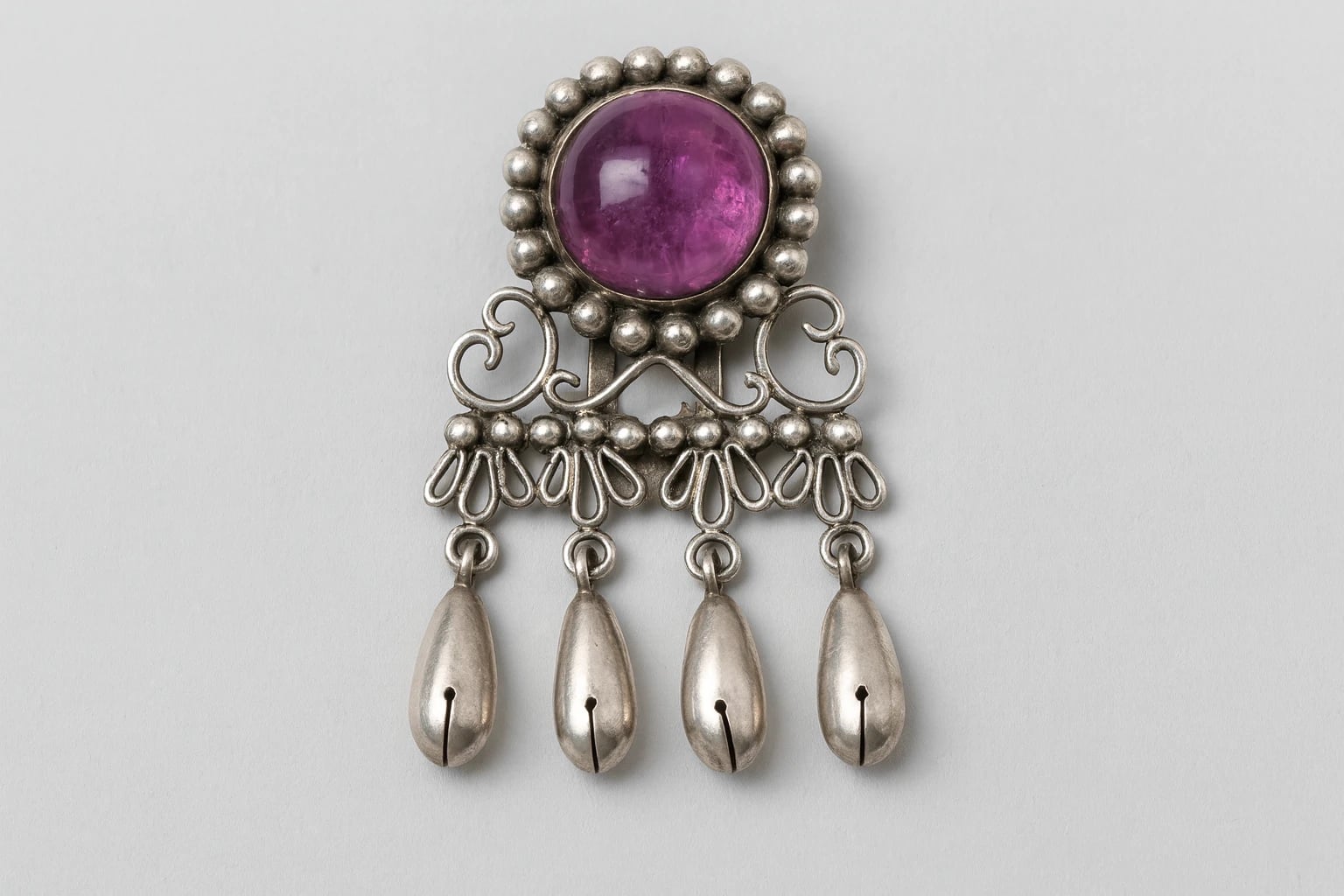
Cascabeles Dress Clip with Amethyst
Silver