Saves instantly, no account needed. Already a member? Sign in.
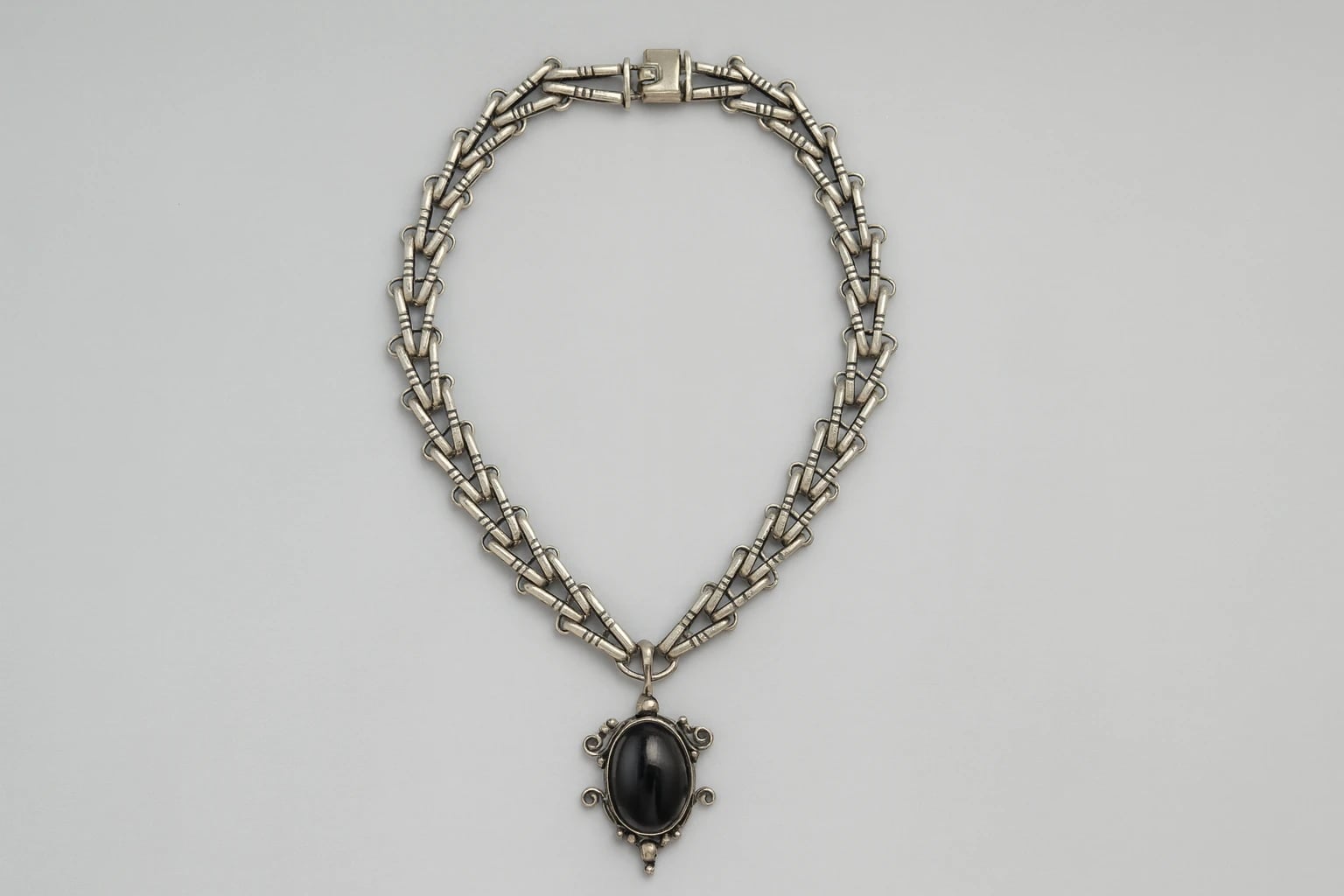
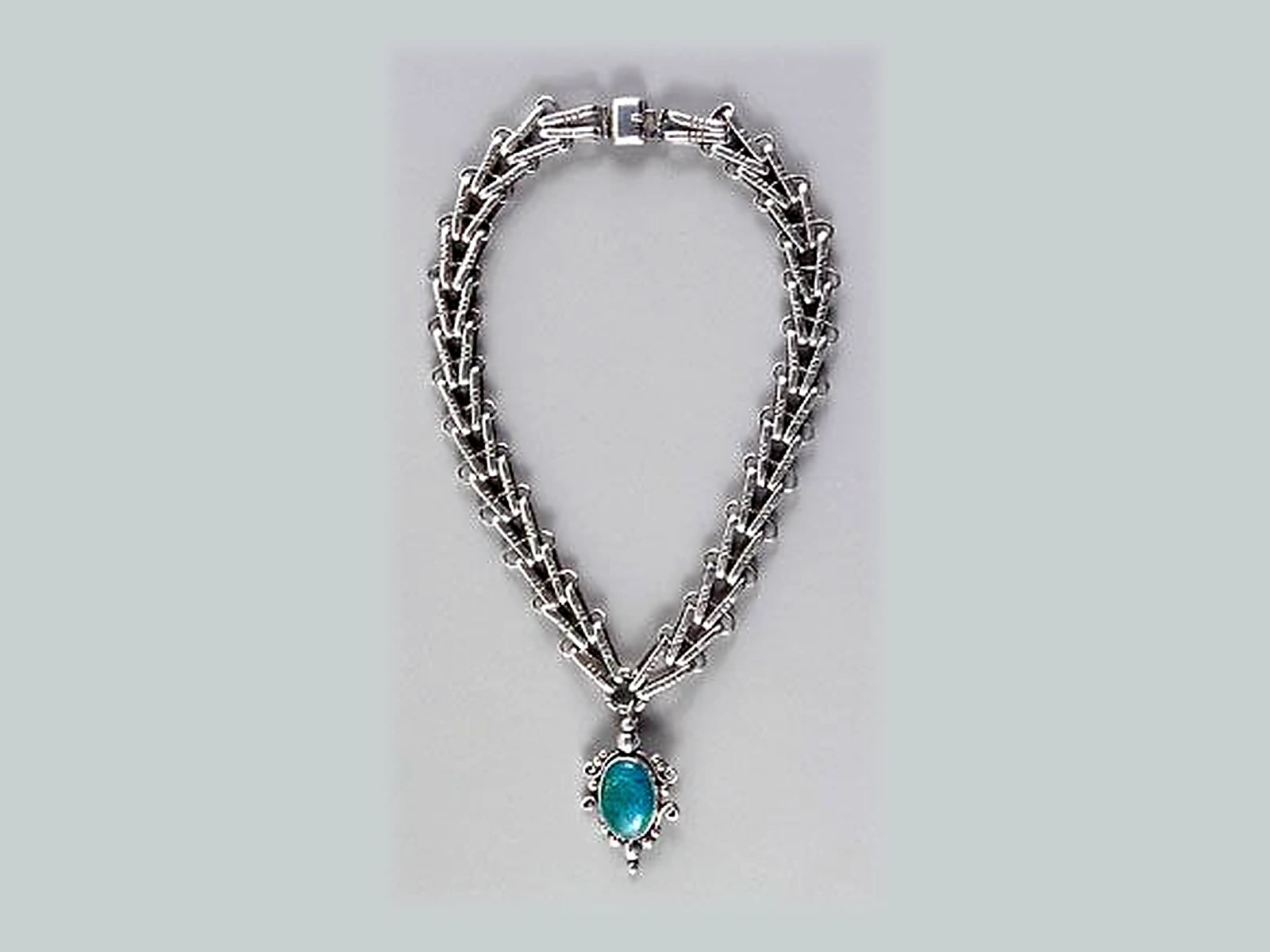
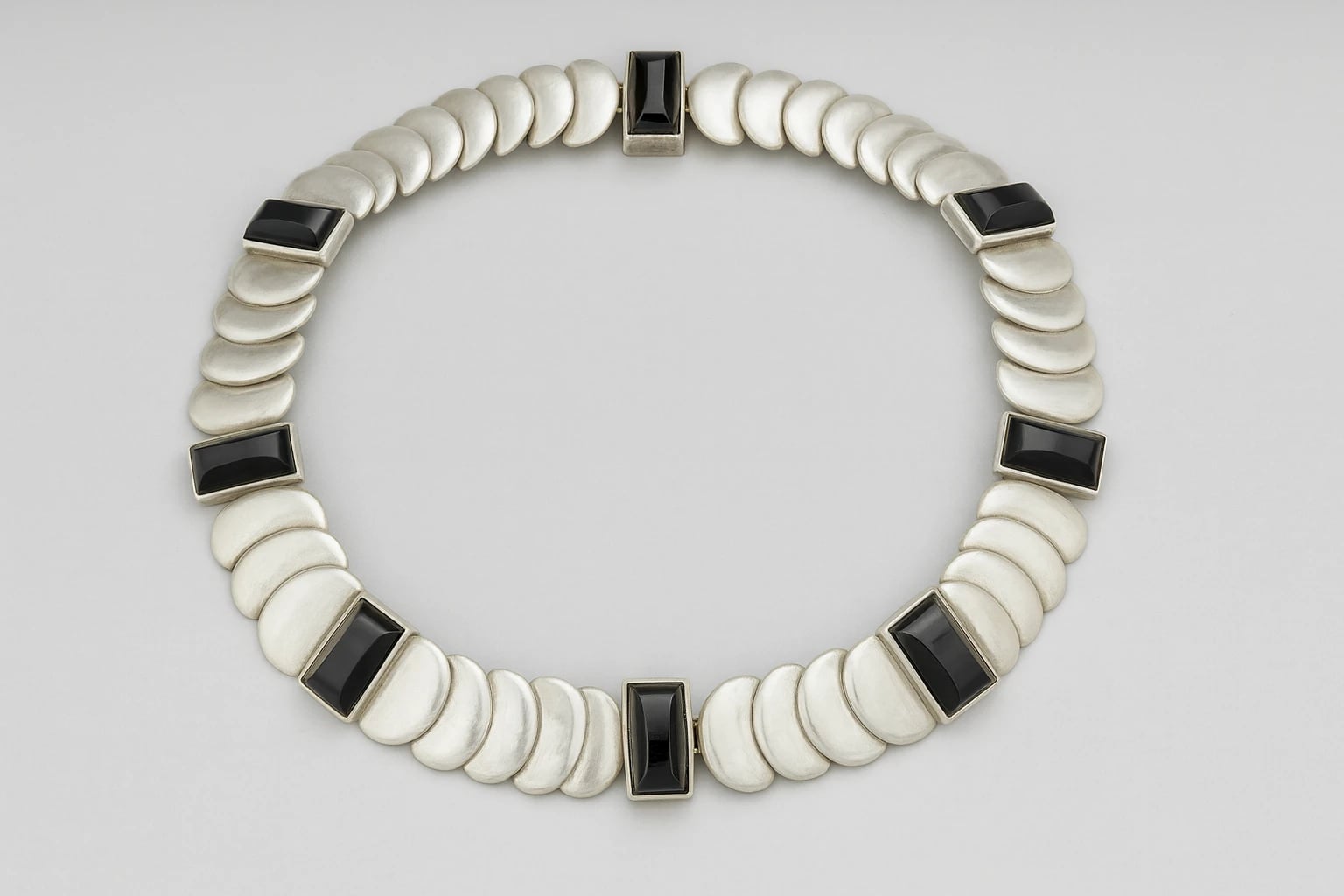
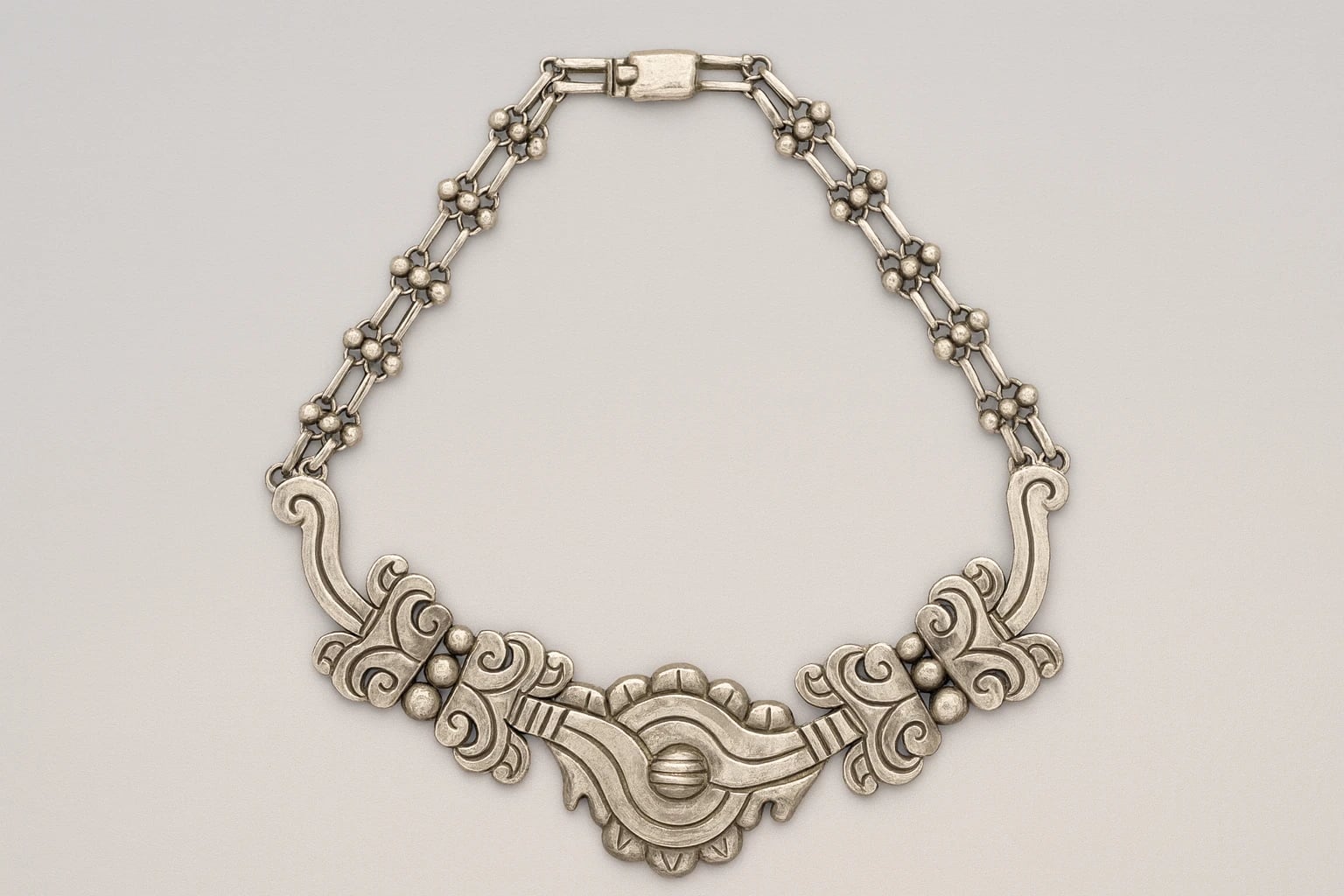
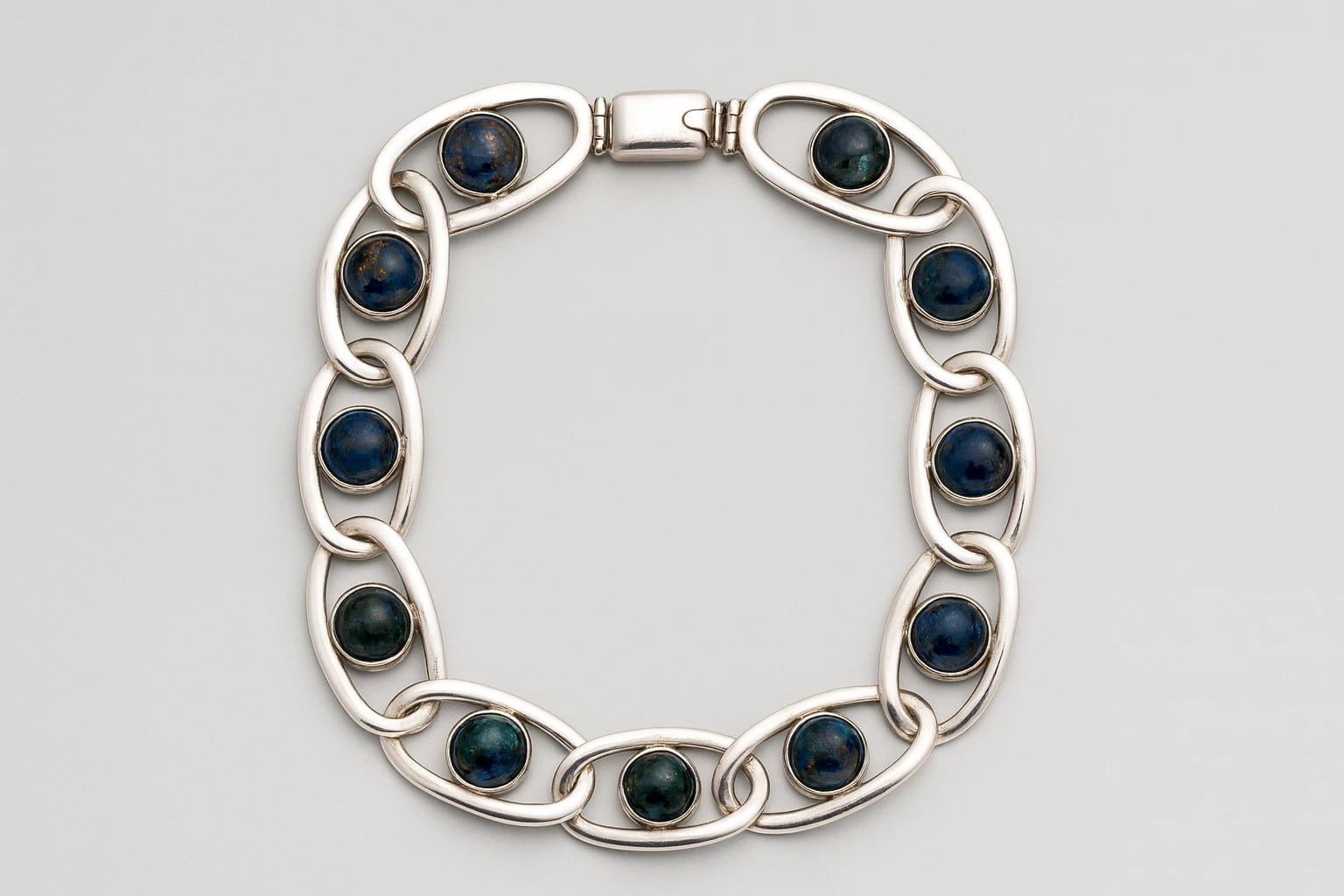
Malachite sets the terms for this necklace, and Héctor Aguilar's design answers with restraint. The banded green stone, opaque and heavy in color, does the work that a faceted gem cannot: it holds light rather than throwing it, and its concentric growth rings supply pattern that no engraving could match. Aguilar built the necklace so that silver frames and links the malachite without competing with it, letting the stone carry the visual weight while the metal establishes rhythm and structure. This is a designer thinking in terms of density and repose rather than sparkle.
The pairing of silver and malachite recurs across Aguilar's output, and the Morrill reference records several distinct necklaces built on that combination, including a carved malachite faces necklace dated to about 1939 and later chain necklaces with malachite clasps from the middle 1940s. Those examples share a way of treating the stone as a structural component rather than a mounted jewel: malachite serves as clasp, as central element, or as the repeated color note that organizes a chain. Aguilar favored substantial silver of high fineness, and his early Taxco marks carry 940 and 990 designations that reflect a heavier standard than sterling. The color logic is consistent throughout. Green against warm silver, matte against reflective, opacity against shine.
Aguilar left William Spratling's Taller de las Delicias in 1939 to open his own shop, Taller Borda, in Taxco, and the workshop's hallmarks trace its long working life. The conjoined HA marks with a Taxco stamp belong to the early years around 1940 to 1945, while the addition of the national eagle assay stamp places later production between 1948 and 1962. The wide design period assigned to this necklace, 1939 to 1962, spans that entire arc and reflects how consistently Aguilar returned to the malachite idea across more than two decades. A Taller Borda that ran on specialized hands and supervised production could repeat a successful design without diluting it, and the malachite necklaces show that continuity of thought rather than a single moment of invention.
Within the Mexican silver renaissance, Aguilar occupies a position distinct from the sculptural extravagance of some Taxco contemporaries. His preference for weighty metal, clear construction, and stones chosen for color and mass gives his jewelry a grounded, architectural character that reads as its own language rather than a variation on Spratling's. This malachite necklace records that sensibility directly: a Taxco designer working out how a native-colored stone and dense silver could be joined into ornament that depends on presence rather than glitter. It documents both Aguilar's material intelligence and the sustained productivity of Taller Borda across the middle decades of the twentieth century.
Museum of Mexican Silver. “Malachite Necklace.” Catalog no. MoMS-001364. https://museumofmexicansilver.com/pieces/aguilar-necklace-malachite
See something wrong with this record? Suggest a correction and the piece details fill in automatically.
Héctor Aguilar
Onyx and Silver Collar Necklace
c. 1945
Sterling silver