Saves instantly, no account needed. Already a member? Sign in.
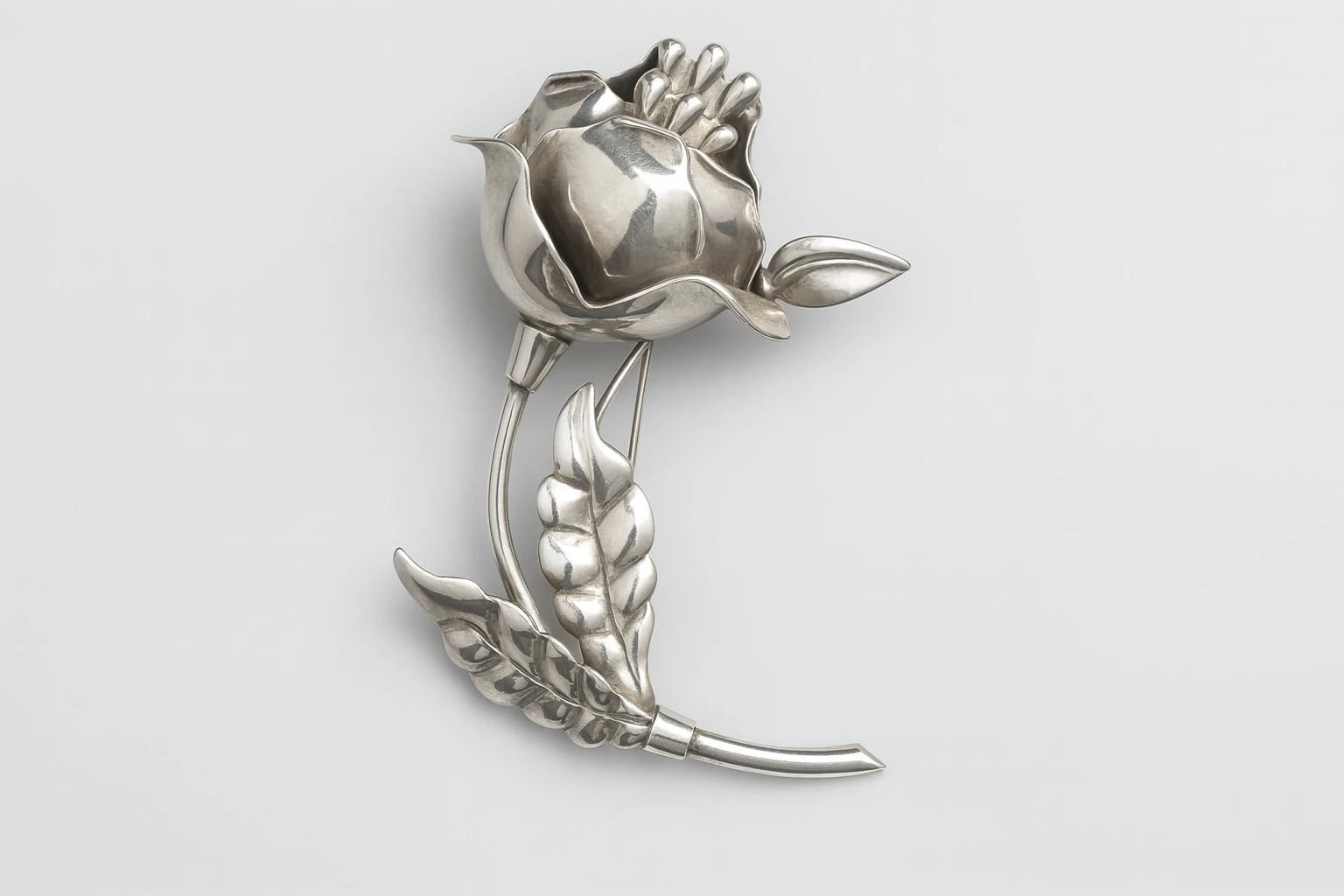
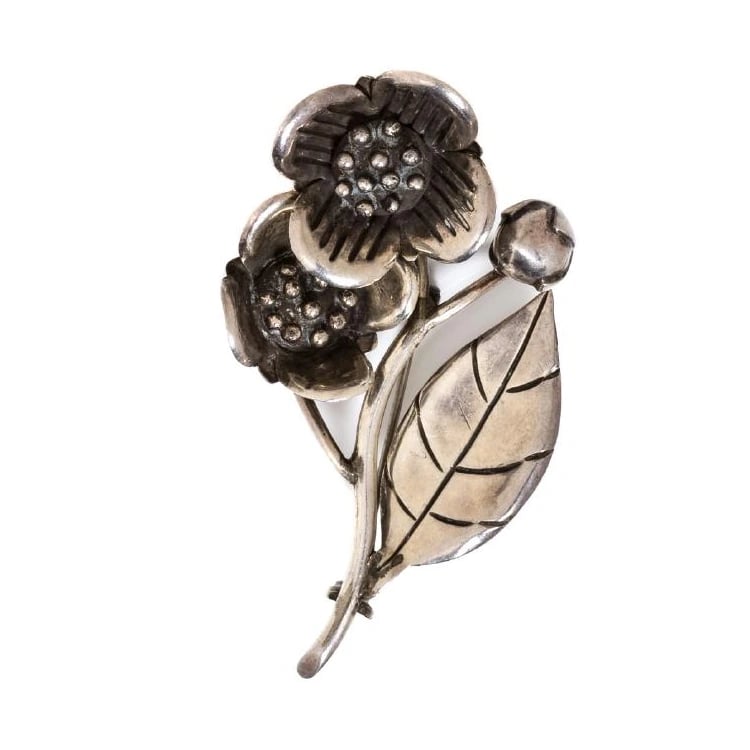
A pomegranate blossom, translated into sterling silver, gives Héctor Aguilar's Taller Borda a chance to work in three dimensions rather than on a flat plane. The brooch builds its flower from layered petals that overlap and lift away from the base, so the form reads as a bloom caught partway open rather than as an outline of one. Where a stamped floral pin would flatten nature into a badge, this design carries the weight and shadow of handwrought metal, and the petals gain their presence from mass and edge instead of from applied detail.
The construction is what separates this piece from lighter decorative silver. The petals appear to have been shaped individually and assembled in tiers, each catching light along its curved surface and casting the one beneath it into shadow. That layering produces the dimensional movement the design depends on: from different angles the flower opens or closes, and the silver alternates between bright reflection and deep gray. Aguilar's workshop favored substantial gauge and visible handwork, and here that preference serves a naturalistic subject well, since a pomegranate blossom is a compact, sculptural flower rather than a delicate one. The heaviness of the metal suits the density of the source.
Taller Borda operated under the mark bearing Aguilar's initials, but the floral vocabulary of the shop is associated with his collaboration with Valentin Vidaurreta, whose designs gave the workshop several of its plant and flower forms. Within that body of work the orchid brooch is the better known example, and this pomegranate blossom is scarcer in the published record. Its interest lies partly in showing a different solution to the same problem: how to render a botanical subject in silver without reducing it to thin ornament. The answer at Taller Borda was to keep the metal thick and the modeling firm, letting the material's own weight stand in for the substance of the plant. This approach connects the brooch to the broader current of the Mexican silver renaissance, in which handwrought heft was treated as an expressive resource rather than a limitation.
For a collection tracing Aguilar's range, the pomegranate blossom fills a specific place beside the more familiar orchid. It documents how the workshop handled dimensional floral form, and it demonstrates that naturalistic inspiration at Taller Borda passed through a sculptor's sense of layered volume rather than a jeweler's instinct for filigree. The brooch records a working method as much as a motif.
Museum of Mexican Silver. “Pomegranate Blossom Brooch.” Catalog no. MoMS-001979. https://museumofmexicansilver.com/pieces/aguilar-pomegranate-blossom-brooch-34
See something wrong with this record? Suggest a correction and the piece details fill in automatically.
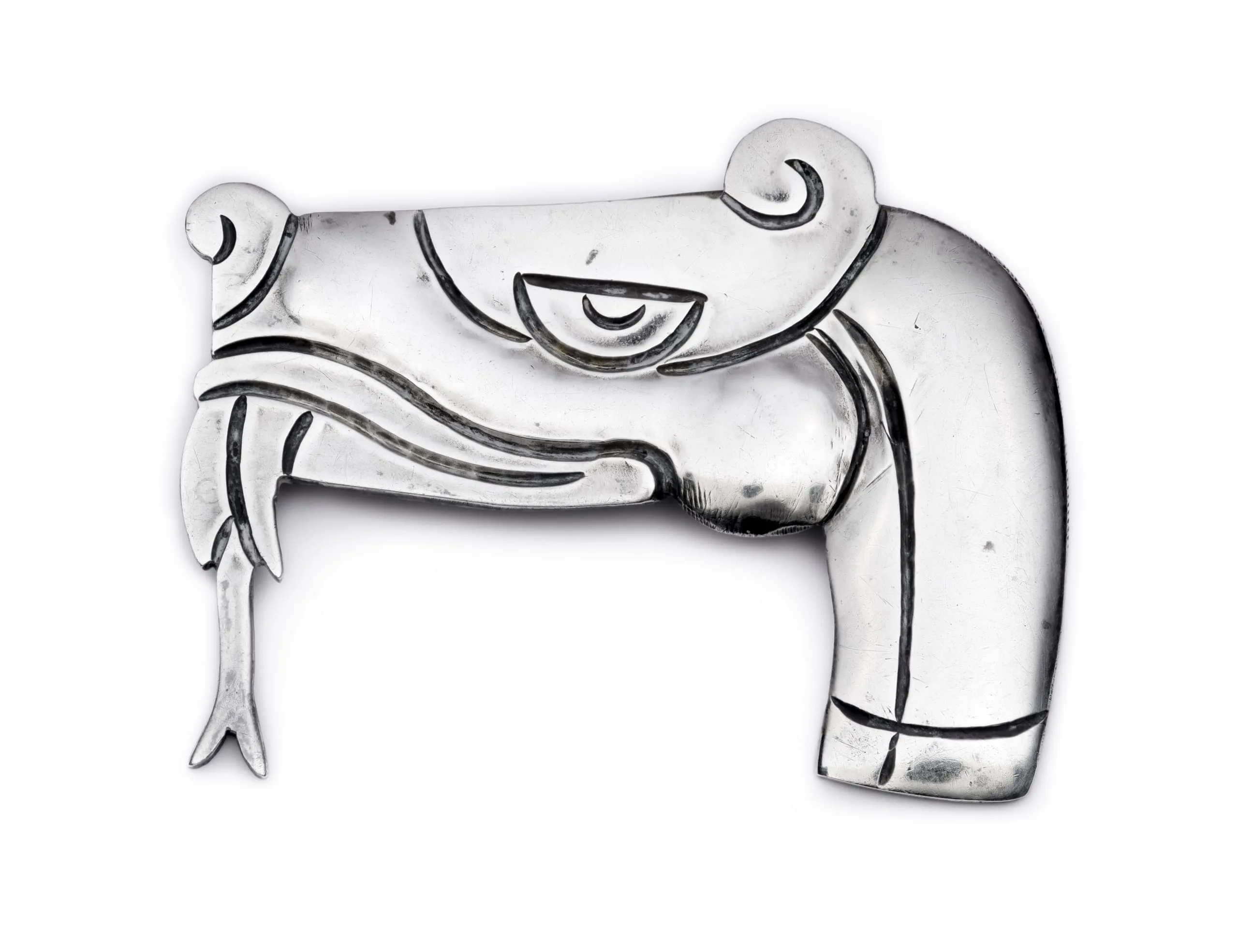
Serpent Brooch
c. 1940
990 silver