Saves instantly, no account needed. Already a member? Sign in.
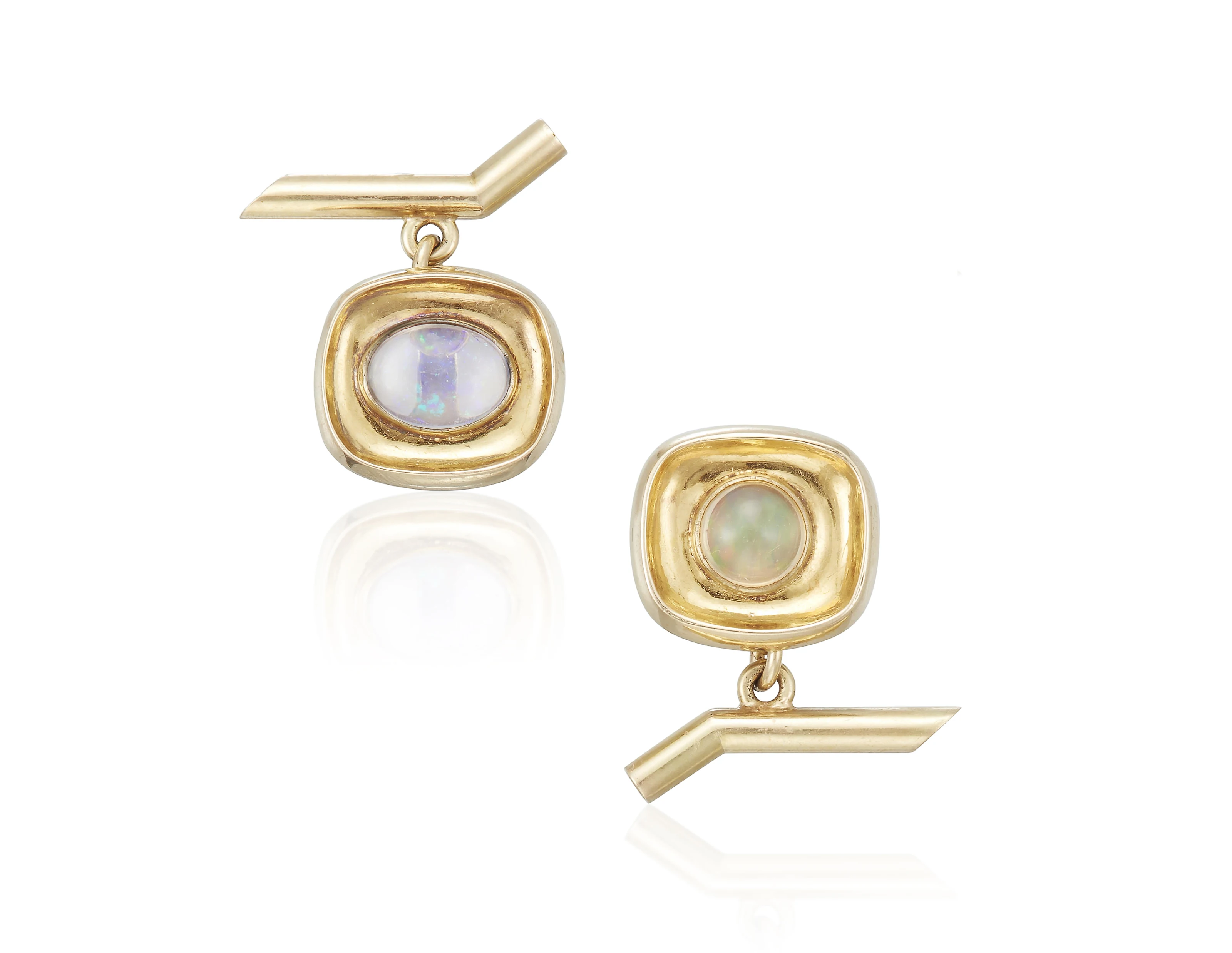
A pair of gold cufflinks sits at the quiet edge of an oeuvre built almost entirely in silver. Antonio Pineda is remembered for the amethysts, obsidian, and onyx he set into 970 silver, the material that carried his name out of Taxco and into Gump's windows. Gold he made rarely, and that scarcity is exactly what makes a piece like this worth pausing over: it is the modernist sensibility he refined in silver, transposed into 14k yellow gold and tuned for a man's cuff. The form is disciplined and warm at once, each cushion-shaped head a smooth gold frame closing around a single cabochon opal, the play of color in the stone set off against the matte glow of the metal.
The two heads are not identical, and Pineda meant them not to be. One cradles an oval opal, the other a round, each held in a deep bezel within a softly squared cushion, the gold rising and rounding to the edge so the stone reads as the still center of a calm field. The opals are cut en cabochon, the form that lets the stone's internal fire speak rather than faceting it away, and the asymmetry of round against oval is the kind of small, considered variation that runs through Pineda's design thinking. The hinged toggle bars and chain links are spare and architectural, the whole object resolved with the sleek economy that defines his modernist period.
The marks fix both the maker and the moment. The signature reads ANTONIO TAXCO beneath a crown, the hallmark Pineda adopted in 1953 and used from then on, so the cufflinks belong to his mature workshop rather than his earlier AP or Jewels by Toño years. Alongside it the metal carries 14K and the eagle assay number 17, the Mexican government's quality-and-tax stamp reinstated in 1948 and assigned to major workshops by individual number. That a goldsmith of Luis Montes de Oca's caliber worked in Pineda's taller, accomplished in fine European-style gold jewelry, helps explain how a shop known for silver could turn out gold of this finish.
Pineda's gold is uncommon enough that it is treated as a category apart by those who handle it. Dealers and appraisers alike note that he made very little of his work in gold, and that gold cufflinks bearing the post-1953 crown and a 14K stamp represent an unusual departure from the silver for which he is renowned. That rarity, combined with the unhurried confidence of the design, is what gives this small pair its weight within the larger story of Mexican modernist silver, where the master of the medium occasionally, and memorably, set silver aside for gold.
Museum of Mexican Silver. “Opal Cufflinks.” Catalog no. MoMS-002092. https://museumofmexicansilver.com/pieces/antonio-pineda-opal-cufflinks
See something wrong with this record? Suggest a correction and the piece details fill in automatically.
Antonio Pineda
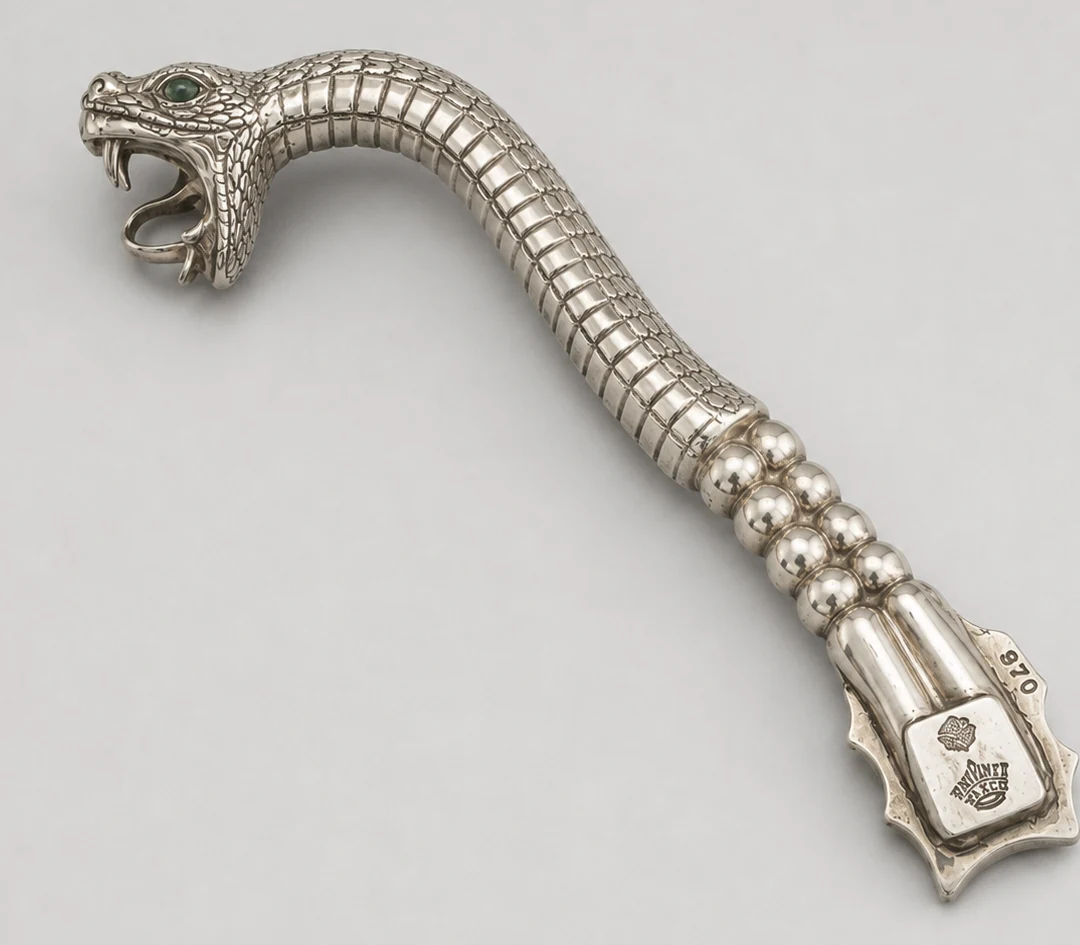
Rattlesnake Sculpture
970 silver