Saves instantly, no account needed. Already a member? Sign in.
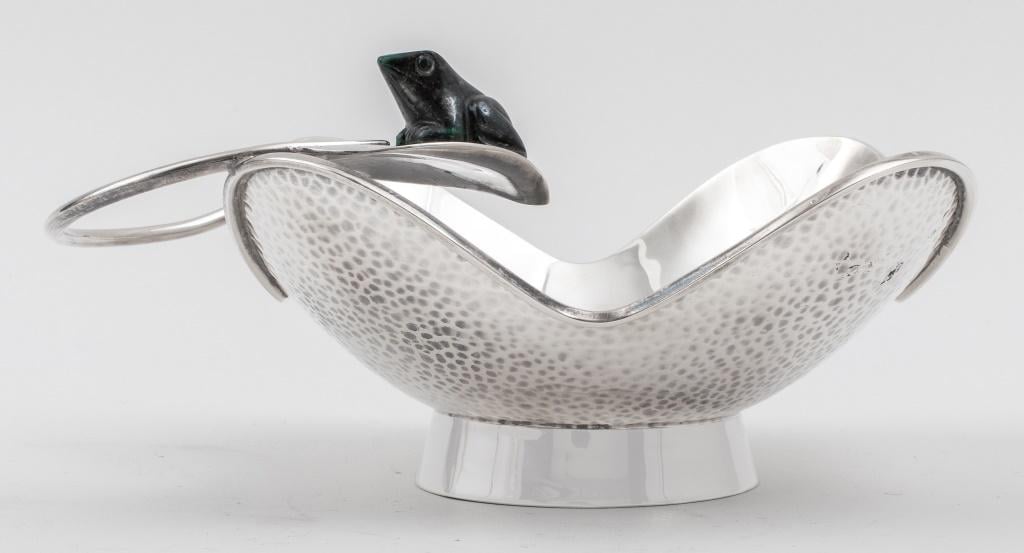
A carved stone frog seated at the rim of a hammered sterling bowl holds the relationship at the center of the Los Castillo decorative vocabulary: nature as motif, stone and silver as complementary materials, handwork that treats the metal's own surface as part of the design rather than a neutral ground.
The bowl is oval and boat-shaped, riding on a low flared oval foot. A pair of wire loop handles rises from each end of the rim and curves back to meet the body, extending the vessel's horizontal silhouette. Every exposed exterior surface has been worked in a uniform dense peen — small, closely spaced hammer marks giving the silver a cellular, matte quality — while the interior is left mirror-polished, so the piece reads differently from the exterior and interior. The frog, carved from dark green stone and positioned at the junction of rim and handle, is rendered in a naturalistic seated posture; the dark mineral stands quiet against the bright silver. Penny C. Morrill documents crushed stone and mineral materials as a consistent element of Los Castillo production across multiple forms, noting pieces in silver paired with onyx and crushed stone (Penny C. Morrill, 1996, p. 174), and this bowl belongs to that thread.
Los Castillo was founded in 1939 by the Castillo brothers — Antonio, Jorge, Justo, and Miguel, who had been among the first apprentices in William Spratling's Taller de Las Delicias — along with their cousin Salvador Terán. Morrill records the workshop eventually employing more than three hundred fifty artisans, maintaining the stone-and-silver pairing as a recurring signature through its long output (Penny C. Morrill, 1996, p. 168).
Museum of Mexican Silver. “Quatrefoil Frog Bowl with Stone Inlay.” Catalog no. MoMS-001157. https://museumofmexicansilver.com/pieces/los-castillo-bowl-frog-stone-inlay
See something wrong with this record? Suggest a correction and the piece details fill in automatically.
Los Castillo
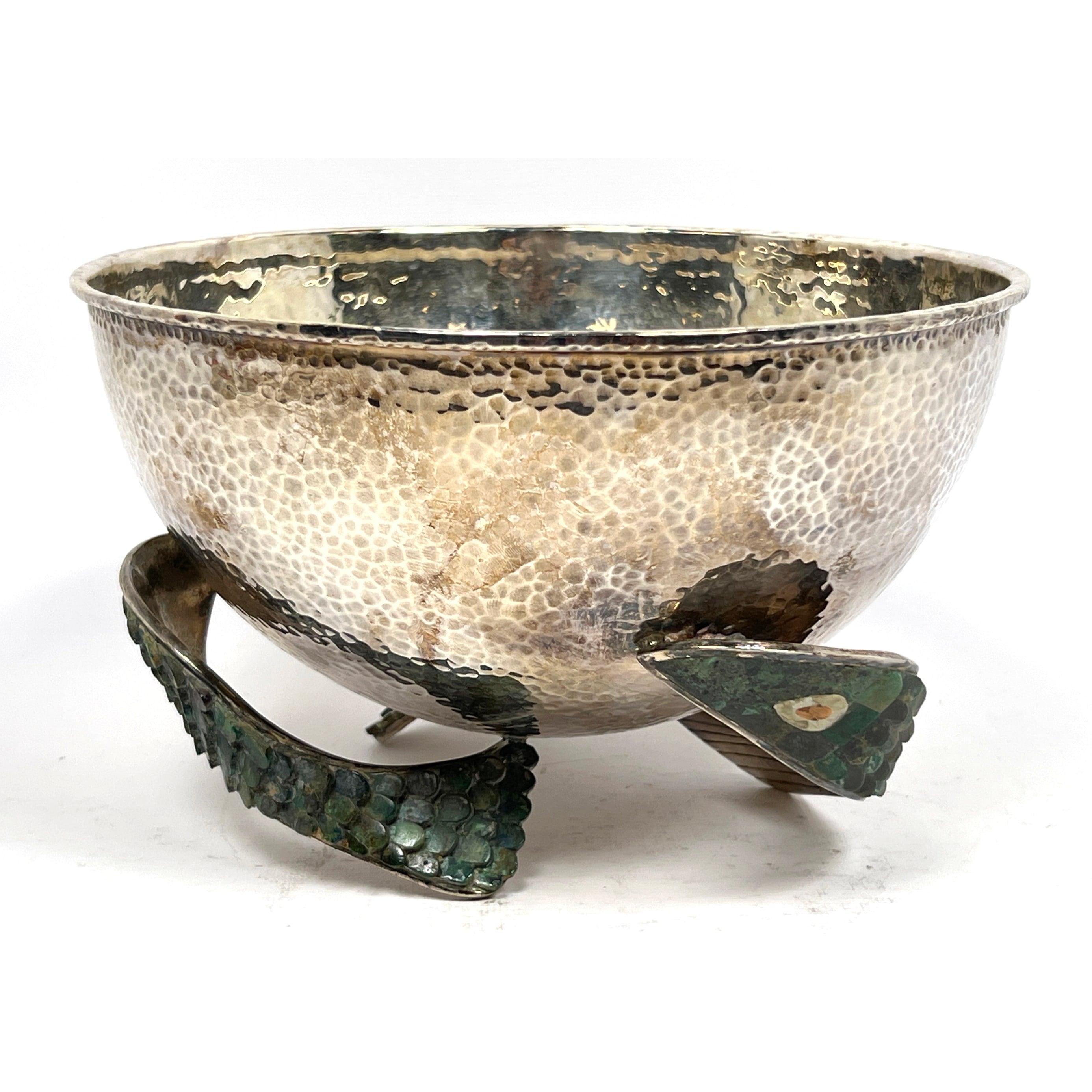
Hammered Bowl with Three Stone-Inlaid Fish Feet
Unidentified stone