Saves instantly, no account needed. Already a member? Sign in.
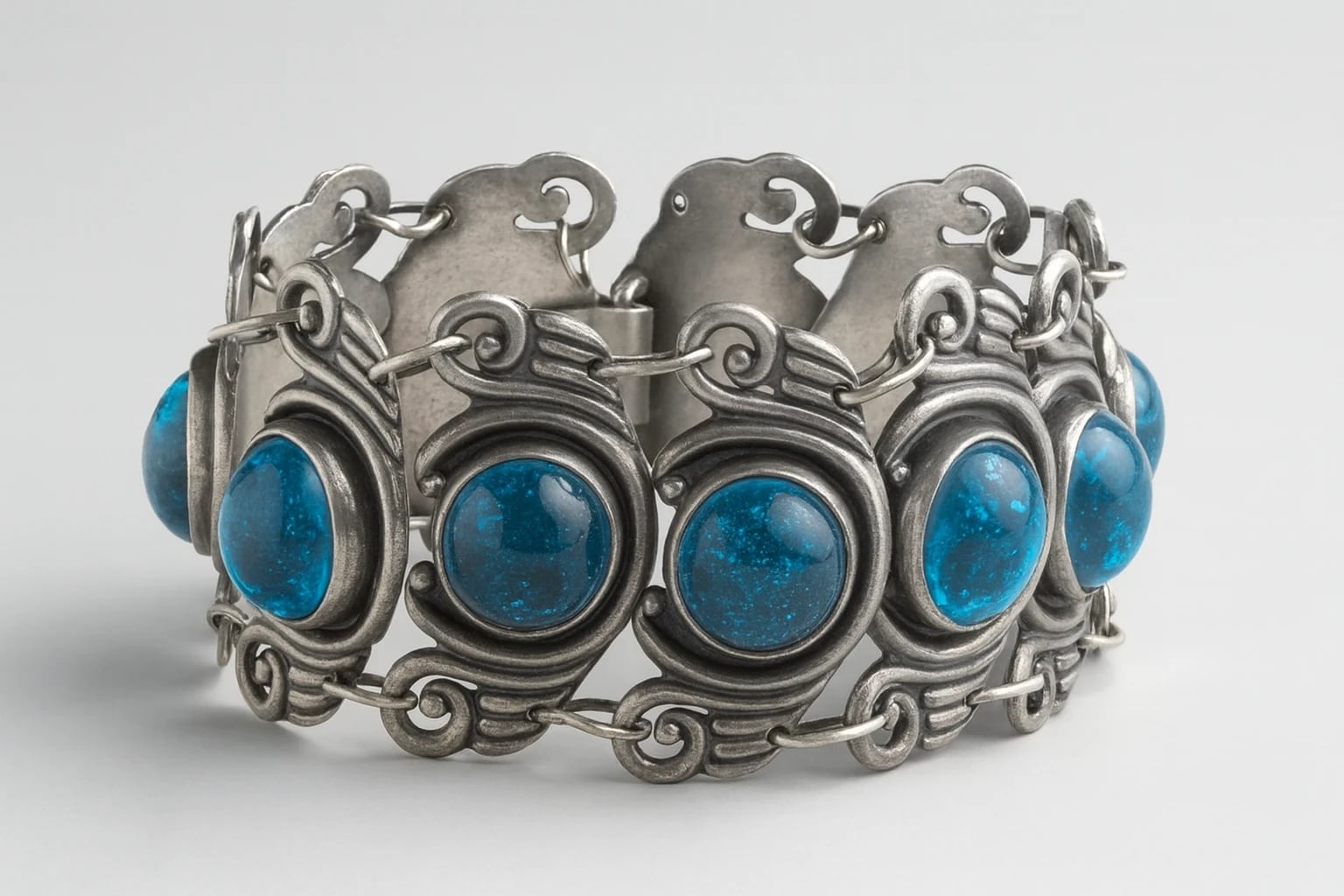
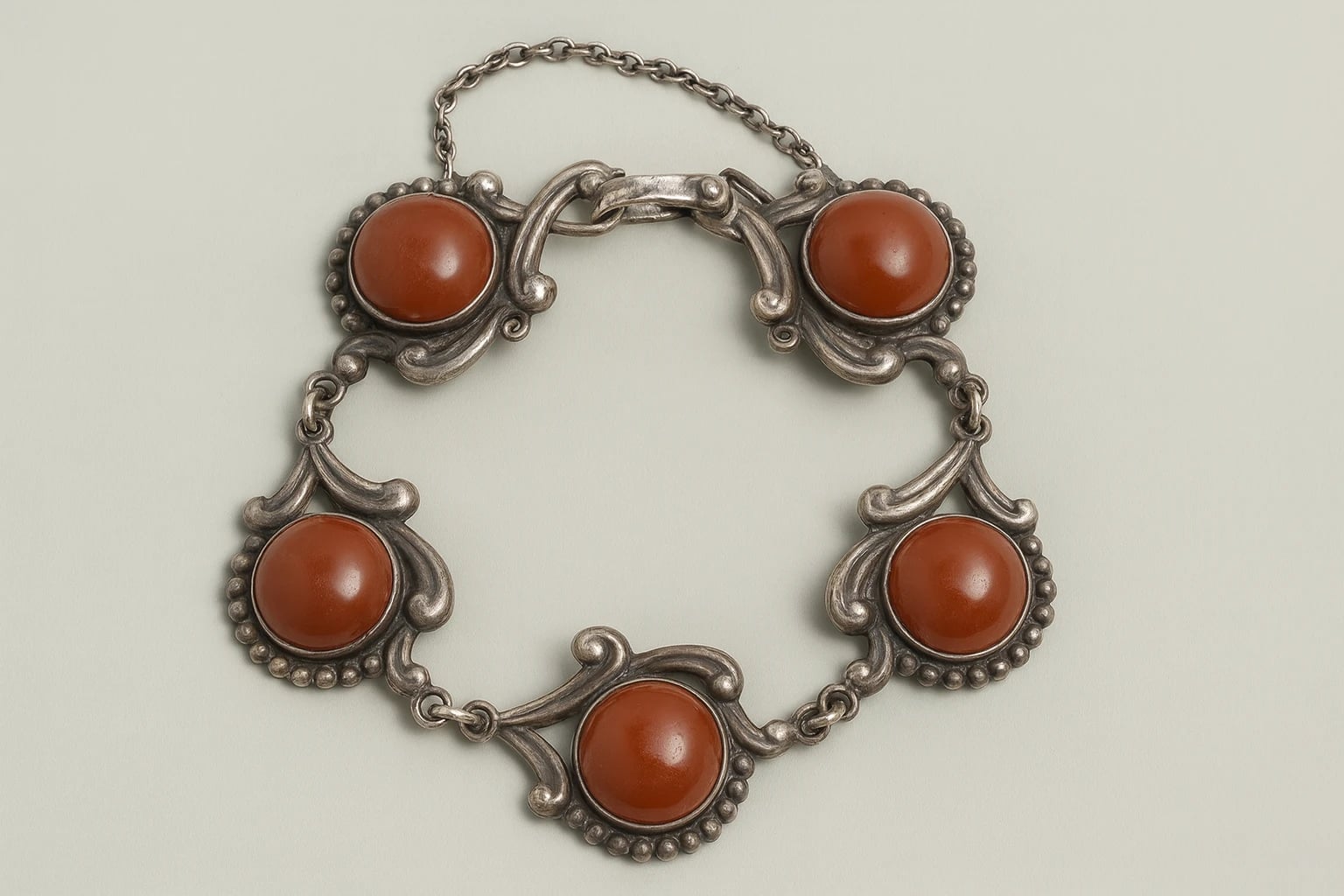
Five carnelian cabochons give this Los Castillo bracelet its slow, measured rhythm. Each stone sits high in a rounded bezel, framed by scrolling silver forms that curve outward and then tighten back toward the wrist. The design, Los Castillo number 595, belongs to the workshop’s early vocabulary of linked, stone set bracelets, but the carnelian version has a particular warmth. The orange red stones do not simply punctuate the silver. They steady the composition, drawing the eye from one circular center to the next while the surrounding metal supplies movement.
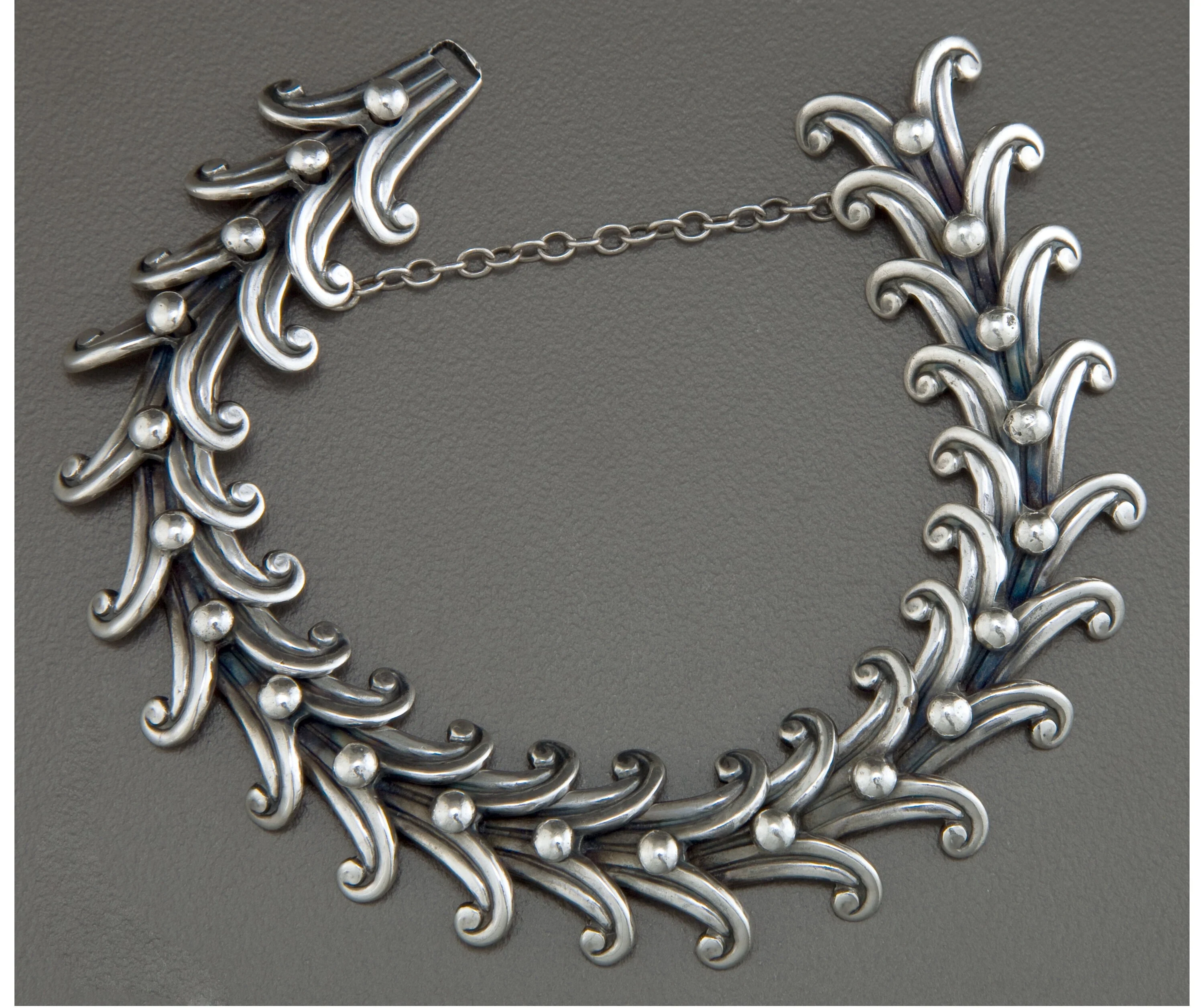
The bracelet measures seven inches long by seven eighths of an inch wide, a scale that keeps the design close to the wrist while allowing each link to read as an individual unit. The links are not identical decorative panels placed end to end. Each one is organized around a cabochon and extended by curling silver arms, small bead details, and open spaces that lighten the silhouette. The safety chain and clasp belong to the practical life of the object, but they also remind us that this is an articulated design. Its ornament depends on joining, turning, and repeating, rather than on a single static front.
The old linear Los Castillo mark and the absence of an eagle assay mark place the bracelet within the workshop’s 1940s production, before the numbered eagle system became standard in Mexican silver marking. Hougart records Los Castillo as an influential Taxco design and manufacturing enterprise established in 1939 by Antonio Castillo, his brothers Justo and Jorge, and their cousin Salvador Terán, and documents early Los Castillo marks from the 1940 to 1945 period as well as later eagle marked forms. The design number 595 also fits the workshop practice Hougart describes, in which Los Castillo pieces, except for the earliest 980 marked production, were generally stamped with a design or inventory number.
Within that early Los Castillo setting, the bracelet shows the workshop’s ability to absorb historical ornament without turning it into pastiche. The scrolling forms carry a trace of nineteenth century revival taste and Art Nouveau line, yet the bracelet is ordered by modular repetition and by the disciplined alternation of silver, stone, and void. Stromberg’s discussion of Los Castillo notes the workshop’s recognizable floral and Art Nouveau inflected jewelry, as well as its range of techniques and styles, while Morrill and Berk place Los Castillo bracelets firmly within the 1940 to 1945 period of Taxco production.
Museum of Mexican Silver. “Scroll Link Bracelet with Carnelian Cabochons.” Catalog no. MoMS-002298. https://museumofmexicansilver.com/pieces/los-castillo-bracelet
See something wrong with this record? Suggest a correction and the piece details fill in automatically.
Carnelian gives this example a distinct place within the design’s known material range. The form was produced with different cabochon materials, including stones, glass, and metals, but carnelian is rarely encountered in this model according to the Museum’s object record. That material difference matters visually. Amethyst or green stones would shift the bracelet toward cool contrast or botanical association. Carnelian brings it closer to ember, clay, and polished seed, allowing the silver scrolls to read less as foliage than as a bright armature around concentrated color. The result is a bracelet that documents Los Castillo’s early command of serial design and also preserves a less common chromatic decision within a favored Taxco pattern.
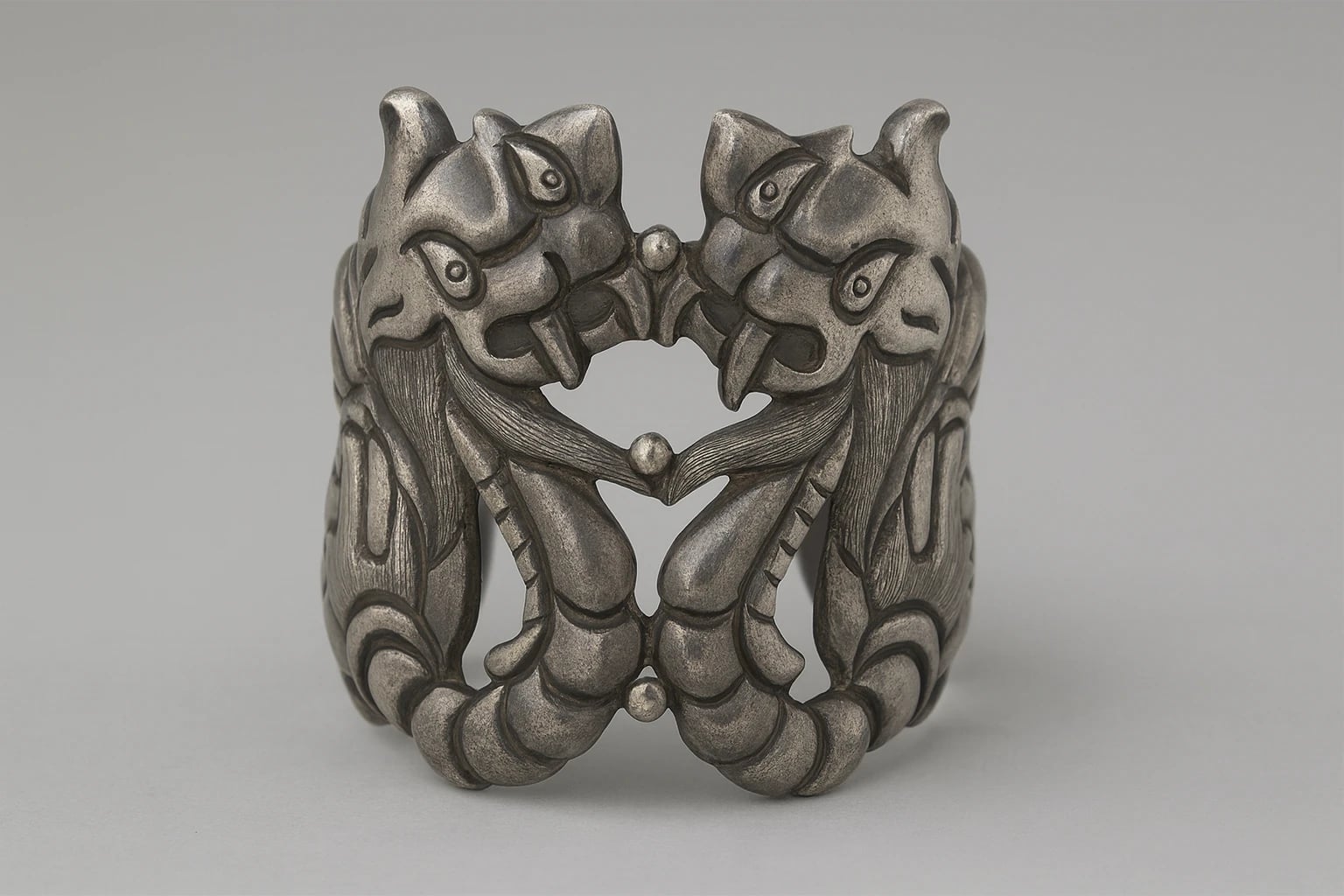
Double Dragon Bracelet