Saves instantly, no account needed. Already a member? Sign in.
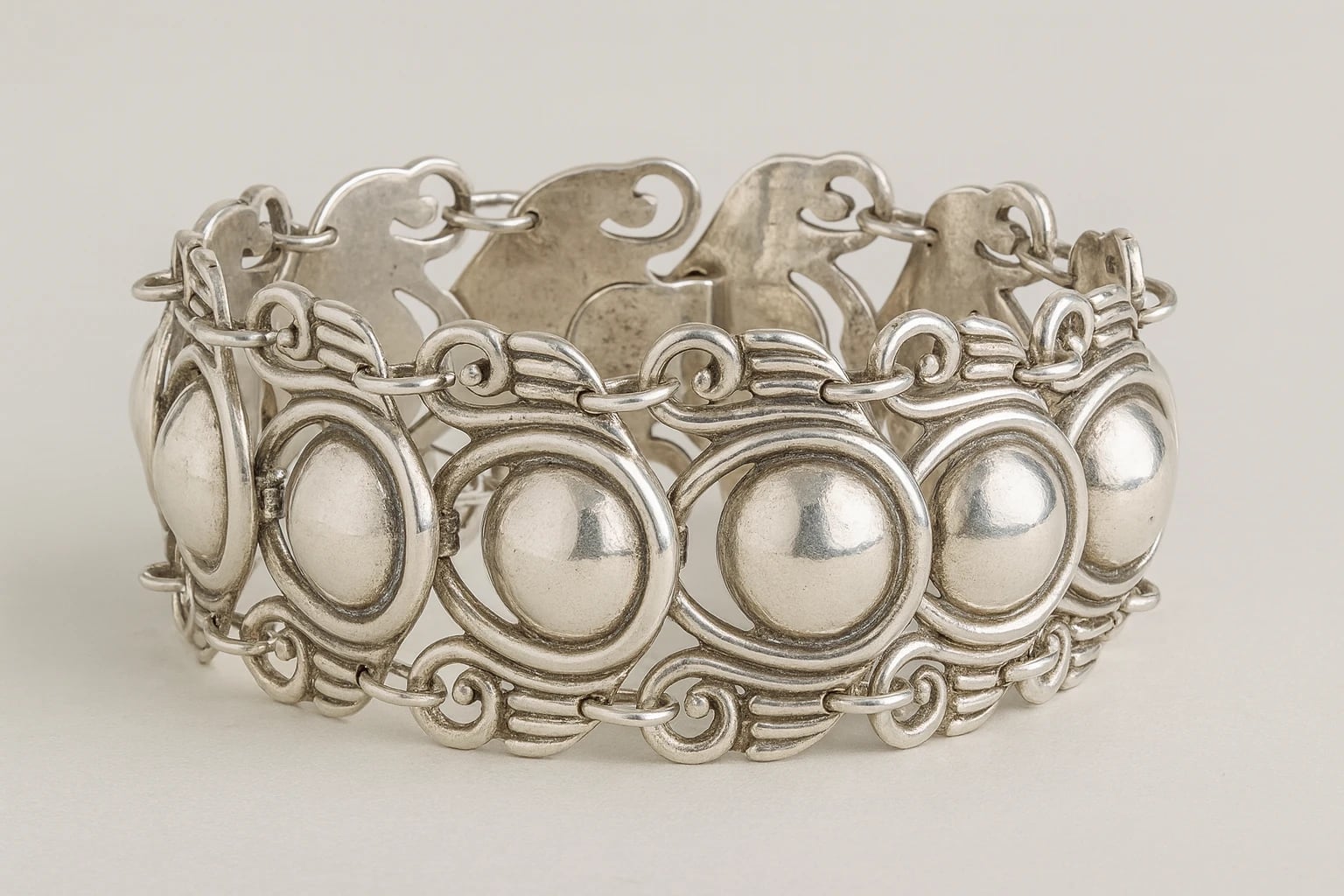
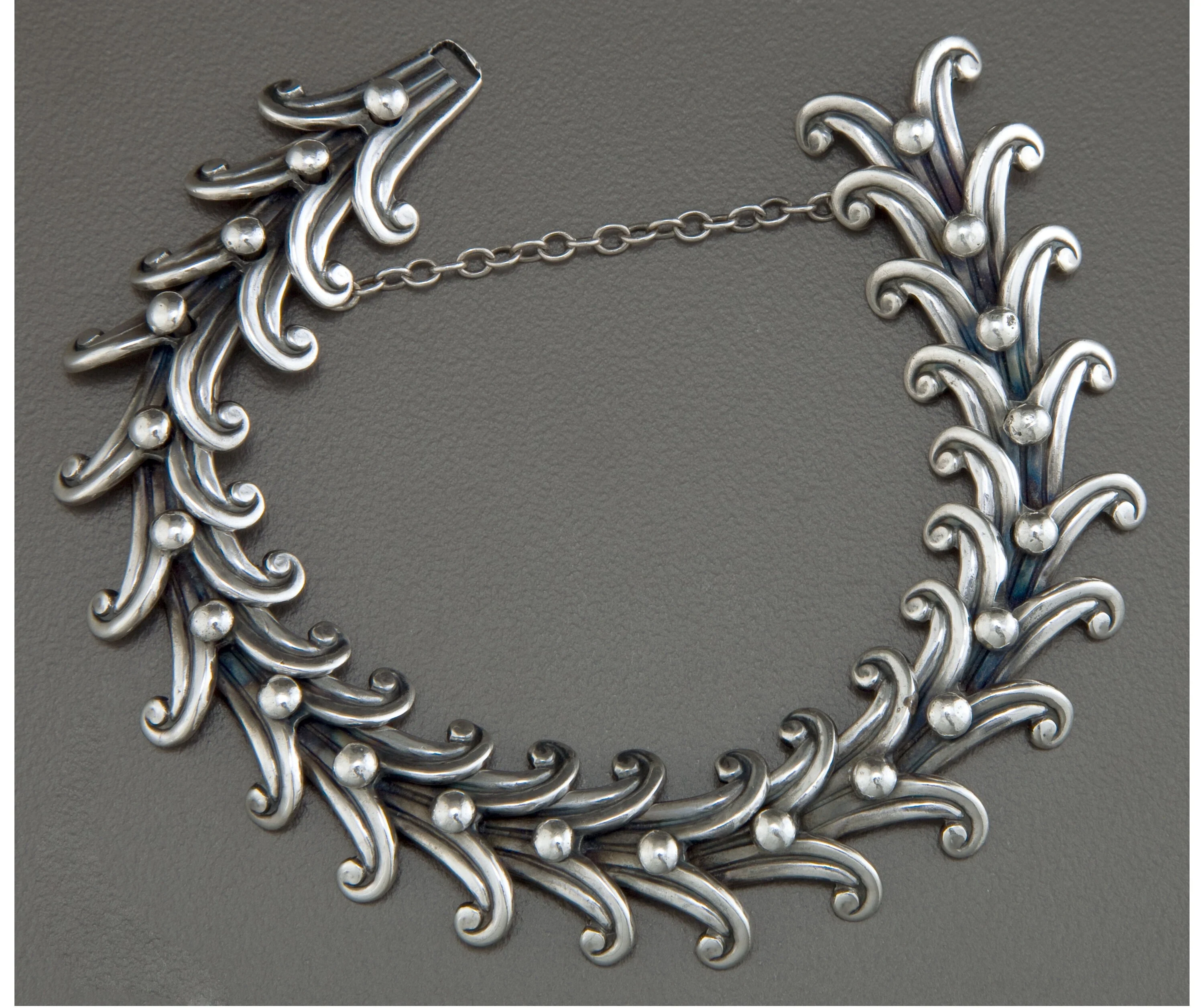
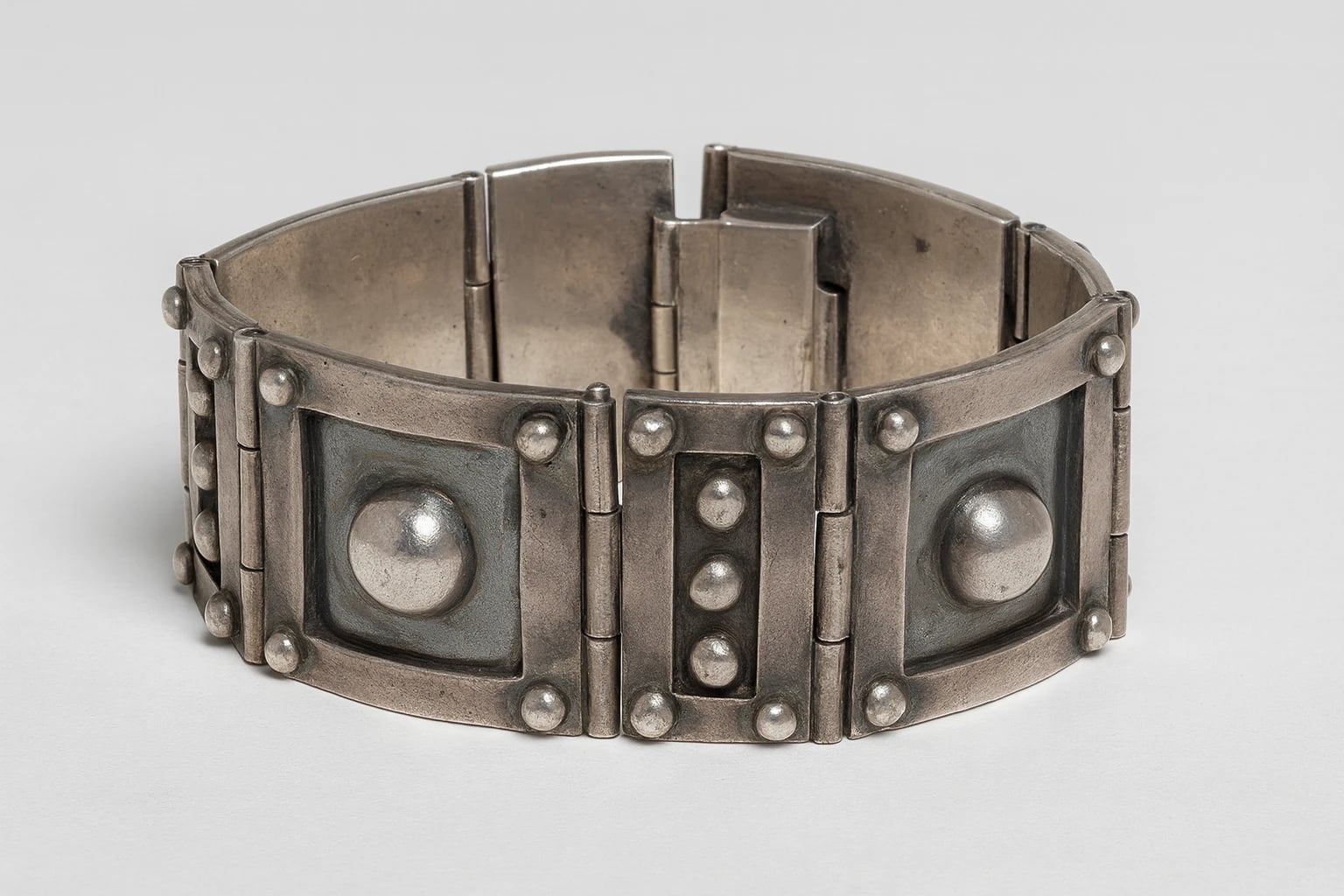
The bracelet is organized as a compact sequence of hinged silver panels, each one broad enough to register as a small shield and narrow enough to follow the wrist. Its force comes from that balance. The links are not treated as a continuous ribbon, but as separate architectural units joined by vertical knuckles and punctuated by rounded bosses. Across a width of one inch, the design creates a measured alternation of flat planes, raised borders, hinge barrels, and hemispherical accents. The result is substantial without becoming blunt. It has the compressed presence of early Taxco silver at a moment when bracelets often carried the visual weight of small metal constructions.
The central panels use shallow rectangles framed by applied or raised edges, with a domed silver element set into the field. Smaller silver beads appear along the vertical joins and at the clasp, making the hinge structure part of the ornament rather than a merely functional necessity. The push-in clasp is concealed within the same vocabulary of rectangular plates and beaded details, while the safety chain belongs to the practical world of a heavy bracelet meant to be worn. The surface has acquired the softened tonal variation associated with age and use, especially in the recesses around the bosses and hinge lines. That patina matters visually because it clarifies the relief: the darker passages hold the joints in shadow, while the higher silver surfaces catch light in broad, muted flashes.
The marks recorded on the piece place it within the early history of Los Castillo: block-letter Los Castillo, Taxco, Sterling, Hecho en Mexico, and design number 117, in the old linear mark, with no eagle assay stamp. The dealer archive records the bracelet as a 1940s pre-eagle work, and that dating accords with the early Los Castillo mark sequences documented by Bille Hougart, including 1940 to 1945 marks using 925 or related early wording before the later eagle-stamped systems became standard. Hougart also notes that, apart from the earliest 980 production, Los Castillo pieces were generally stamped with a design or inventory number. Number 117 should not be treated as an exact date, but in this bracelet it strengthens the impression of an early numbered workshop design rather than a later revival of the form.
Los Castillo was founded in 1939 by Antonio Castillo with his brothers Justo and Jorge, his wife Margot van Voorhies Carr, and his cousin Salvador Terán, after several of the family members had worked in William Spratling’s Taller de Las Delicias. The workshop soon developed a language separate from Spratling’s, shaped by multiple designers and by a collaborative taller system able to move between jewelry, hollowware, married metals, enamel, feather work, and other experiments. This bracelet belongs to the more direct silver vocabulary of the early years. It does not rely on stone color, enamel, or figural sources. Its interest lies in the conversion of clasp, hinge, and link into a unified rhythm of mass and articulation.
Museum of Mexican Silver. “Studded Dome Panel Link Bracelet.” Catalog no. MoMS-002308. https://museumofmexicansilver.com/pieces/los-castillo-bracelet-5
See something wrong with this record? Suggest a correction and the piece details fill in automatically.
Within a museum collection, the bracelet is valuable for showing how early Los Castillo could give a simple wrist form an unusually strong physical identity. Its scale is modest, but the construction is assertive: every joint is visible, every fastening contributes to the pattern, and every panel keeps its own weight within the larger curve. The piece helps explain why the Mexican silver renaissance cannot be understood only through spectacular motifs or named iconographies. It was also built through disciplined workshop designs like this one, where modern form, hand fabrication, and the realities of wear meet in a compact object made for the body.
Los Castillo
Domed Link Bracelet with Wire Scrolls