Saves instantly, no account needed. Already a member? Sign in.
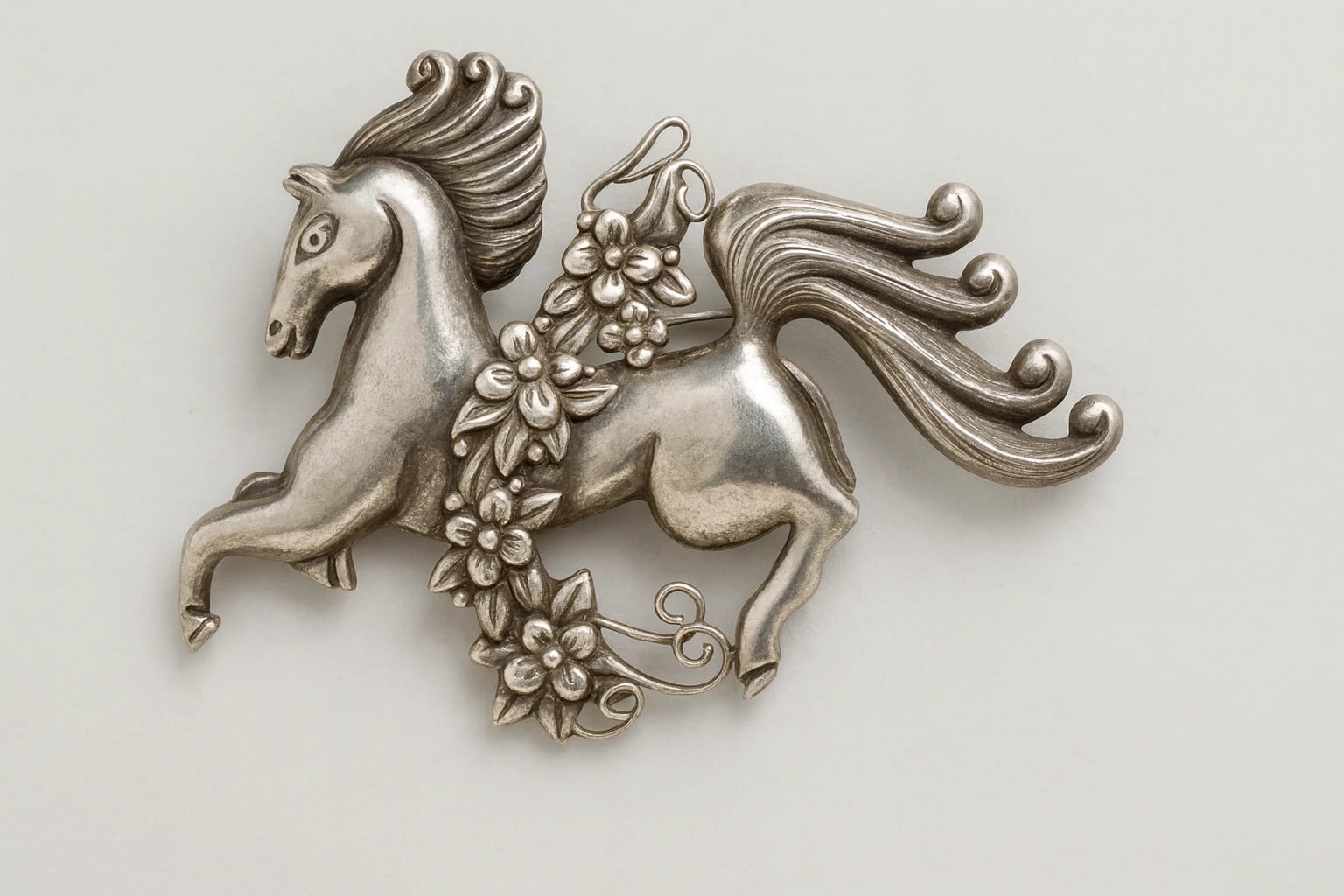
The galloping horse gives this large brooch its movement before any pin mechanism or garment can activate it. At four inches across, the animal has the scale of a small relief sculpture, with the head lowered, the foreleg lifted, and the hindquarters compressed into a forward spring. The mane and tail are not treated as naturalistic hair. They are organized as separate curling lobes, each ending in a rounded bead of silver, so that the horse’s speed is translated into repeated scrolls. Across the body, a garland of flowers and leaves interrupts the silhouette. It softens the animal’s force without taming it, placing a floral Taxco vocabulary over an equestrian form that is otherwise all muscle, curve, and directional thrust.
The brooch depends on a careful balance of mass and open line. The horse’s body is broad and polished, catching light in large passages, while the garland introduces smaller raised elements that break the surface into petals, berries, and leaves. The lower scrolls of the garland echo the tail and mane, creating a second rhythm below the animal’s belly. This is not a flat cutout enlivened only by engraving. The design uses relief, applied ornament, and controlled voids to make the brooch read clearly at distance and reward close viewing. The flowers also serve a structural visual purpose: they bind the composition across the flank, preventing the large silver body from becoming a single unmodulated shape.
The applied circular Los Castillo mark and design number 667 place the brooch within the early workshop practice of Los Castillo, before the eagle assay mark became standard on Mexican export silver around 1948. The absence of an eagle mark is especially useful here because Los Castillo later used several eagle numbers and a wide range of specialized line marks. This piece belongs instead to the period when the workshop was still consolidating its identity after its founding in 1939 by Antonio Castillo with Justo “Coco” Castillo, Jorge “Chato” Castillo, Salvador Terán, and Margot van Voorhies Carr. It should be understood as a Los Castillo workshop object rather than as the personal fabrication of Antonio Castillo alone. The taller system joined design authority, skilled execution, and repeatable workshop numbering without reducing the work to anonymous manufacture.
Within the Los Castillo field, the brooch is revealing because it does not depend on the workshop’s best known technical innovations, such as married metals, feather mosaic, enamel, or stone inlay. Its interest lies in silver itself: shaped surface, applied detail, and silhouette. The horse and garland show the workshop working through a more pictorial mode, close to the early Taxco taste for animals, flowers, and animated natural forms, but disciplined by modern design. The curling tail is decorative, yet it is also a compositional device. The garland is charming, yet it organizes the whole brooch. In this object, Los Castillo’s early modernism appears not as abstraction, but as a clear transformation of figure and ornament into a compact, wearable relief.
Museum of Mexican Silver. “Galloping Horse Brooch with Flower Garland.” Catalog no. MoMS-002311. https://museumofmexicansilver.com/pieces/los-castillo-brooch-2
See something wrong with this record? Suggest a correction and the piece details fill in automatically.
Los Castillo
Floral Bouquet Brooch