Saves instantly, no account needed. Already a member? Sign in.
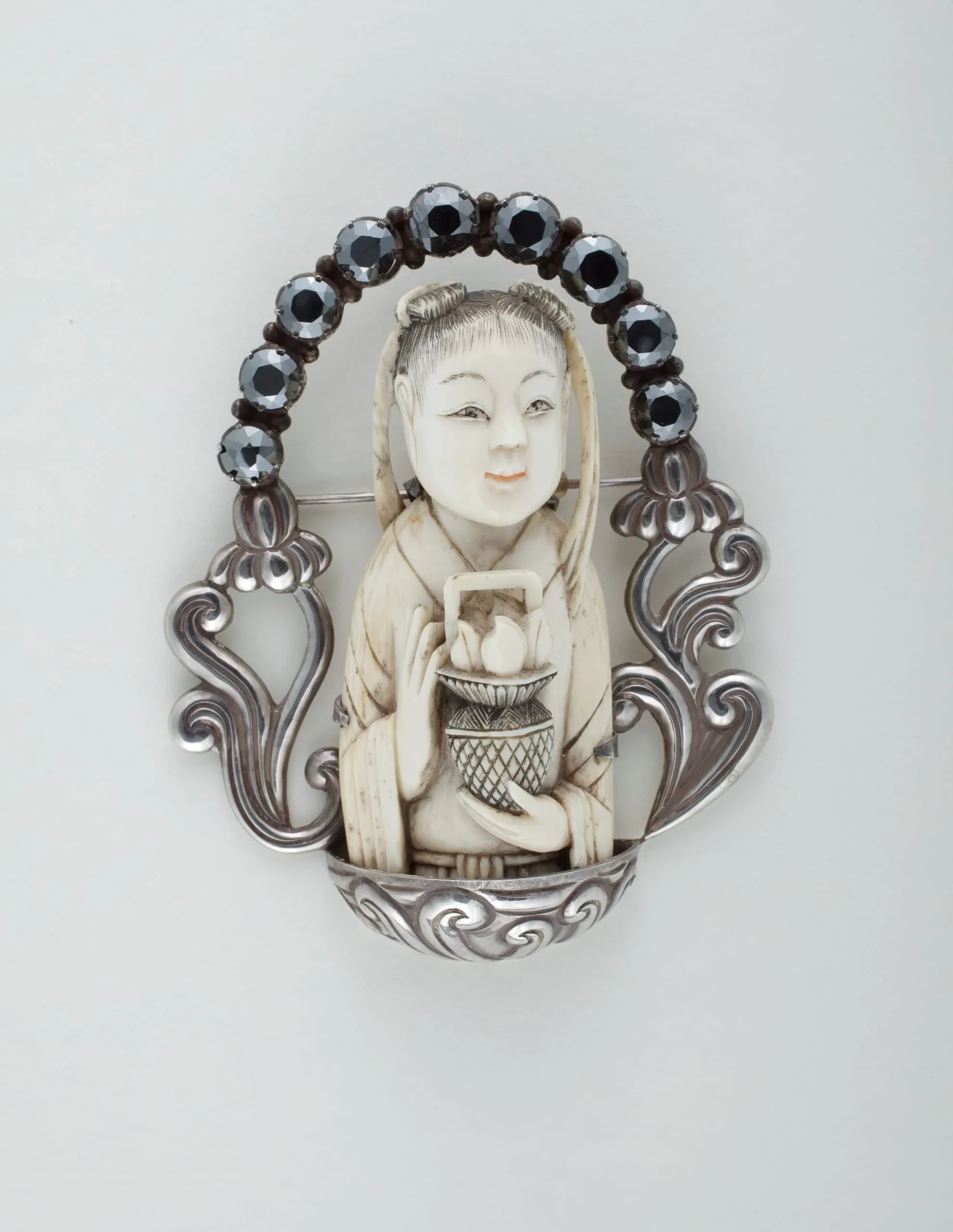
This brooch organizes a small Japanese ivory netsuke as the still center of a much more expansive Mexican silver setting. The carved figure, pale and compact, is held within a framework of scrolling silver, dark hematite beads, and a shallow lower cup whose curling decoration repeats the movement of the side scrolls. The contrast is deliberate: the netsuke gathers attention through minute carving and quiet facial expression, while the surrounding silver enlarges it into an object for the body. At 3 1/2 inches high, the brooch is intimate in scale, but its setting gives the figure a formal stage.
The design depends on a careful play of enclosure and release. The upper arc of faceted hematite beads forms a dark halo above the ivory head, each bead held in a small setting that catches light differently from the polished silver below. The side elements curve outward and then inward, building an open frame rather than a closed border. Their bright, rounded channels have the botanical ease associated with Los Castillo scrollwork, but they also serve a structural purpose, widening the composition without making the netsuke appear crowded. The pin stem crosses behind the figure, a reminder that the brooch is a wearable construction, not simply a mounted carving. The lower silver cup steadies the object visually and physically, enclosing the base of the netsuke while continuing the same spiral vocabulary in lower relief.
LACMA records the brooch as Margot van Voorhies Carr’s design for Los Castillo, made in Taxco around 1940, with Los Castillo’s working period for this object placed circa 1942 to 1948. That placement is important. It belongs to the years before Margot opened her own shop, when she was designing within the Los Castillo workshop and developing the themes that later became closely associated with her name. Morrill and Berk observed that many early Los Castillo works were unmistakably designed by Margot and that her interest in Japanese art appeared in both subject and approach to form. This brooch makes that observation concrete. It does not imitate Japanese metalwork. Instead, it absorbs a Japanese carved object into the visual language of the Taxco silver renaissance, where setting, silhouette, and bodily presentation transform a collected miniature into modern Mexican jewelry.
The absence of a visible hallmark in the available photograph limits what can be said from marks alone, and the object is best understood through its museum record, its construction, and its place in Margot’s Los Castillo period. Hougart’s hallmark reference documents the later Margot de Taxco marks and their eagle associations, but those marks belong to the identification history of her independent shop rather than to what is visible on this brooch. Here the central issue is design authorship within a workshop system. Los Castillo was not merely a retail name, nor was Margot’s role confined to ornamenting finished silver. The brooch shows her particular intelligence as a designer: a capacity to recognize the sculptural force of a found or collected object, then build a setting that changes its function without overwhelming its character.
Museum of Mexican Silver. “Netsuke Brooch.” Catalog no. MoMS-002277. https://museumofmexicansilver.com/pieces/margot-los-castillo-netsuke-brooch
See something wrong with this record? Suggest a correction and the piece details fill in automatically.
Within a museum collection, the brooch clarifies an aspect of the Mexican silver renaissance that is easy to miss when the field is reduced to national motifs or to technical categories. Taxco modernism was also cosmopolitan, alert to imported objects, tourism, collecting, Asian art, and the circulation of taste through artists, travelers, workshops, and patrons. Margot’s brooch gives that network a small but persuasive form. The ivory figure remains recognizably Japanese, the silver frame recognizably Taxco, and the finished object belongs to neither source alone. It belongs to the experimental world of Los Castillo, where silver design could make a brooch from cultural encounter, material contrast, and the disciplined shaping of a frame.
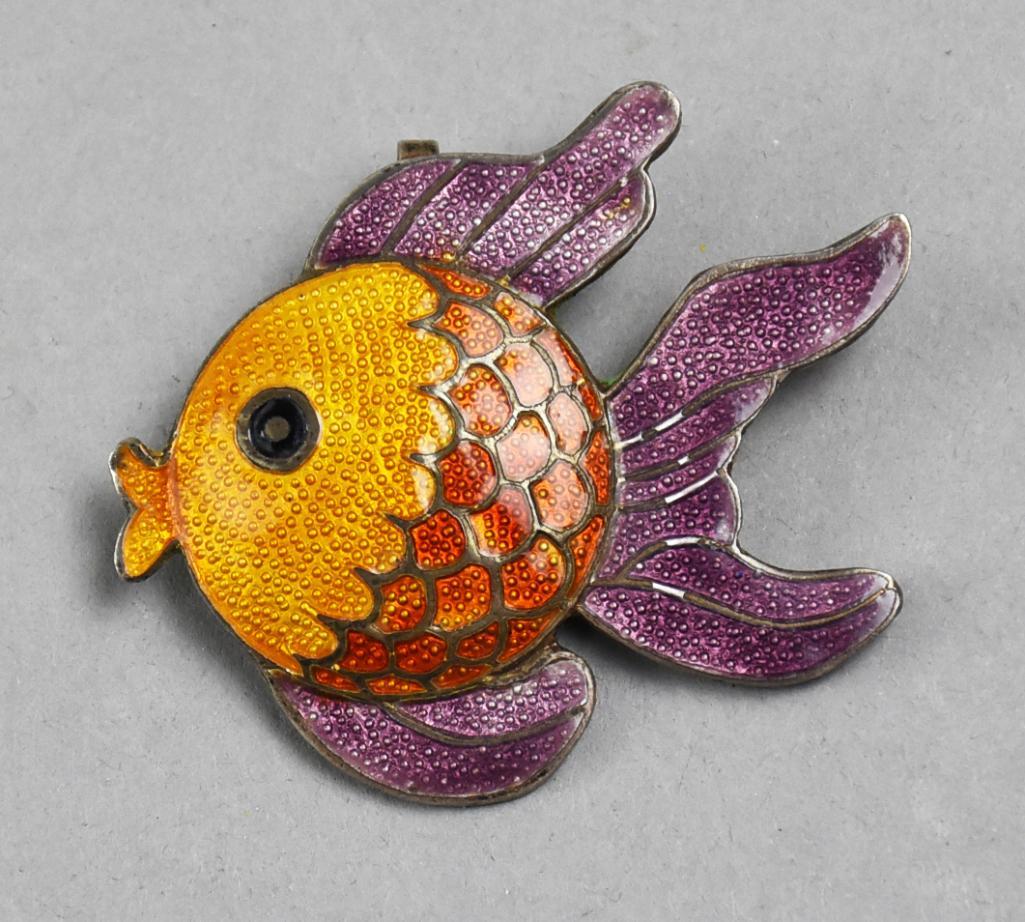
Fish Brooch
Sterling silver