Saves instantly, no account needed. Already a member? Sign in.
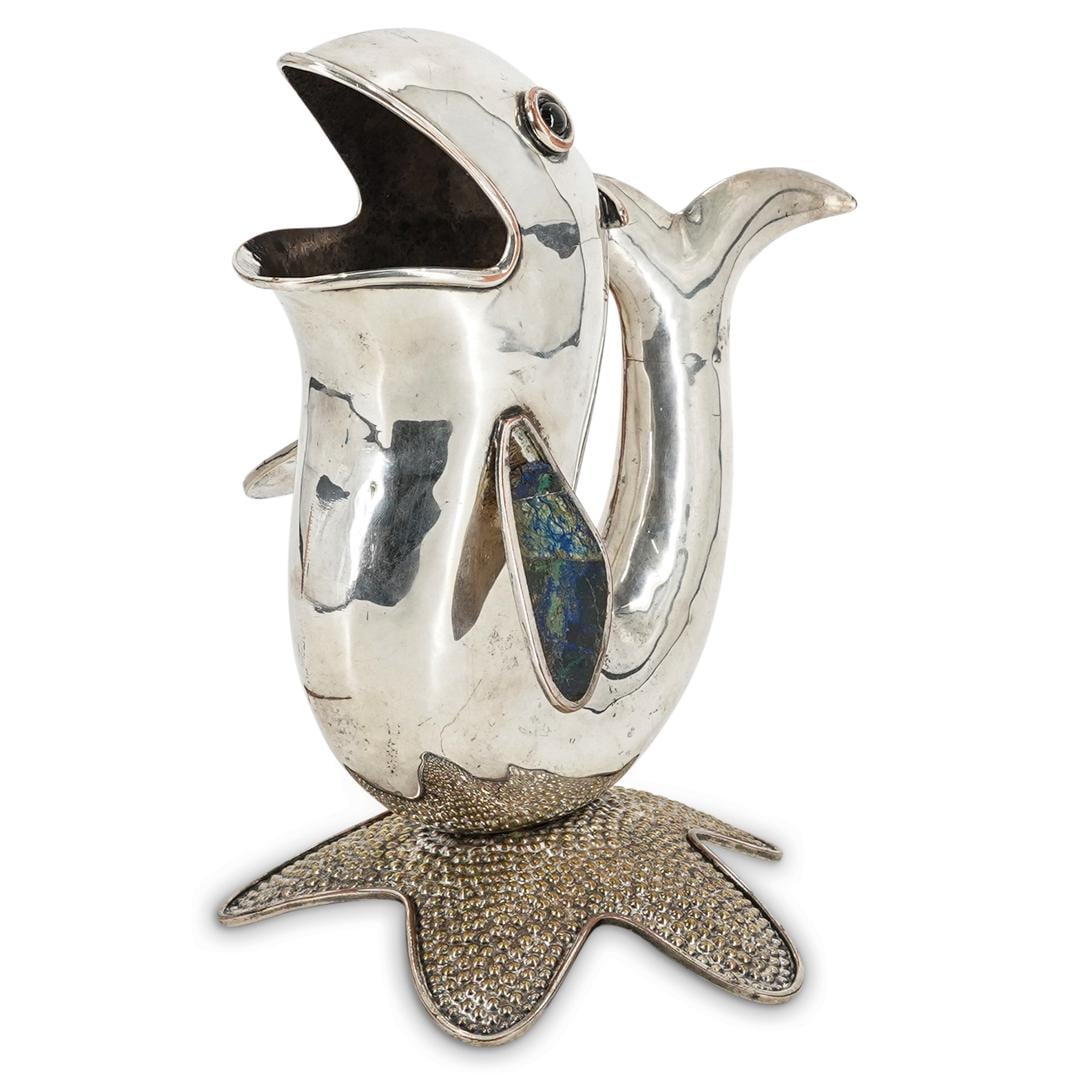
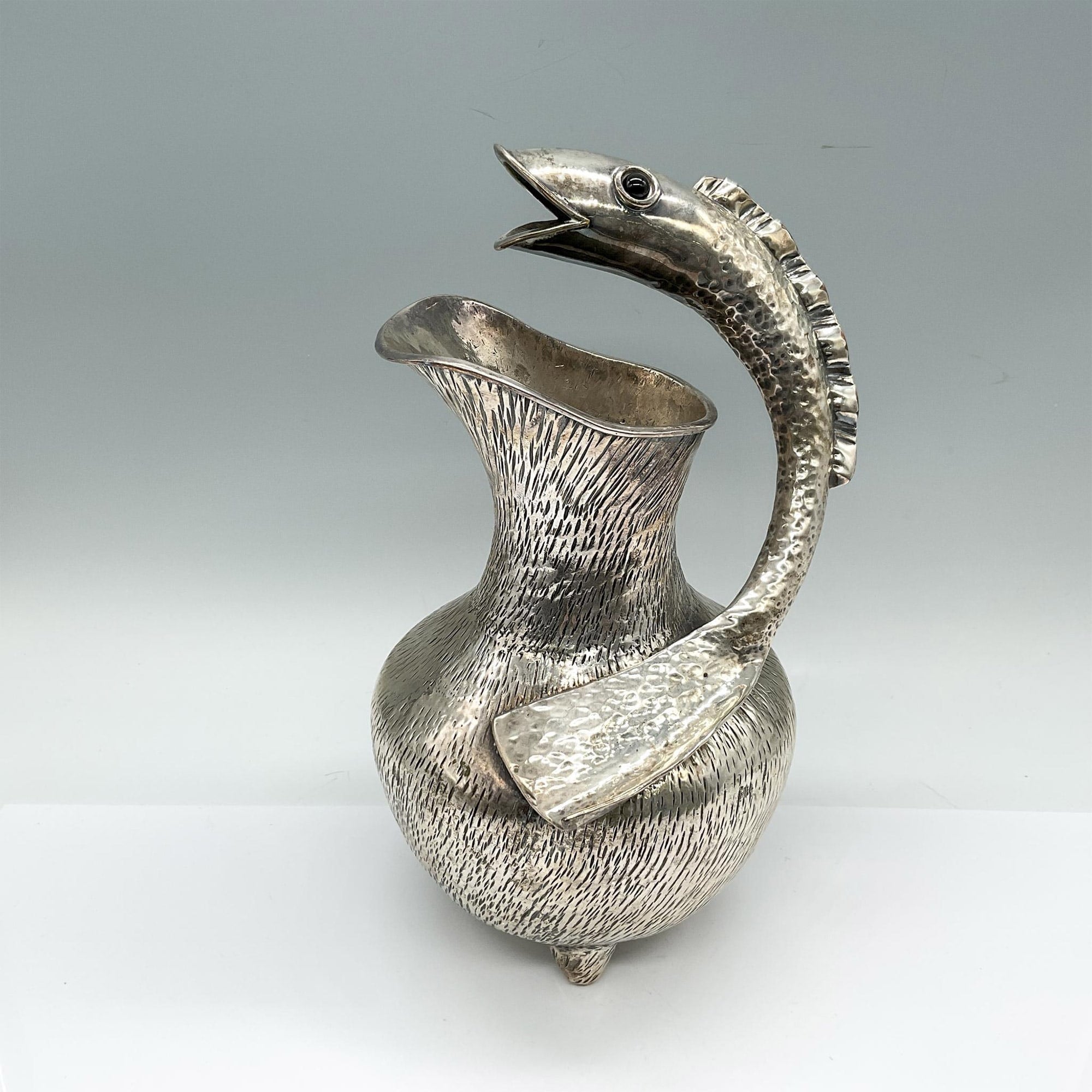
A pitcher in the form of a fish makes an unlikely proposition work: it turns a functional vessel into a single continuous animal, the body swelling to hold liquid, the tail sweeping up to become handle and spout. Los Castillo built its reputation on exactly this kind of transformation, where a domestic object stops being neutral and takes on the character of a creature or a natural form. The agate here is not incidental. Set into the silverplate body, the banded stone reads as the shifting color of a fish seen through water, its natural striations doing the work that no engraving could.
The design depends on the marriage of two very different materials. Silverplate gives the vessel its bright, reflective skin and its clean structural line, while the agate introduces opacity, weight, and the irregular pattern that only a mineral can supply. Agate polishes to a soft gloss rather than a jewel's fire, and that restraint suits the piece: the stone behaves like a section of the fish's flank, banded and translucent at its edges, catching light differently than the metal around it. Where many workshops treated inlay as decoration applied to a finished form, Los Castillo used the stone as an integral panel, so that the boundary between silver and agate becomes part of the drawing of the animal itself. This interest in setting hardstone directly into metal runs throughout the workshop's output, from its Onix Negro line of black onyx inlay to its stone-set hollowware.
Los Castillo, founded by the Castillo brothers who had passed through Spratling's Taller de Las Delicias before establishing their own operation in 1939, became one of the most inventive workshops of the Mexican silver renaissance precisely because it refused to stay within jewelry. The taller produced enameled work under named lines such as Mosaico Azteca and Pluma Azteca, developed married-metals techniques, and treated hollowware, boxes, and serving pieces as fully designed objects rather than afterthoughts. A figural animal pitcher belongs to this ambitious decorative-arts program, where the whimsy of a fish or a bird was carried by real structural resolution. The workshop's mark history records both sterling and plated production, including plateado stampings used on silverplate goods, which places pieces like this within an established category of the workshop's output rather than at its margins.
Figural silver and silverplate from Los Castillo demonstrates how seriously the Taxco workshops took the whole household, not only the body it adorned. A fish pitcher asks to be handled, poured from, set on a table, and read as a small sculpture between uses, and it shows a Mexican workshop applying modernist confidence to the oldest of subjects, the animal made useful. For a collection tracing the renaissance beyond jewelry, an object like this records the moment when a Taxco taller decided that a pitcher could be as designed, and as animate, as anything it made to be worn.
Museum of Mexican Silver. “Fish-Handled Pitcher with Agate Inlay.” Catalog no. MoMS-001288. https://museumofmexicansilver.com/pieces/los-castillo-pitcher-fish-agate-footed-silverplate
See something wrong with this record? Suggest a correction and the piece details fill in automatically.
Los Castillo
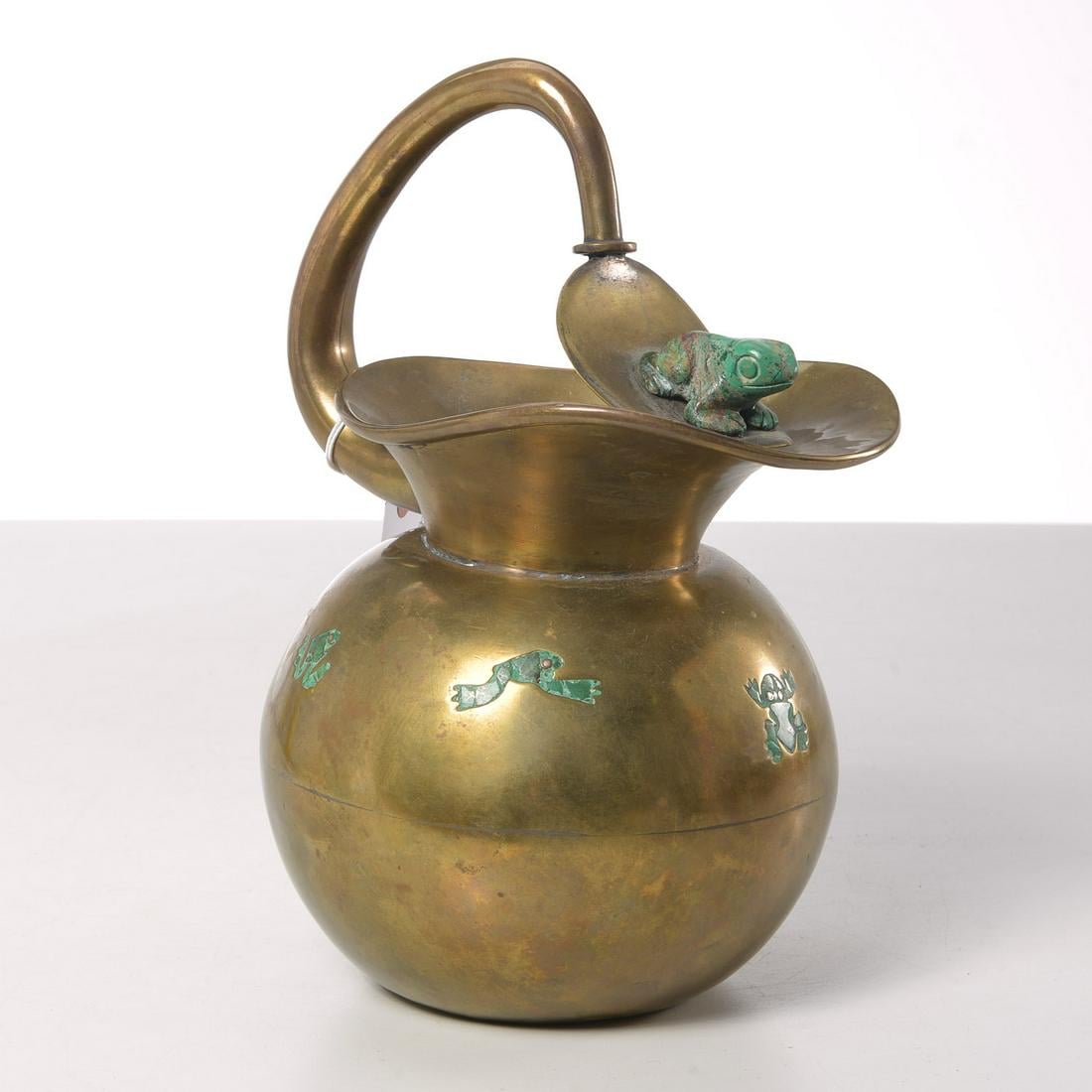
Frog Mixed Metal Malachite Pitcher
Malachite