Saves instantly, no account needed. Already a member? Sign in.
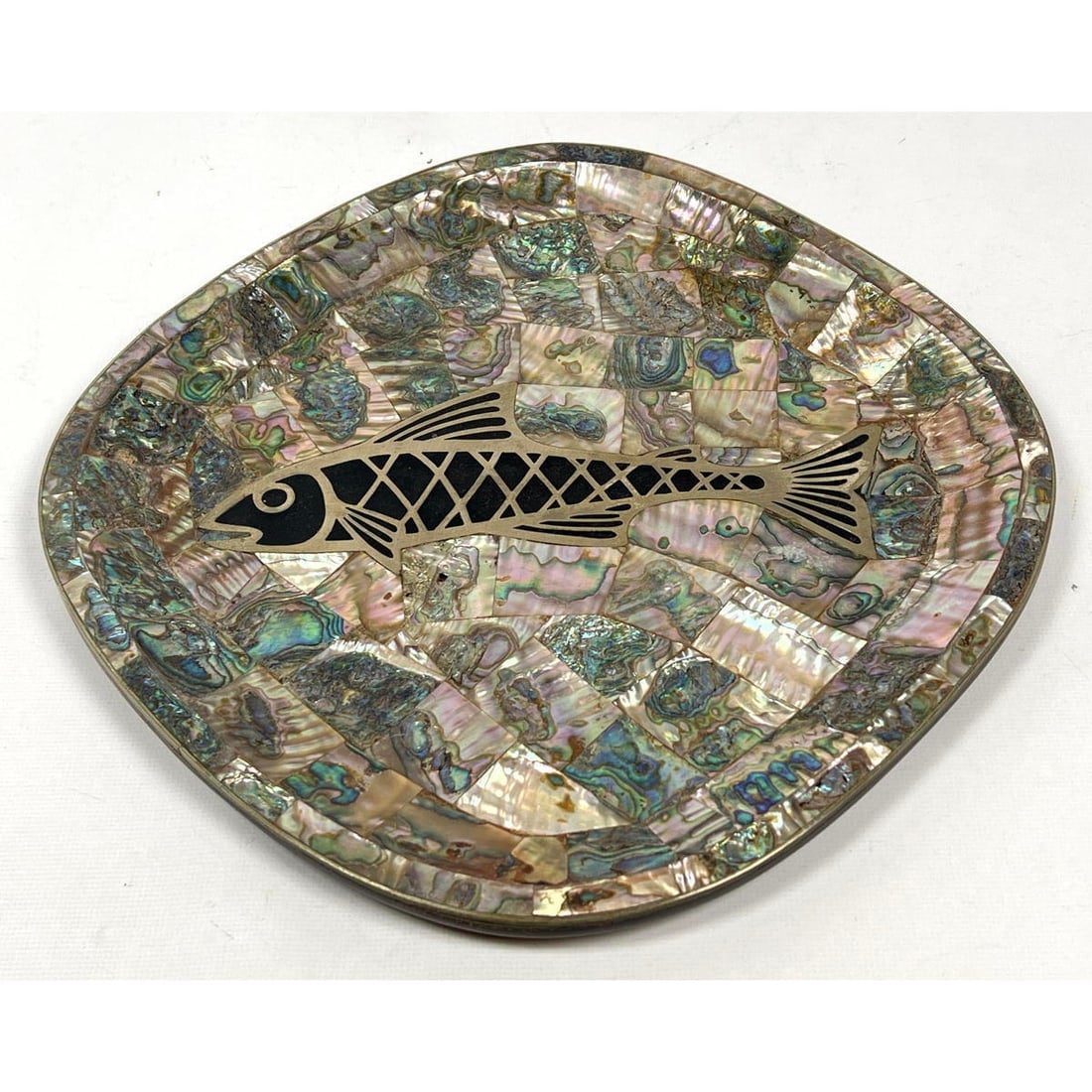
A shoal of fish, cut from mother of pearl, swims across a metal ground in this Los Castillo tray, and the whole design turns on the quiet drama of that material. Mother of pearl does not sit still under light. It shifts from milk white to pale rose to a cool green depending on how the tray is angled and where the viewer stands, so the fish seem to move even when the object is still. Los Castillo built much of its reputation on exactly this kind of inlay work, setting shell, stone, and enamel into metal so that surface pattern carries the design rather than applied ornament or heavy modeling. The tray is a functional object that behaves like a small composition in light.
The fish motif rewards the material choice. Each fish reads as a flat silhouette, its body a single piece of shell whose natural iridescence supplies the sense of scales and wetness that a smith would otherwise have to chase and engrave. Grouped and overlapped across the field, the fish set up a rhythm of repeated curves broken by the gaps between them, and those gaps of plain metal become as active as the inlay itself. This is a workshop that understood negative space. The reflective ground throws light back through the translucent edges of the shell, while the opaque centers hold their color, so the tray oscillates between the flash of polished metal and the softer glow of nacre. The result is decorative in the most serious sense, a pattern that changes as the object is used and carried.
Los Castillo emerged from the taller system that shaped Taxco silver, founded by the Castillo brothers who had worked with William Spratling before establishing their own workshop, and the firm became known for pushing beyond straight silver into mixed materials. The hallmark record documents this appetite directly, with named production lines for fired enamel, Mosaico Azteca, feather mosaic, and black onyx inlay, each a distinct experiment in setting color and texture into metal. A mother of pearl inlay tray belongs to that same investigative program. It is worth keeping the workshop's roles distinct here: the Castillo name marks the design and the taller under which the piece was produced, while the actual cutting, fitting, and inlaying of shell was specialized bench work carried out by smiths trained in that technique. The tray is the product of that collective skill, not of a single hand or a factory line.
For a collection tracing the Mexican silver renaissance, an inlay tray like this one shows how the movement extended well past jewelry and hollowware into decorative objects that carried the same design intelligence. It also marks the point where Los Castillo's ambitions in mixed media, the same ambitions that eventually produced its enamel and mosaic lines and that shaped Salvador Terán's later work in glass and stone mosaic after he left the firm in 1952, entered the domestic sphere of the table. One caution belongs with any Los Castillo inlay piece: the workshop's classic designs have been reproduced in later years with properly acquired hallmarks, so genuine age must be read in the patina of the metal and the wear of long handling rather than in the mark alone. Judged on its design, the tray demonstrates that the renaissance treated the surface of a serving object as a place worth thinking hard about.
Museum of Mexican Silver. “Fish-Motif Oval Tray with Mother-of-Pearl Mosaic.” Catalog no. MoMS-001332. https://museumofmexicansilver.com/pieces/los-castillo-tray-fish-mop
See something wrong with this record? Suggest a correction and the piece details fill in automatically.
Los Castillo
Fish-Motif Oval Tray with Mosaic Inlay