Saves instantly, no account needed. Already a member? Sign in.
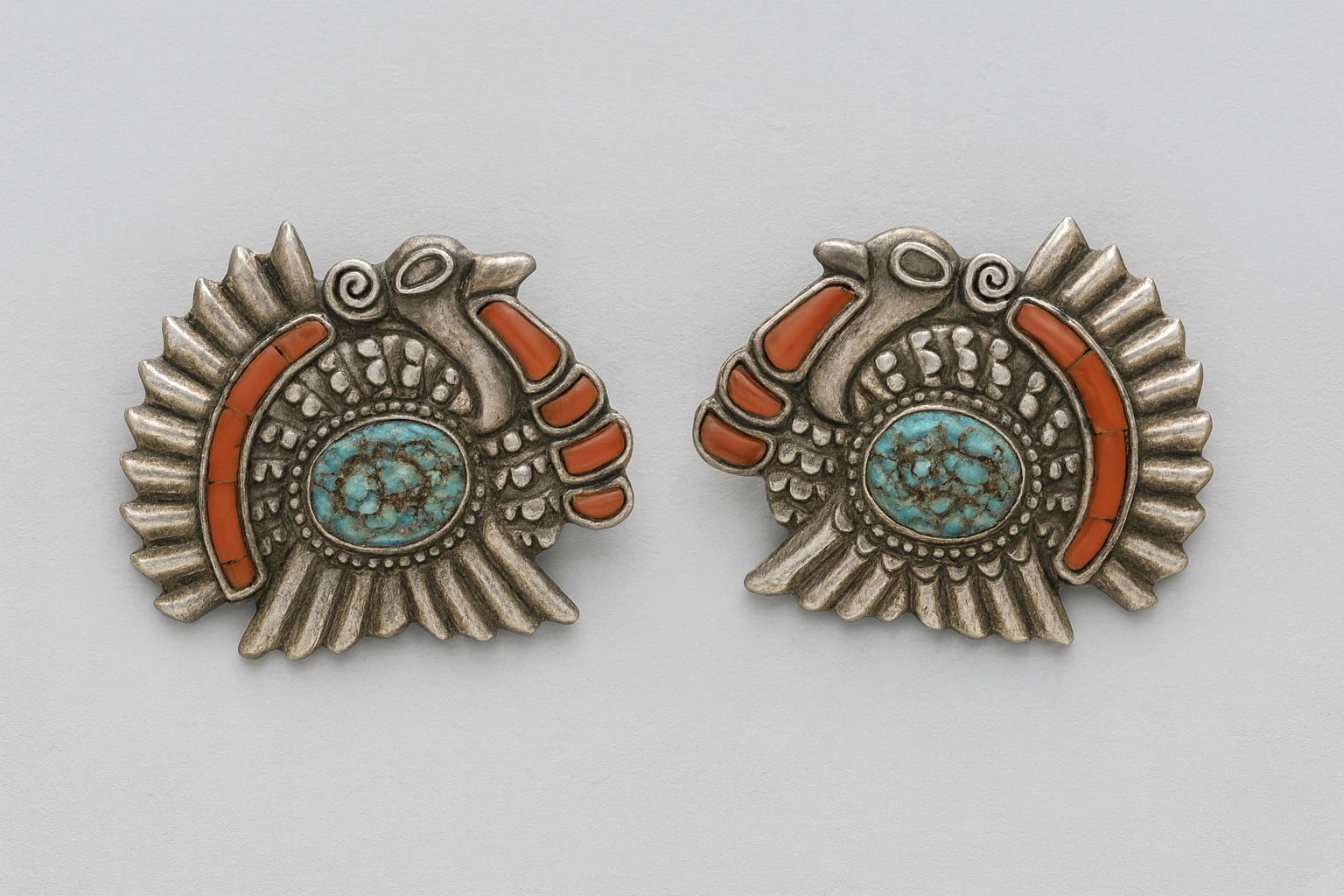
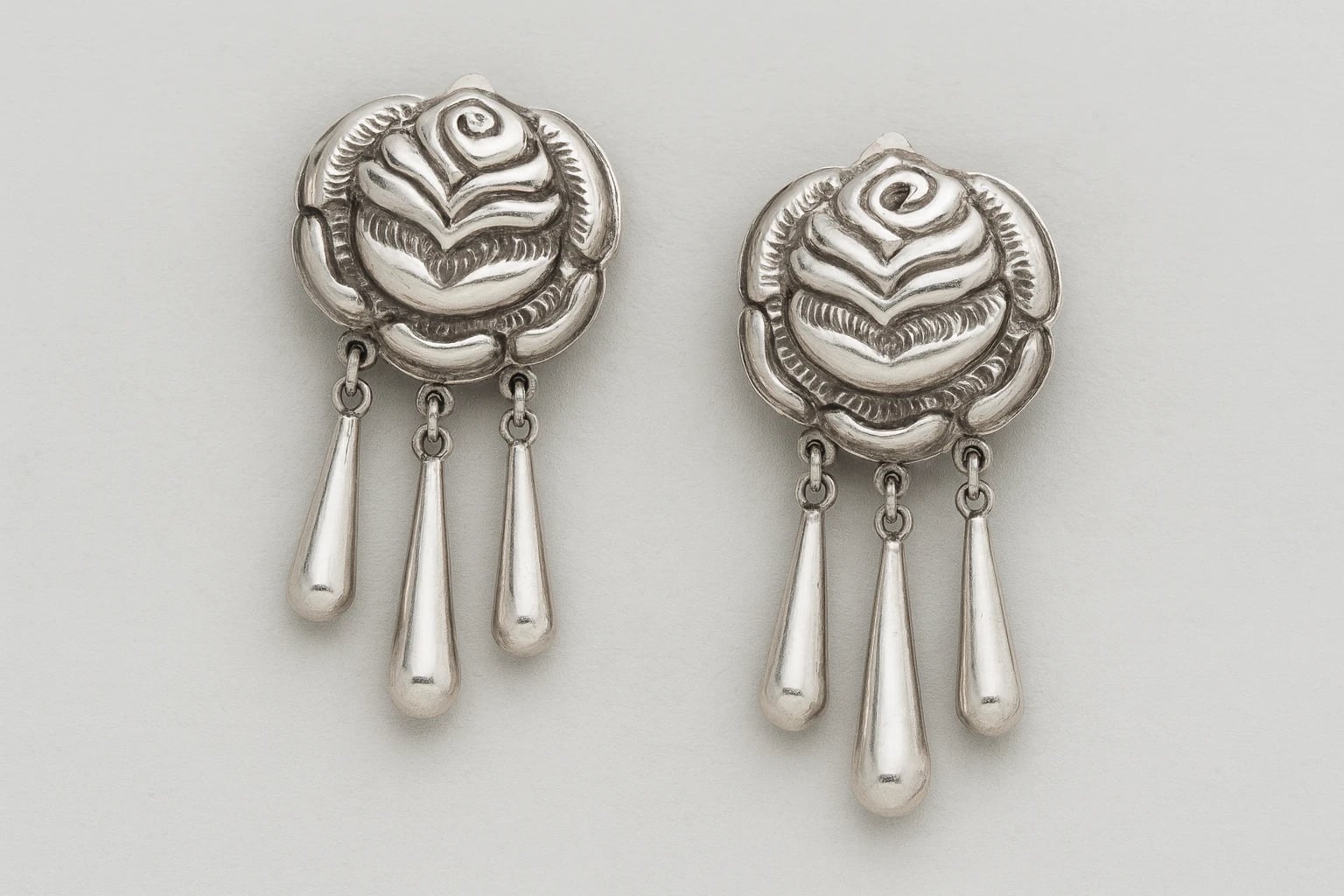
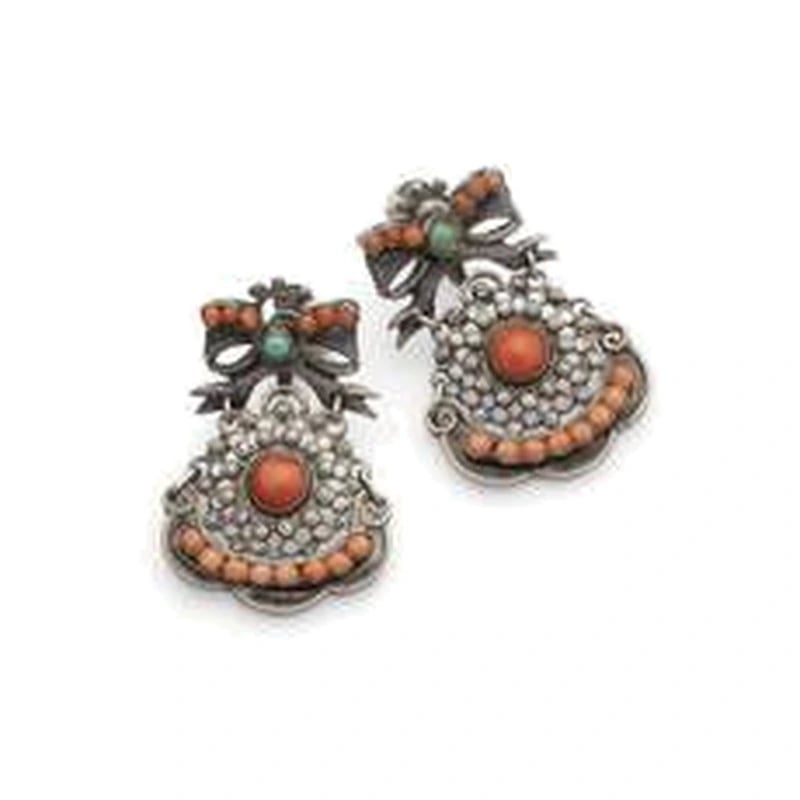
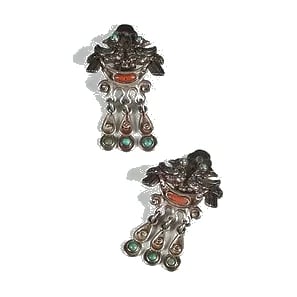
These clip-back earrings condense the MATL workshop’s luxuriant vocabulary into a small, mobile format: a bird-and-garland form centers an irregular coral branch, while three articulated silver drops fall below, each ending in a small turquoise. The composition is built from contrasts that MATL used with unusual confidence. Coral is left as a branching natural form rather than reduced to a polished cabochon, and turquoise punctuates the lower edge with cool, rounded color. The silver does not simply frame the stones. It curls, beads, overlaps, and opens into small intervals of shadow, making the earrings read as miniature reliefs that move against the ear.
Their relation to the hardstone pendant choker in this collection matters. The choker, signed MATL and measuring 14 1/2 inches, establishes the earrings as part of a suite rather than as isolated ornaments. In that context the three pendant drops become especially important: they translate the frontal density of a choker into movement at the side of the face. The clip-back mechanism fixes the upper bird-and-garland section close to the ear, while the lower elements remain free to swing. MATL’s color is never incidental in such work. Coral and turquoise provide points of light and density, but they also break the silver surface into a rhythm of natural red, mineral blue-green, and oxidized recess.
The MATL signature places the suite within the Mexico City workshop of Matilde Eugenia Poulat and Ricardo Salas. Hougart records Poulat as a painter and designer trained at the San Carlos Academy, with her shop opened in 1934, and identifies “MATL” as registered trademark number 142093, a number that appears on MATL jewelry and decorative objects. His hallmark chronology also records early 0.900 and 0.925 marks, 0.950 marks, and later marks incorporating the trademark registration number, with eagle numbers 1, 123, and 129 associated with the workshop. Morrill and Berk’s account is particularly useful for understanding authorship here: Salas worked closely with his aunt from childhood, learned silversmithing and the carving of coral, turquoise, ivory, and other materials, and described their design collaboration as so close that a comparison of their work could not really be made.
These earrings belong to the part of the Mexican silver renaissance that developed outside Taxco’s dominant workshop genealogy. Morrill and Berk place Poulat’s jewelry within the postrevolutionary search for a Mexican aesthetic, noting her attention to Mixtec gold from Monte Albán as well as to birds, flowers, tiny bells, and other motifs associated with Mexican popular and devotional art. The present earrings do not reproduce an archaeological source literally. They convert bird, garland, branch, and pendant into a dense modern ornament that remains unmistakably Mexican without becoming schematic. A related public benchmark is LACMA’s circa 1940 MATL Birds and Pendant Brooch Necklace, also in silver with coral and turquoise, which shows how fully bird imagery and colored hardstones belonged to the workshop’s larger design language.
Sold in one lot with the hardstone pendant choker in this collection (matl-hardstone-pendant-choker-and-earrings), Sloans & Kenyon 2015; the set is signed MATL.
Museum of Mexican Silver. “Bird-and-Garland Drop Earrings with Coral and Turquoise.” Catalog no. MoMS-002198. https://museumofmexicansilver.com/pieces/matl-coral-turquoise-drop-earrings
See something wrong with this record? Suggest a correction and the piece details fill in automatically.
As a suite component, the earrings show the MATL workshop at its most characteristic scale: intimate, pictorial, and carefully animated. They also show why MATL cannot be treated as a decorative footnote to Taxco modernism. Poulat and Salas developed a parallel language of silverwork in Mexico City, one that joined painterly color, relief surface, religious and folk imagery, and hardstone carving into jewelry meant to be worn but also closely read. Here the smallest elements carry the structure. The coral branch anchors the upper field, the turquoise drops measure the lower edge, and the articulated silver links give the design its final cadence.
MATL (Matilde Poulat)
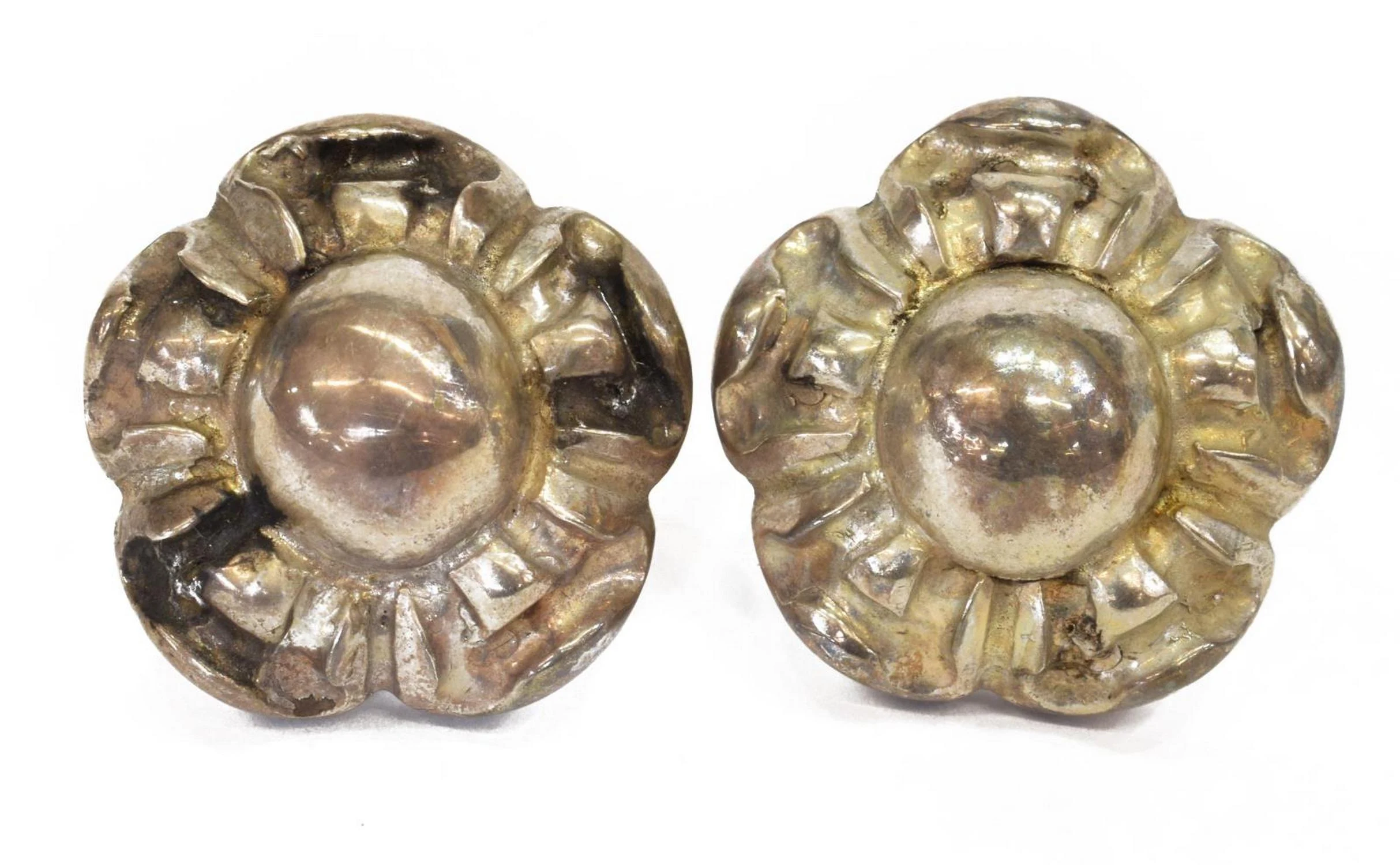
Floral Earrings
1934 or later
Silver