Saves instantly, no account needed. Already a member? Sign in.
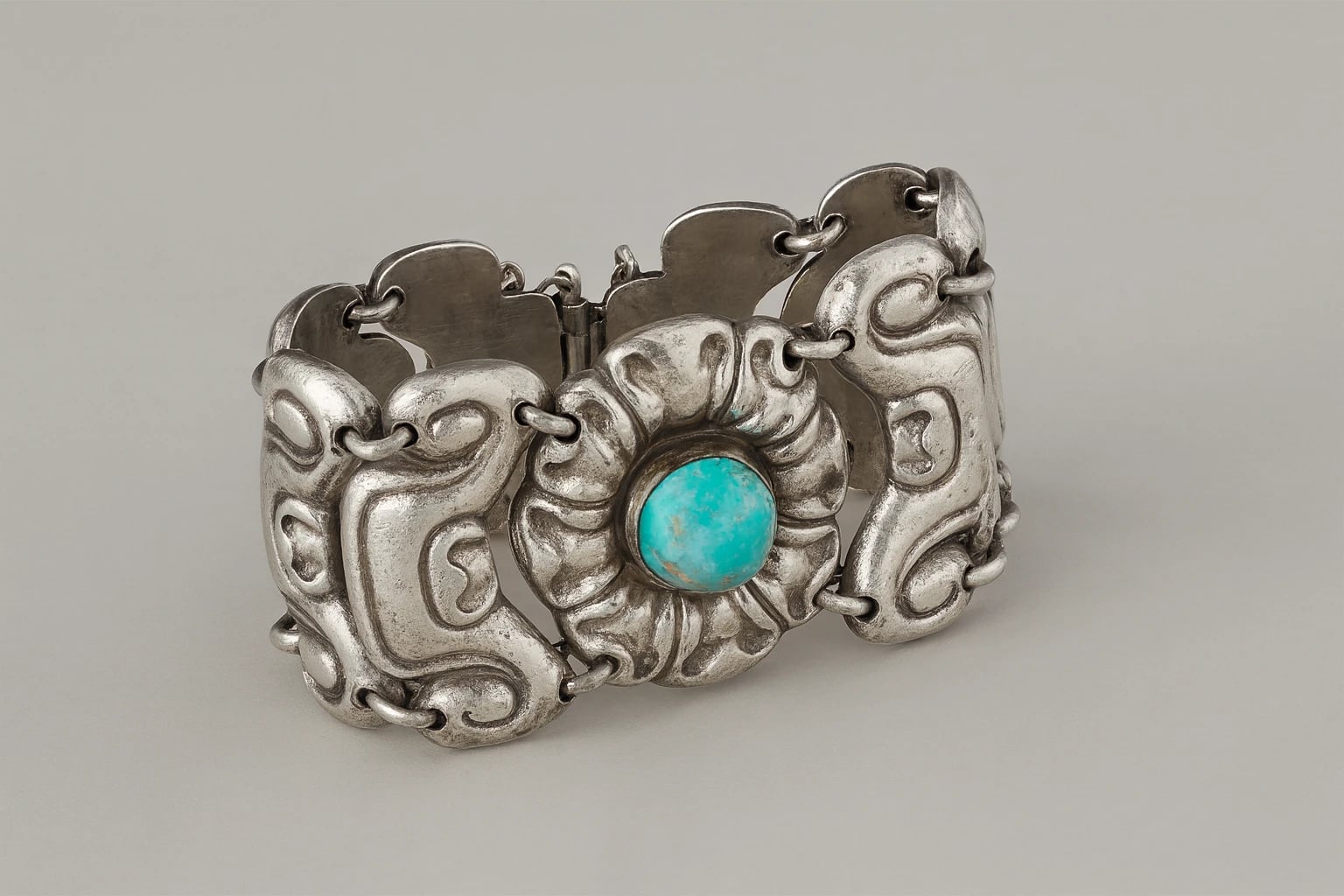
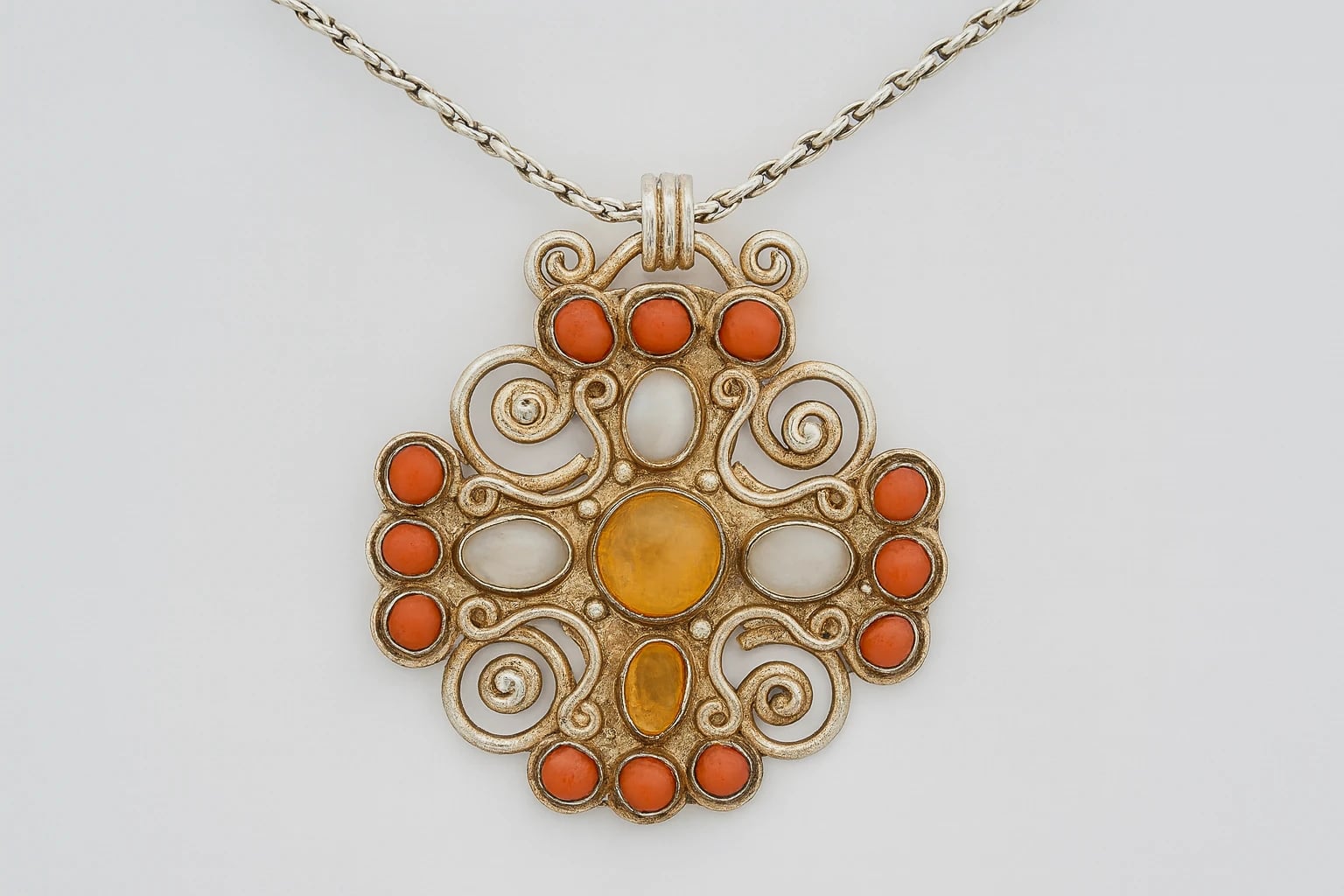
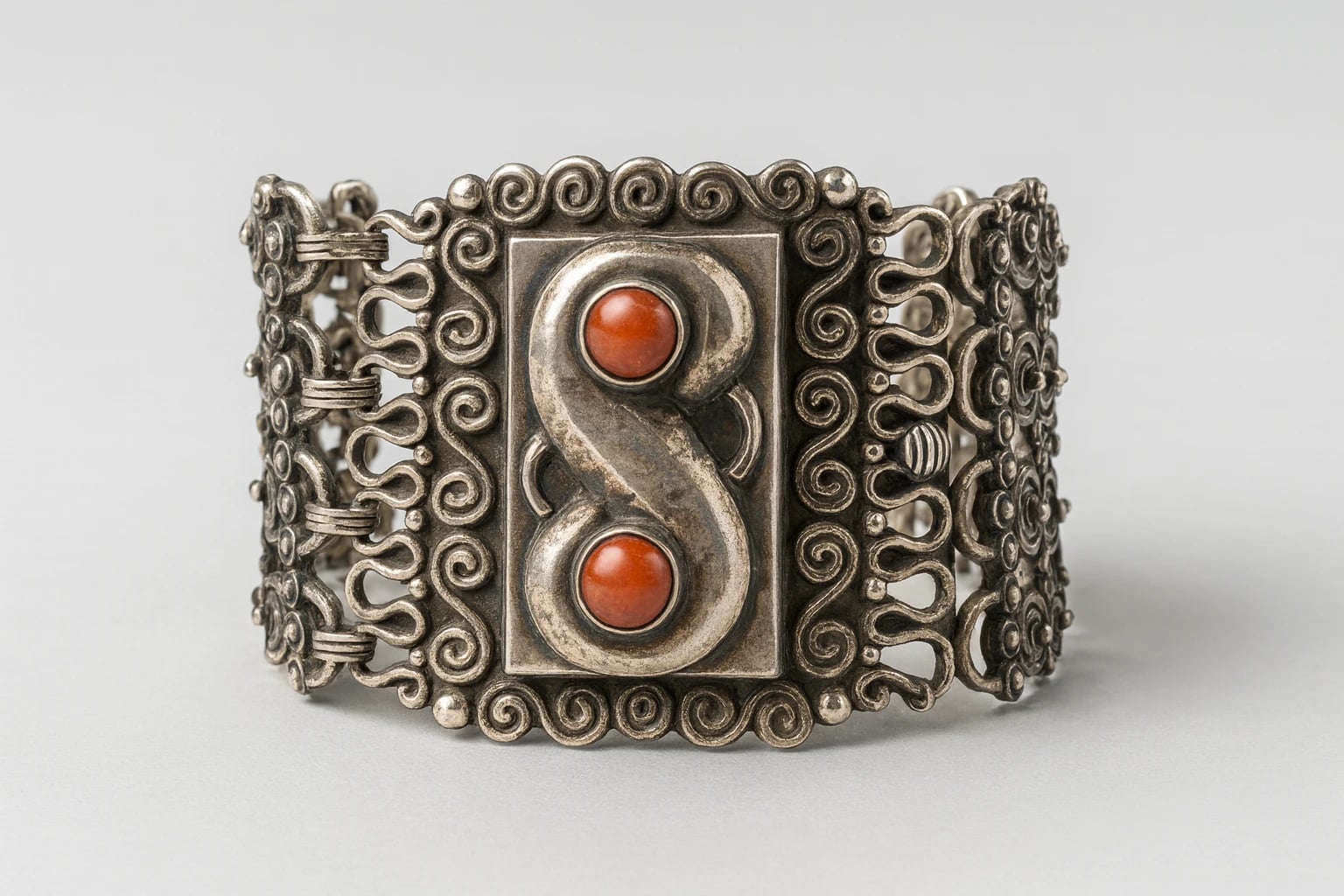
A rigid silver cuff carries a central panel of dense floral and scroll ornament set with coral, the kind of tightly composed frontal design that defines the MATL workshop's approach to jewelry. Rather than treating the bracelet as a plain band, the design concentrates its incident in a single field, framing coral against silverwork so that the warm red reads as the focal color against a cooler metallic ground. The result is ornament organized as a small panel of relief, worn on the wrist and legible from a short distance.
The composition depends on symmetry and layering. Scrolling tendrils, small blossoms, and beaded silver elements build up a surface with real depth, so that light catches the raised passages and shadow gathers in the recesses. Coral supplies opacity and saturated color where the silver alone would remain tonal, and the contrast between the two materials gives the panel its structure: the stones anchor points within the design while the silver carries the linear movement around them. This decorative vocabulary, rooted in Mexican colonial and folk ornament rather than in the severe geometry favored by other Taxco workshops, is the signature of Matilde Poulat's designs. A painter and designer trained at the San Carlos Academy before she opened her shop in 1934, Poulat brought a pictorial sensibility to silver, treating the metal surface as a field to be composed.
The MATL name, a variation of an Aztec word for water, was registered as a trademark under number 142093, and the mark appears on the workshop's jewelry and decorative objects in several forms. Hougart's hallmark reference records early stamps combining script MATL with fineness marks such as 0.925 and the curved legend Hecho en Mexico DF, in use during the workshop's first decades, alongside later etched-script marks that incorporate the registration number. That registration matters for chronology, because the MATL design language did not end with Matilde Poulat's death in 1960. Her nephew Ricardo Salas, who worked alongside her throughout her career, continued producing the MATL designs and supervised a workshop of silversmiths, with pieces made after 1980 bearing both the MATL mark and the MS-12 registration. Reading the specific mark on a given cuff is therefore the way to distinguish when the object itself was fabricated from when the design was conceived.
Within the Mexican silver renaissance, the MATL workshop occupies a position distinct from the streamlined modernism associated with Spratling and his successors. Poulat looked to colonial silver, popular art, and older devotional and folk imagery, and she made those sources the basis of a coherent decorative style rather than a passing quotation. A coral cuff of this type shows how that style translates into a wearable object: a frontal panel of dense ornament, color set deliberately against metal, and a continuity of workshop production that carried the designs across several decades. For a collection tracing the range of the renaissance, it documents the ornamental, tradition-minded current that ran alongside the movement's geometric experiments.
Museum of Mexican Silver. “Panel Cuff with Coral.” Catalog no. MoMS-002222. https://museumofmexicansilver.com/pieces/matl-coral-panel-cuff-bracelet
See something wrong with this record? Suggest a correction and the piece details fill in automatically.
MATL (Matilde Poulat)
Bird-and-Garland Drop Earrings with Coral and Turquoise
Sterling silver