Saves instantly, no account needed. Already a member? Sign in.
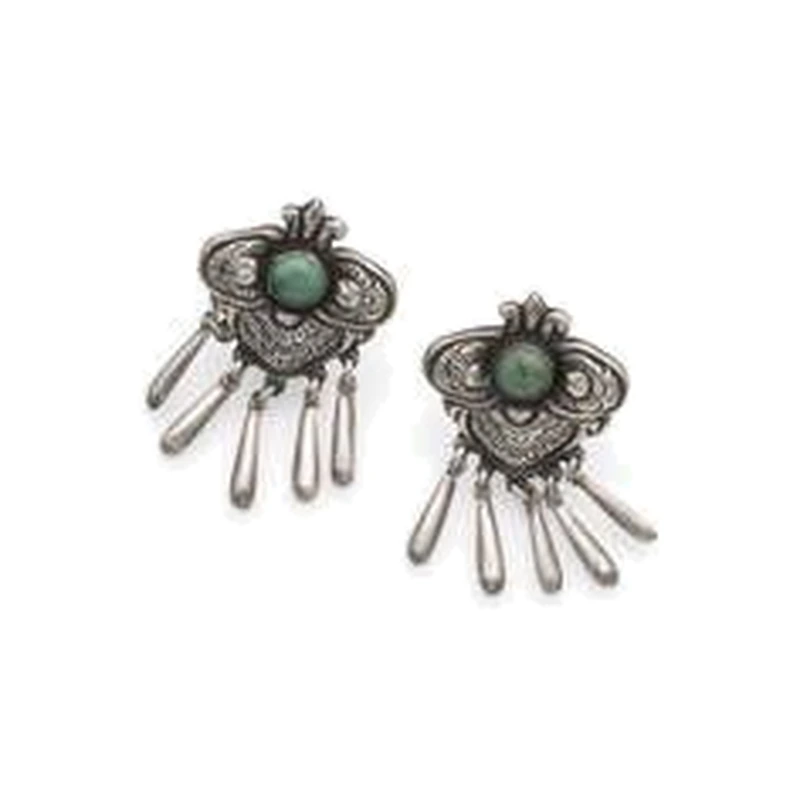
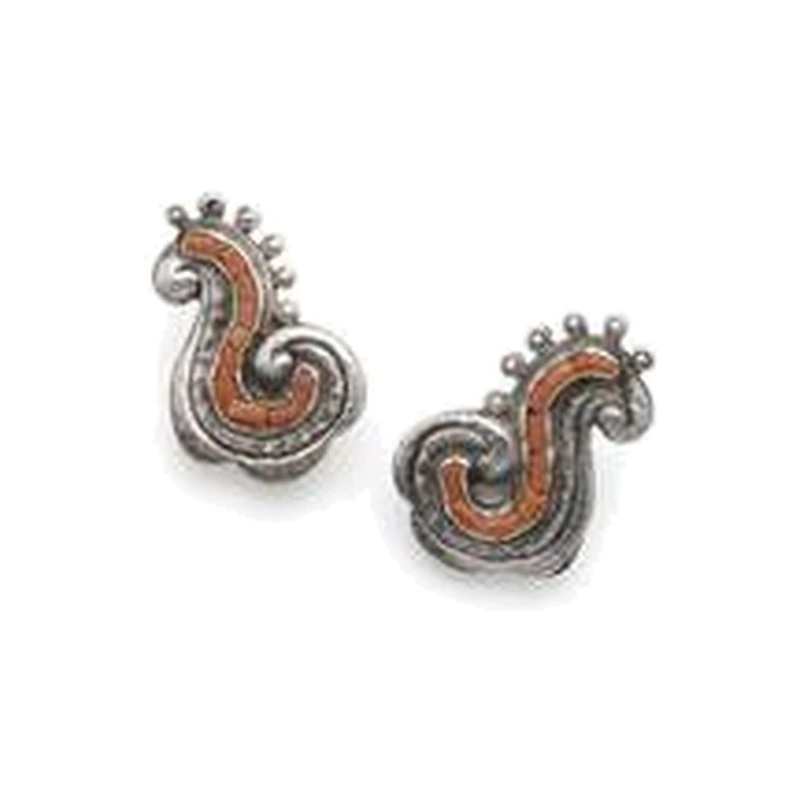
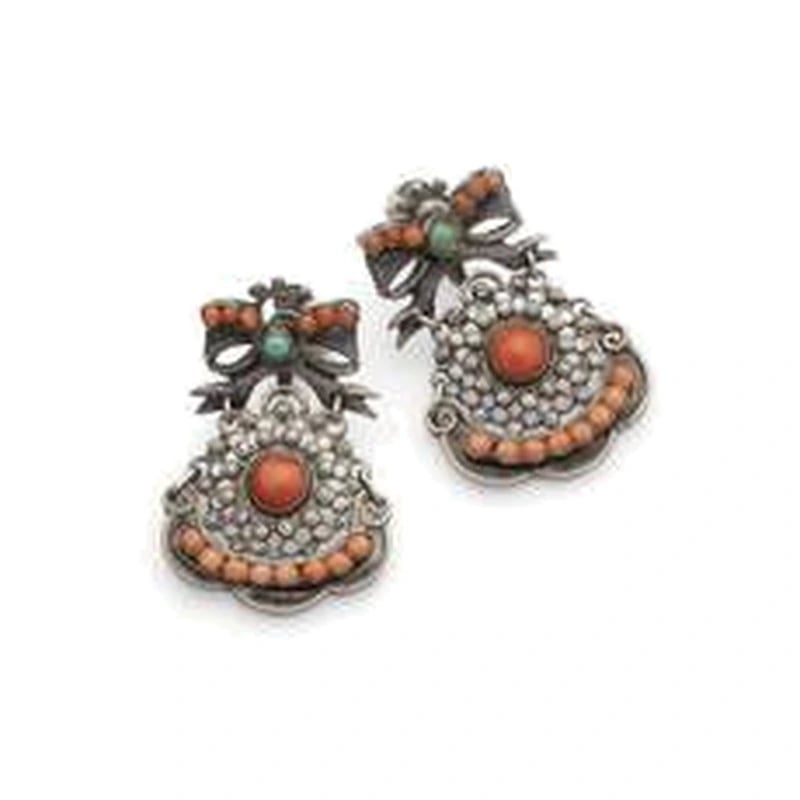
A dense floral cluster set with turquoise and coral, these earrings compress the vocabulary of Mexican colonial and popular religious ornament into a form small enough to sit at the ear. The design fills its silver ground with tightly worked flowers, leaves, and scrolling elements, with the blue-green turquoise and warm red coral placed to punctuate the composition rather than dominate it. This is the ornamental language for which the MATL workshop of Matilde Poulat became known, adapted here to the scale and symmetry that earrings require.
The organization of color carries much of the design. Turquoise and coral are opaque stones, and Poulat's workshop used them for their flat, saturated color against the reflective silver rather than for transparency or brilliance. The pairing of blue-green against red produces a strong contrast that reads clearly at a distance, while the silverwork holds the stones within a densely patterned field of foliage and blossom. The result depends on the relationship between the busy, curvilinear metalwork and the calm, solid color of the cabochons: the silver supplies movement and shadow, the stones supply fixed points of color. As with much MATL work, the visual sources lie in colonial silver and Mexican popular art, particularly the floral and devotional ornament that Poulat reinterpreted throughout her jewelry and decorative objects.
Matilde Poulat trained as a painter and designer at the San Carlos Academy before opening her shop in 1934, and she registered the "Matl" trademark, number 142093, that appears on the workshop's jewelry and decorative objects. Her designs stand somewhat apart from the geometric, modernist current associated with Taxco. Where much silver of the renaissance drew on pre-Hispanic sculpture recast as severe abstraction, Poulat worked a denser, ornamental idiom rooted in colonial and folk sources, built from clustered flowers, birds, and hearts set with turquoise and coral. That distinct visual language proved durable. After Poulat's death in 1960, her nephew Ricardo Salas continued the MATL designs, at times supervising several dozen silversmiths, so the style remained in production long after its originator. Because the workshop's marks span several decades, from the early script stamps of the 1930s and 1940s through the registered-number marks of the 1950s and the MS-12 marks used by Salas after 1980, the specific date of any given MATL object depends on its hallmark rather than on the design alone, which changed little over time.
Earrings occupy a modest but useful place in the MATL body of work, which is better known for larger brooches, crosses, and necklaces where the floral vocabulary can spread across a broad field. Here the same ornamental system is condensed and made symmetrical, showing how the workshop translated its characteristic imagery to smaller wearable forms. For a collection documenting the Mexican silver renaissance, the pair records the alternative to the geometric Taxco School: a strand of the movement that looked to colonial and popular ornament, and that Poulat established and Salas carried forward for decades.
Museum of Mexican Silver. “Floral Earrings with Coral.” Catalog no. MoMS-002257. https://museumofmexicansilver.com/pieces/matl-floral-earrings-with-coral
See something wrong with this record? Suggest a correction and the piece details fill in automatically.
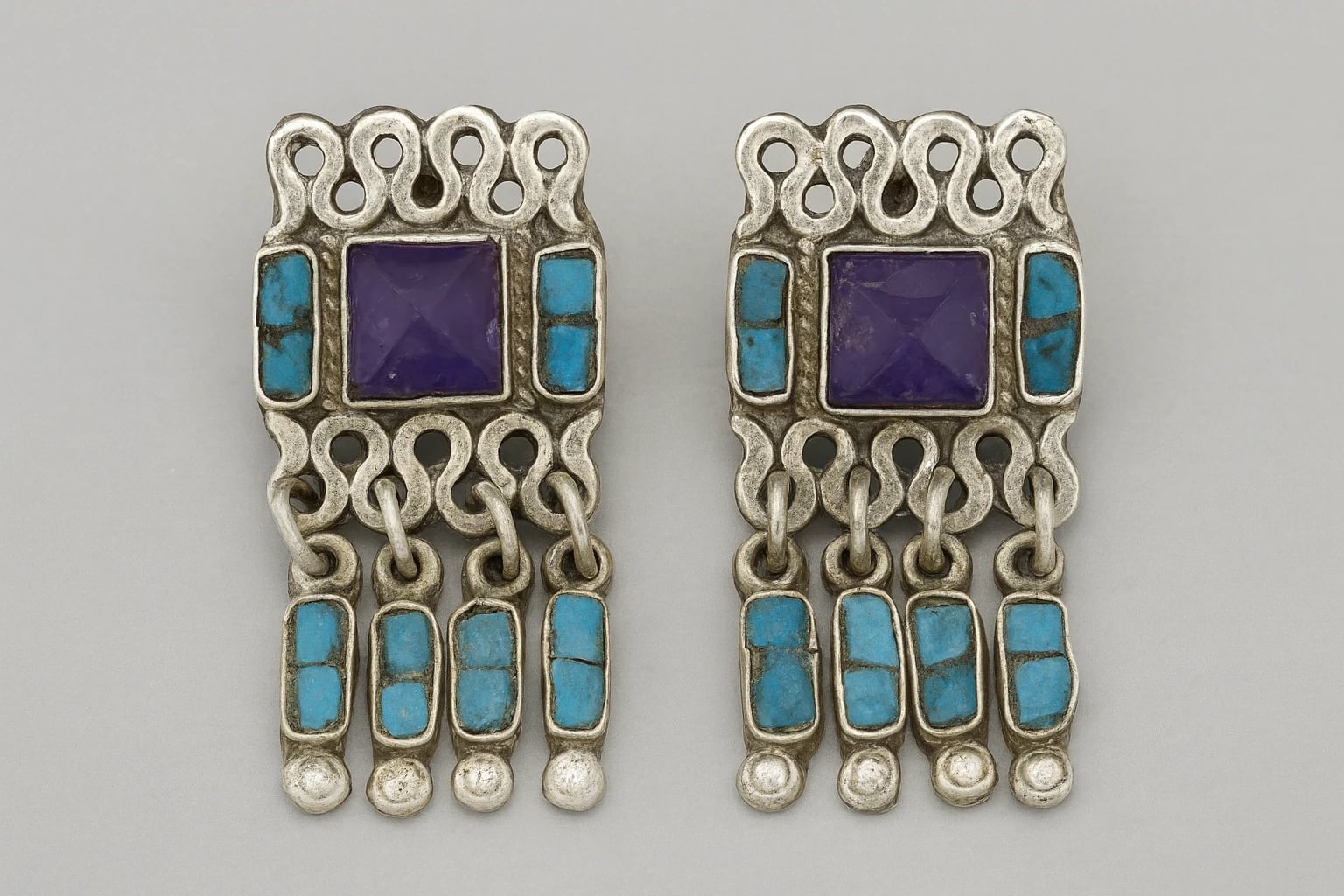
MATL (Matilde Poulat)
Rectangular Turquoise and Amethyst Earrings
1934 or later
Turquoise