Saves instantly, no account needed. Already a member? Sign in.
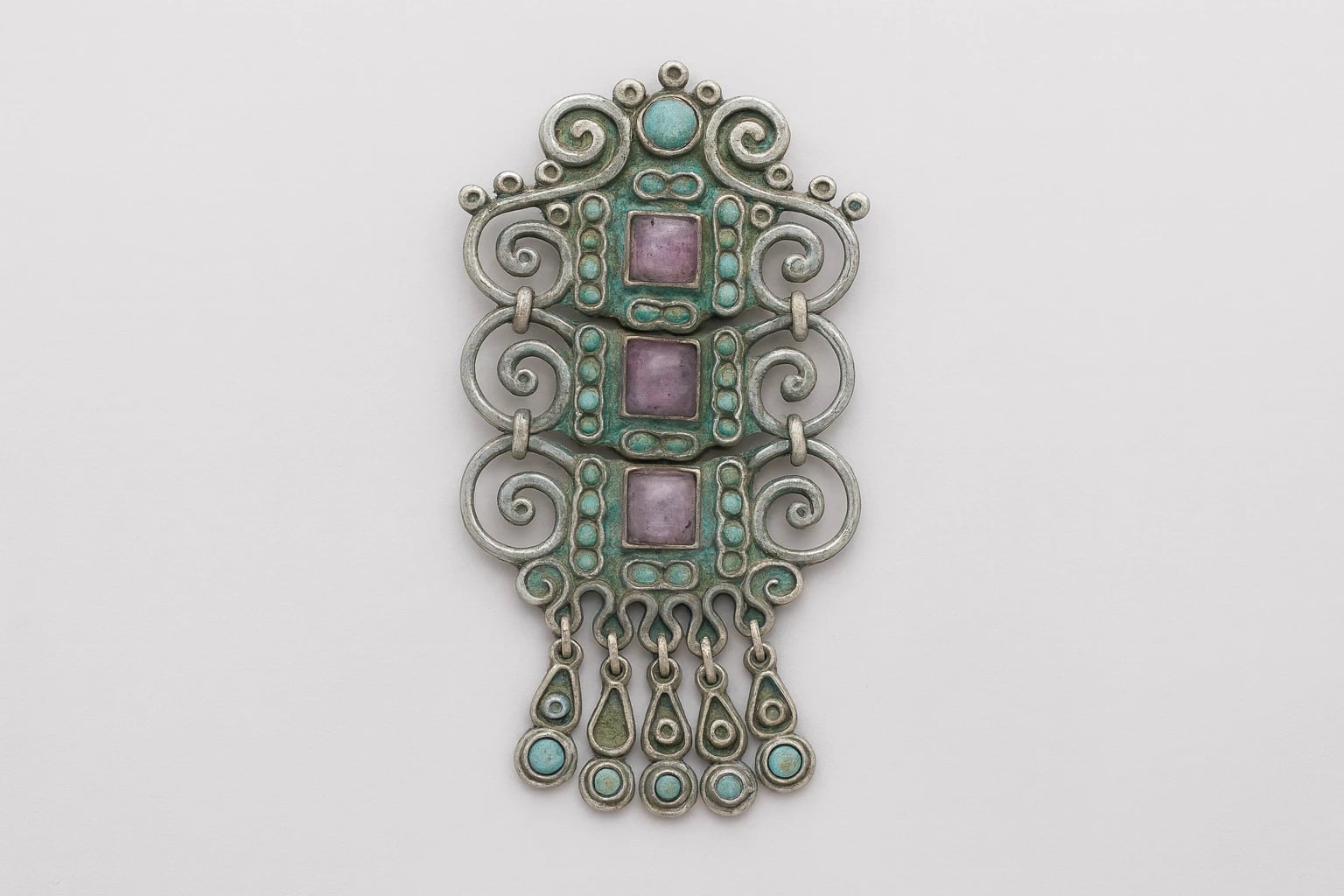
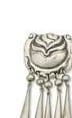
A dense curtain of silver drops hangs from a central floral cluster in this MATL brooch, and that fringe is where its interest concentrates. The pendant elements swing free from their anchoring points, so the ornament shifts and catches light with the wearer's movement rather than presenting a fixed silhouette. Matilde Poulat built her jewelry around this kind of layered, symmetrical abundance, and the fringe drop is one of the clearest statements of her preference for surface incident over restraint. The eye moves from the compact bloom at the top down through the loosening rhythm of the hanging elements, an organization that gives the piece both a stable center and a mobile edge.
The construction depends on repetition and suspension. Small elements are joined at their upper edges and left free below, a method that turns a rigid metal into something closer to drapery. Poulat's designs typically combine repoussé blossoms, scrolling foliage, and beadwork with set stones, frequently turquoise and coral, arranged in the tight, frontal symmetry associated with Mexican devotional and folk ornament. The floral head governs the composition while the fringe extends and dissolves it. Silver here is worked for its reflective liveliness rather than mass: the many small surfaces multiply highlights, and the movement of the drops keeps those highlights in flux. Without the physical object in hand, the gauge, the stone species, and the exact assembly method are not matters the design alone can settle, but the visual logic of anchored cluster and free-hanging fringe is legible and consistent with her known work.
Poulat trained as a painter and designer at the San Carlos Academy, and she opened her shop in Mexico City in 1934, registering the "Matl" trademark, number 142093, drawn from an Aztec word for water. Her formation outside the Taxco workshops matters to the character of this brooch. Rather than the pared geometry that ran through much of the Taxco School, she pursued a densely worked folk idiom rooted in colonial and popular Mexican sources, a personal language within the broader silver renaissance rather than an extension of Spratling's studio vocabulary. After her death in 1960, her nephew Ricardo Salas continued the Matl designs and, at peak production, supervised as many as several dozen silversmiths who fabricated and assembled the pieces, so a given MATL brooch reflects a workshop system as much as a single hand. Dating any individual example requires attention to the mark: the early script and fineness stamps fall in the 1934 to 1948 range, the registration form with M. Regis 142093 in roughly 1950 to 1960, and the MS-12 Salas-era marks after 1980, as recorded in Hougart's hallmark reference.
Museum of Mexican Silver. “Fringe Drop Brooch.” Catalog no. MoMS-002253. https://museumofmexicansilver.com/pieces/matl-fringe-drop-brooch
See something wrong with this record? Suggest a correction and the piece details fill in automatically.
As a museum object, the fringe drop brooch documents a distinct current within the Mexican silver renaissance, one led by a woman trained as a painter who chose ornamental density and religious folk sources over Taxco modernism. It shows how repetition and suspension could be used to make static metal move, and it records a design idiom that outlived its author through a defined workshop lineage. Read against the marks, the piece also demonstrates why chronology in Poulat's output must be established through the stamp rather than the design, since the same compositional vocabulary was produced across several decades and two generations of makers.
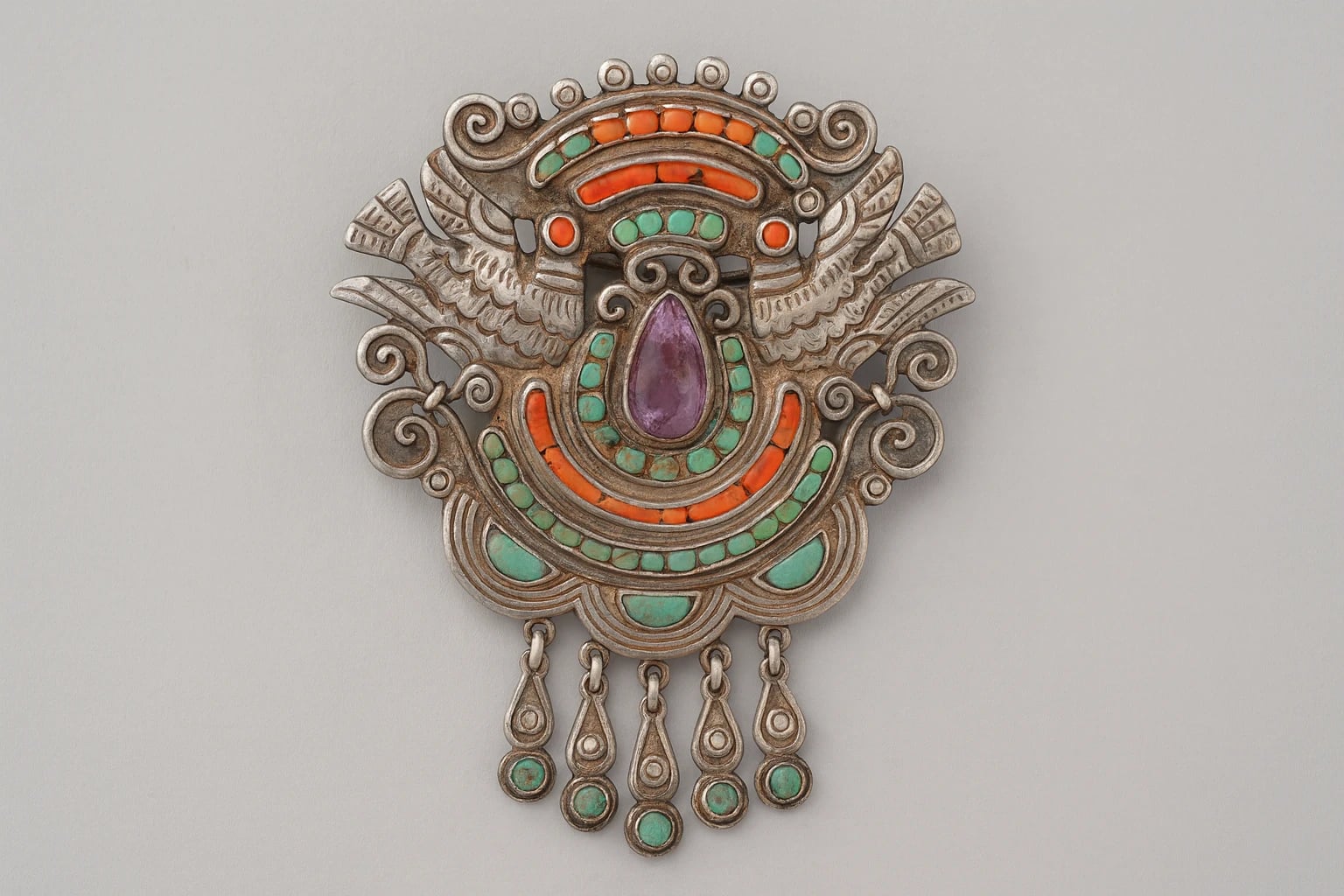
MATL (Matilde Poulat)
Paired-Dove Drop Brooch with Turquoise and Coral
1934 or later
Silver